
Mukan Khan was the second son of Bumin and the third khan of the Göktürks. His reign of nineteen years, from 553 to 572, is the longest of the First Khaganate’s founding generation.[1] Under him the eastern half of the state reached the limits it would keep. The Kirghiz on the upper Yenisei were annexed, and the Khitan on the edge of Manchuria were driven east. The last Rouran were put to death. The Göktürks fought their first war inside China, and a daughter of the house became empress of a Chinese dynasty. The Chinese remembered his face. The Zhou Shu describes him as a man of strange appearance. His face was more than a foot broad and very red, his eyes were like glass, and he was hard and violent by nature and bent on war.[1] It is the only physical portrait of any Göktürk khan the sources give.[1]
Accession
Issik died in 553, and Mukan, the next brother, took the throne.[1] On the best view, the nobility stood behind him, and the state was stabilised in 554. The succession was lateral, from brother to brother, and it would be so again at his own death. Turkic Atlas sets out the rule under the Ashina. He acted early for the house. At Mukan’s request the Western Wei seized Dengshuzi and some three thousand of the Rouran who had reached them. They handed the prisoners to the Göktürk envoys and had them killed outside the Qingmen gate of Chang’an.[1] The severity may have answered only the existential threat the Rouran posed to the new dynasty’s legitimacy. It may also have answered the memory of what it had been to live under Anagui. The sources do not say which.
Conquests in the north and east
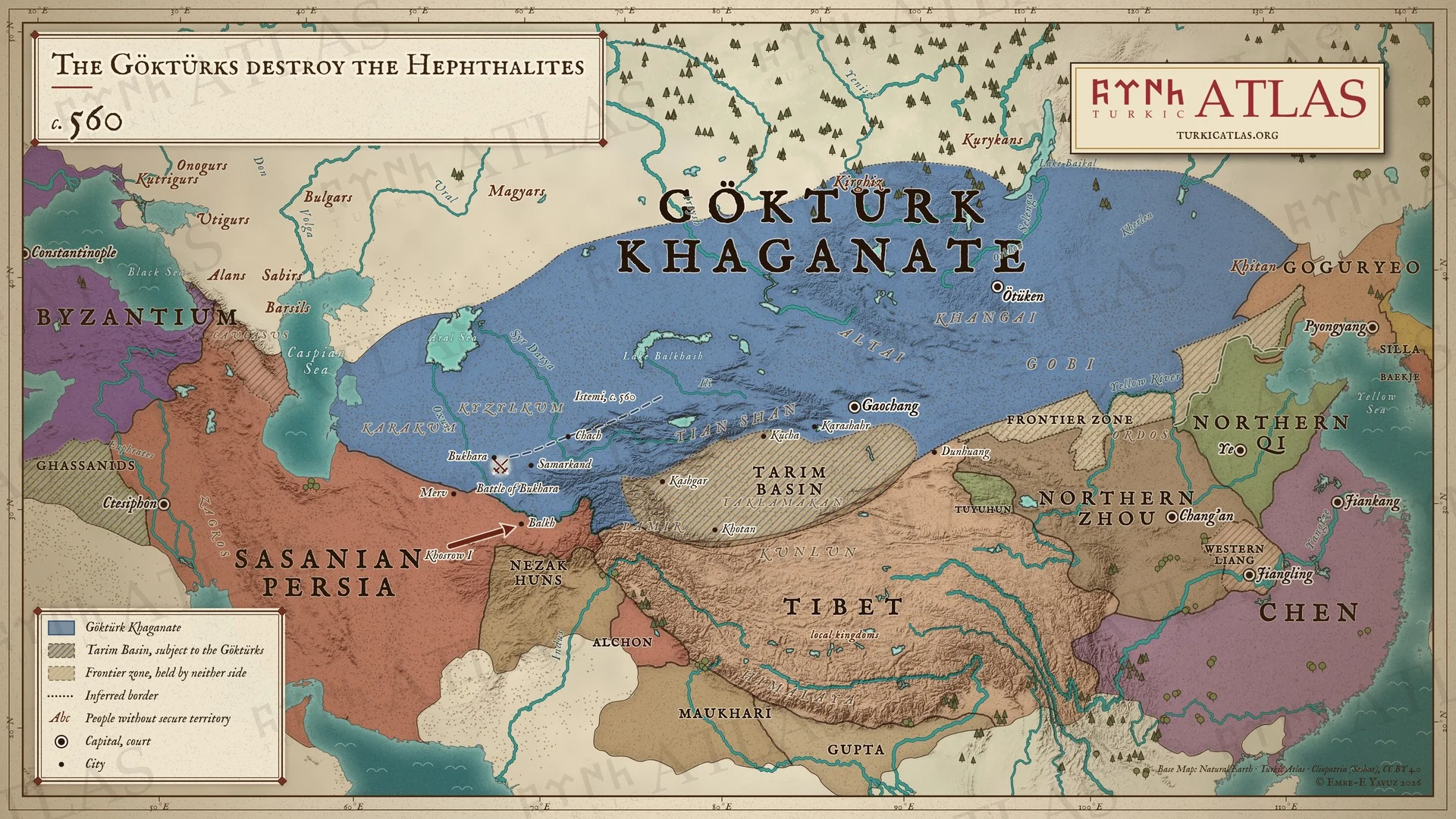
The southern frontier was closed by his brother, so Mukan turned the other way. The Zhou Shu puts his conquests in one line. He broke the Hephthalites in the west, drove the Khitan eastward, annexed the Qigu, that is the Kirghiz, in the north, and brought the states beyond the frontier under his authority.[1] It gives no years for any of it. The dating to the span between 554 and 560 is a reckoning of the literature. The Kirghiz mattered for their mines.[2] They were known for iron and gold. From now on gold flowed from the Yenisei to the khan’s seat at Ötüken.[2] A Chinese source has them accept the arrangement grudgingly. The Kirghiz were expected to rise when they could.[2] The Khitan and the Tatabï were proto-Mongolic groups who had been inside the Rouran state against their will and had tried to leave it at Anagui’s death. They were brought back in. With them the Göktürks reached the Khingan range and the Kadırkan forest of the inscriptions. They also reached the eastern limit that the Kül Tegin inscription assigns to the founders.[3]
Korea he left alone. A Korean source has ten thousand Göktürks appear on the frontier of Koguryŏ in 551 and besiege several towns. This would put Bumin’s men there in the last year of the War of Independence.[2] Mukan made no attempt on Koguryŏ. This abstention is taken as the lesson of that earlier failure.
By a modern estimate, the khaganate was larger by 554 or 555 than the Xiongnu empire had been. With its gold, its iron and the trade of the Sogdians, it drew merchants, envoys and pilgrims from India, Tibet and China. Sogdian merchants settled at Ötüken and in the Altai and took up administrative work in the khan’s service. They became the Göktürks’ intermediaries with China. In the west, under Istemi, they lent the Göktürks the script from which the runiform alphabet would later be made.
Zhou alliance and war with the Qi
While Mukan held the east, Istemi carried the west to the Oxus and the Volga. Turkic Atlas tells that story under Istemi. He ranks as the greatest of the Göktürk conquerors. In the east the neighbours changed. The Western Wei gave way to the Northern Zhou in 557. Yuwen Tai, Bumin’s old ally, had been promised a daughter of Mukan. He died before the match was settled, and the promise passed to his son, the emperor Wu.[1] Counted from the Wei embassy of 545, the Zhou–Göktürk alliance ran for thirty years. It held through Mukan’s whole reign.
The alliance was tested against the Northern Qi. Mukan had settled the marriage with the Zhou and had cut off the Qi envoys who had come with a richer offer. He himself asked for a joint campaign against the Qi to the east.[1] In 563 the Zhou general Yang Zhong marched with ten thousand men. Mukan met him with a hundred thousand horse.[1] In the first month of 564 they attacked the Qi ruler at Jinyang, that is Taiyuan, and failed. Mukan let his men plunder the country and went home.[1] Yang Zhong told the emperor that the Göktürks had bad armour, light rewards, many chiefs and no laws, and that they were not hard to handle. The emperor did not listen.[1] The Qi emperor’s wish to flee and the winter siege are the Qi side of the story. The same year Mukan asked for a second campaign. Yang Zhong marched out by Woye, and Yuwen Hu towards Luoyang. Hu was beaten, and Mukan turned back.[1] The outcome reads as a demonstration. The Göktürks had plundered the Taiyuan country and withdrawn without loss. The Qi had learned what a Göktürk army was.
Marriage of 568
The marriage was the alliance’s seal, and the sources make a story of it. In 565 the Zhou sent Yuwen Chun, Duke of Chen and the emperor’s brother, with Yuwen Gui, Dou Yi and Yang Jian to fetch the bride.[1] The literature’s figure for the delegation is a hundred and twenty. When they arrived, Mukan wavered again towards the Qi. Then a portent of wind and thunder came.[1] In the account of the Zhou Shu’s chapter on the empress, the khan read the portent as Heaven’s displeasure at the broken promise and took the storm to have struck his golden tent. He let the delegation go home with her, and she was made empress.[1]
Some scholars take the storm as a Chinese narrative pattern: the stubborn barbarian is corrected by an omen and forgiven by a magnanimous emperor. The story is told to the emperor’s credit. The sources give only the story. What is not in doubt is the outcome. Empress Ashina, as the Chinese called her, remained at the Zhou court for the rest of her life. She kept contact with her father and the house. She was the main link and guarantee of the Göktürk–Zhou alliance. Her tomb, found in 1993, has since yielded the only ancient genome of an Ashina.
Death and succession
The Sui Shu counts Mukan’s reign at twenty years, after which he died.[4] That is 572 by the usual reckoning. By the lateral rule, the throne passed not to his son Töremen but to his brother Taspar. Nine years later Taspar attempted to pass the throne back to Töremen, and this attempt set off the succession war.[4] Envoys from both Chinese states hurried to the new khan with gifts. This shows what Mukan had left him. The Sui Shu says that the Zhou and the Qi competed for a marriage alliance and emptied their treasuries to serve him.[4]
Assessment
The Chinese chronicle presents Mukan throughout as a powerful and courageous ruler. In the marriage story it presents him as a stubborn and naive one. The second view is the perspective of the story’s tellers.[2] On the record he was the khan who made the eastern khaganate whole. Bumin had taken the Rouran state, and Issik had closed its southern flank. Mukan took the north and the east and held the Chinese alliance for nineteen years. He handed his brother an empire that a modern reckoning puts at five to seven million square kilometres, the largest state the world had yet seen. That is a valuation, not a finding. The extent it values is the one the Kül Tegin inscription describes, from the Kadırkan forest to the Iron Gate.[3]
References
Sources
- Zhou Shu (Book of Zhou), juan 50
- Sui Shu (Book of Sui), juan 84
- Zizhi tongjian (Comprehensive Mirror in Aid of Governance), juan 164 (after Wei Shu, Zhou Shu, Sui Shu and Bei Shi)
- Kül Tegin inscription
Literature
- Emre-E. Yavuz, The Gokturk Empire: 2nd Edition (2025)
What links here66
- Persons
- Anagui · Börü Khan · Bumin Khan · Daxi Wu · Dengzhu · Emperor Wu of Northern Zhou · Emperor Wucheng of Northern Qi · Empress Ashina · Issik Khan · Istemi · Maniakh · Niri Khan · Rudan Khan · Taspar Khan · Töremen Apa · Yang Zhong · Yuwen Hu · Yuwen Tai
- States
- First Göktürk Khaganate · Northern Qi · Northern Zhou · Rouran Khaganate · Western Wei · Yenisei Kirghiz Khaganate
- Conflicts
- Hegemony Wars in Northern China · Mukan's Eastern and Northern Wars · The Göktürk–Hephthalite war, 555–563 · The Göktürk–Rouran Wars · The Göktürk–Sasanian Trade Conflict · The Zhou–Qi war, 557–577
- Battles & Events
- Battle of Bukhara · Battle of Mount Mulai (553) · Göktürk Succession Crisis (581) · Göktürk–Wei Campaign against Tuyuhun (556) · Jinyang campaign, 563–564 · Mukan's Destruction of Dengshuzi (553–555) · Music of Empress Ashina (568) · Taspar's Appointment of the Lesser Khans (572) · The Bargain with Mukan (562–563) · The Göktürk–Wei alliance · The Göktürk–Zhou alliance · The Qingmen Executions (555) · The Woye and Luoyang Campaign (564)
- Places
- Beihai · Liaohai · Tarim Basin · Xihai · Xing Ridge
- Peoples
- History of the Turkic peoples · Khitan · Sogdians · Tuyuhun · Yenisei Kirghiz
- Lineages
- Ashina
- Institutions and Titles
- Army of the Steppe Empires · Daluobian · Diplomacy of the Steppe Empires · Göktürk Weapons · Khan (Khagan) · Töre · Warfare of the Steppe Empires · Women among the Turkic Peoples
- Religions
- Stone Figures
- Sources
- Bugut inscription
Cite this article
Yavuz, Emre-E. “Mukan Khan.” Turkic Atlas, revised 8 November 2026. https://turkicatlas.org/persons/mukan-khan/
Last revised: 8 November 2026

