

Bagatur made the Xiongnu an empire, and he did it in a single reign. He came to the throne in 209 BC by killing his father.[1] By the time he died in 174 BC, the Xiongnu controlled the steppe from Manchuria to the Tarim. They had defeated a Han emperor in the field. They had also imposed on the Han court a treaty of yearly payments.[1] The Shiji devotes more space to him than to any other steppe ruler before the Göktürks. Every later account of him rests on that chapter.
Name
- BagaturOld Turkic
- 冒頓ChineseShiji
- MeteTurkish
The Chinese wrote 冒頓. The Shiji and the Han Shu set down foreign names by sound. They chose graphs for the sound they made and not for what they meant. Neither of these two graphs means anything as a name.[2] What the histories preserve is therefore a spelling of a pronunciation heard at the Han frontier in the second century BC.
That pronunciation is not the one the graphs carry today. Modern readers give them as Mòdú, as Màodùn and as Mòdùn. The variation is not a slip. Both graphs hold more than one value, and two thousand years of sound change stand between the reading and the writing. In the Chinese of the Han period, the pair stood for something on the order of *mǝk-tuən.[3] One rule of transcription bears on the second half. Chinese had no final -r and rendered a foreign -r with -n. A foreign name ending in -tur could therefore reach the page only as -tun.[4]
Read with those two facts, the graphs point at baγtur. Baγatur, ‘hero’, is a word the steppe then kept for two thousand years.[5] It stands in Greek letters as Βαγατουρ among the Danube Bulgars, it is the Mongol ba’atur, and it reaches Persian and Turkish as bahādur. Uzun Hasan of the Ak Koyunlu bore it as an honorific in the fifteenth century.[6][5] Some scholars think that the word began as this man’s name and became a title afterwards. That would mean that a title borne by princes from the Danube to India began as one man’s name.[4]
Of the three names he is called by, Bagatur is the only one that reaches for the sound. 冒頓 preserves the ancient spelling. Modu is those graphs read aloud with the values of modern Mandarin. Bagatur is an attempt at what the Xiongnu themselves said. The Chinese form stands beside it in the title because the spelling is what the sources actually give.[5]
Mete, the form of the Turkish tradition, is not a third reading of the ancient name. It descends from a book. Joseph de Guignes rendered the Chinese as Mei-Tei. Hüseyin Cahit Yalçın later translated de Guignes into Turkish, in the years after the republic was founded. In that translation, Mei-Tei came out as Mete.[7] The form then took hold, and today it is a common given name. It is a form of the reception, two stages removed from the graphs and further still from the sound. Turkic Atlas sets out what that reception does and does not establish under Turkic origins.
What stays open is the equation itself, not the ranking. Peter B. Golden sets Bagatur against 冒頓 with a question mark. Others decline to reconstruct at all. They treat the graphs as a personal name that cannot be recovered.[2] An older Turkic interpretation of the early twentieth century had already taken the name for Moduk, Mokduk, Makdur or Bakdur, and so for Bagatur.[8] An interpretation of 1940 held that there was no doubt that the Xiongnu spoke a Turkic language, and that the reading tengri in the title was equally certain.[8] The name may also have been given on his rise rather than at his birth.[5] The competing view does not propose a different sound. It leaves the graphs unreconstructed. Modu and Mete make no claim about how the name sounded in the second century BC.
Accession
Bagatur was the heir of Duman. Duman had a favoured consort who bore him a younger son. Duman wished to depose the heir and set up the younger son. He sent Bagatur as a hostage to the Yuezhi. Then he attacked the Yuezhi in haste, so that they would kill the hostage. The Yuezhi meant to do it. Bagatur stole one of their good horses and rode home. His father thought him brave. He gave him ten thousand horsemen.[1][9]
What he did with them is the most quoted passage in the chapter. He had whistling arrows made. He drilled his riders with an order: whoever fails to shoot where the whistling arrow strikes will be beheaded. He shot at game and beheaded those who did not follow. He shot his own good horse and beheaded those who hesitated. He shot his own beloved wife and beheaded those who hesitated again. He shot his father’s good horse, and every man shot with him. Then he rode out hunting with his father and shot the whistling arrow at Duman. His riders killed the chanyu.[1][10] He put to death his stepmother, his half-brother and the great ministers who would not obey. He made himself chanyu.[1][11]
The Shiji tells the youth of Bagatur in the manner of a story. Modern accounts call the passage highly anecdotal and half legend.[12] Some scholars argue that the account rests on a heroic tale that the Xiongnu told among themselves.[13] Others argue that the Oghuz story is older than Bagatur and was laid later over his youth. In that case the killing of the father is a motif of the epic and not of history.[14]
The Donghu and the Yuezhi
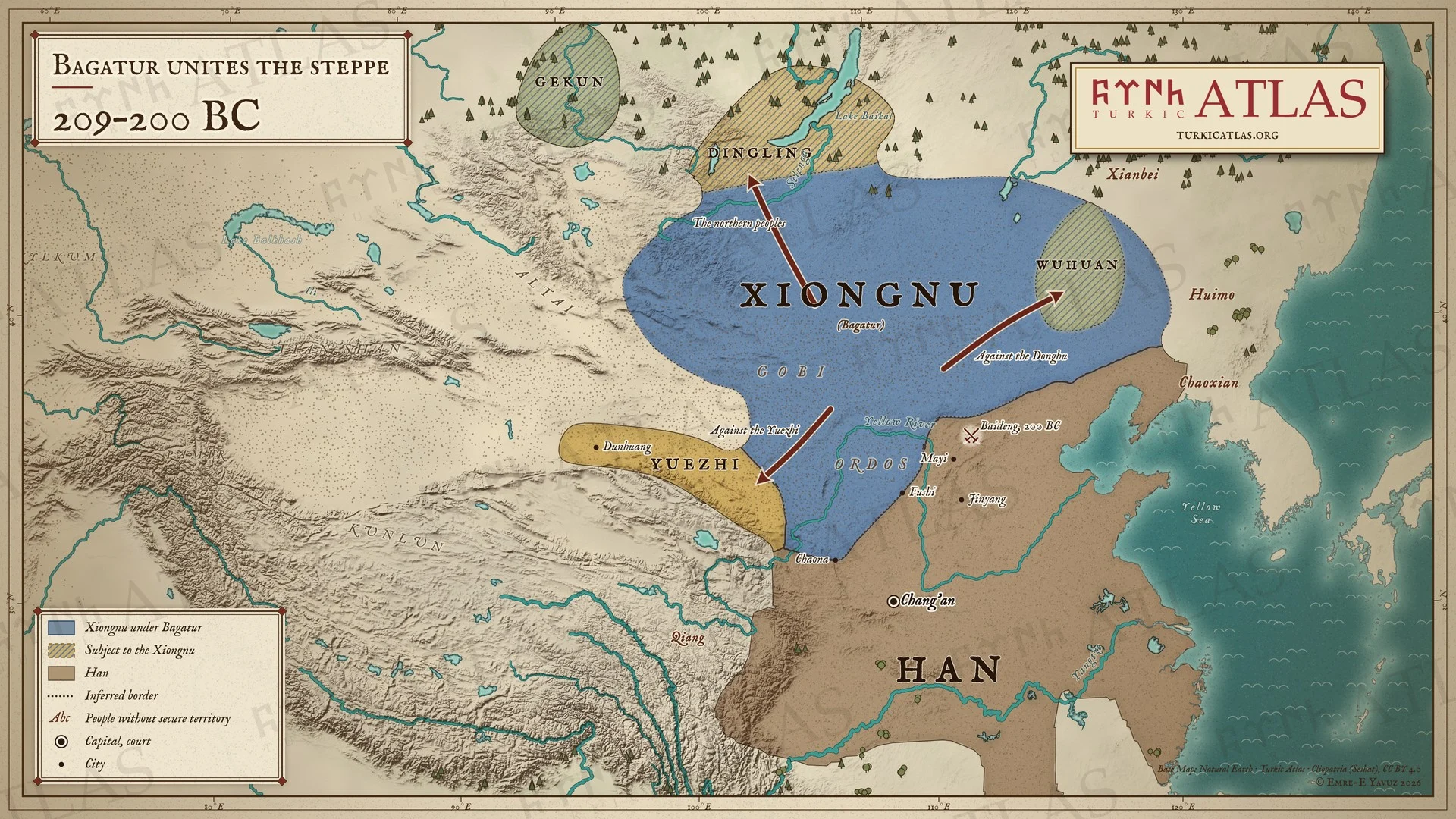
The Donghu were strong in the east. They heard that a son had killed his father. They asked for the thousand-li horse that had been Duman’s. The ministers said it was a treasure of the Xiongnu and should not be given. Bagatur said that one does not grudge a single horse to a neighbour. He sent it. The Donghu asked for one of his consorts. The ministers were angry and asked leave to attack. Bagatur said that one does not grudge a single woman to a neighbour. He sent her. Then the Donghu asked for the empty land between the two peoples, a thousand li of unoccupied ground that each watched from its own side. Some ministers said the land was waste and might be given. Bagatur was enraged and said that land is the foundation of the state. He beheaded the men who had advised giving it. He mounted and ordered the death of any who lagged behind. The Donghu had not thought him dangerous and had made no preparation. He destroyed their king and took their people and their herds. Then he came home.[1][15][16] The Shiji calls the border posts on the strip 甌脫, outuo.[1] Some scholars regard the word as the Xiongnu form of Mongol otog, “territory”. On this conjecture, the war with the Donghu was fought for control of a garrisoned frontier strip and not only for pasture.[17] Others take the same word for the earliest form of ordu, “camp”.[18] For the Xiongnu the land was probably sacred, as land and water are sacred in the Töre of the Old Turkic peoples. Among the Göktürks it was the same. Their inscriptions call the forest of Ötüken sacred and bind the realm to it. They also set the sacred Earth-and-Water of the Göktürks beside Tengri.[19]
Then he drove the Yuezhi west. He annexed the Loufan and the king of Boyang south of the bend of the Yellow River. He also recovered every mile of Xiongnu land that the Qin general Meng Tian had taken.[1] At that moment the Han were locked in the war between Liu Bang and Xiang Yu, and the country was exhausted by arms. The Shiji gives this as the reason for how easily it was done.[1] He had more than three hundred thousand men who drew the bow.[1] The figure is the Shiji’s. It is a round number of the Han court with no count behind it. It probably measures all the men of the Xiongnu who could draw a bow, not an army in the field. Afterwards he subdued the Hunyu, the Qushe, the Dingling, the Gekun and the Xinli in the north.[1] Gekun is the name that the Han sources later write as Jiankun. It is the first appearance in any text of the people who became the Yenisei Kirghiz.
The order of the state
The Shiji sets out the Xiongnu order immediately after this passage. It is the earliest description of a steppe polity from the inside out. There were a Left and a Right Worthy King, a Left and a Right Guli King, Left and Right great generals, great commandants, great danghu and gudu marquises. The Xiongnu word for ‘worthy’ was tuqi. The heir apparent was always the Left Tuqi King. From the Worthy Kings down to the danghu, the greater commanded ten thousand horsemen and the lesser several thousand. There were twenty-four of them, styled the Ten Thousand Horsemen. The great ministers held their offices by inheritance. Three clans were noble: the Huyan, the Lan, and later the Xubu.[1][20] Some scholars identify the Left Worthy King with the forerunner of the Göktürk office of the Left Bilge Beg. They derive the title of Bilge Khan from that office.[21] The royal house itself was Luandi.[22] One older reading names the Tuge instead, the people who later supplied the strongest Xiongnu tribe, and tentatively reads their name as Türk.[23]
Three assemblies held the year together. In the first month the chiefs met at the chanyu’s court for a small gathering and a sacrifice. In the fifth month they met in force at Longcheng. There they sacrificed to the ancestors, to Heaven and Earth, and to the spirits. In autumn, when the horses were fat, they met at Dailin. There they counted the men and the animals.[1] In the morning the chanyu came out of his tent and bowed to the rising sun, and in the evening he bowed to the moon. They attacked when the moon waxed and withdrew when it waned.[1] The law was short. To draw a blade a foot from the scabbard was death. Theft cost a man his household. No prisoner was held more than ten days.[1]
Baideng
In 200 BC the Han king Xin surrendered to the Xiongnu at Mayi. Bagatur came south over Gouzhu and struck at Taiyuan as far as Jinyang.[1] Emperor Gaozu took the field himself. It was a hard winter with rain and snow. Two or three men in ten lost fingers to the cold. Bagatur made a show of defeat and drew the Han on. He hid his good troops and let the weak be seen. The Han came north with three hundred and twenty thousand men, most of them foot. Gaozu reached Pingcheng ahead of his infantry. Bagatur loosed four hundred thousand picked horse and shut him up on Baideng for seven days. The white horses stood to the west, the grey to the east, the black to the north and the red to the south.[1][24] The Han Shu gives more than three hundred thousand picked horse instead of four hundred thousand.[22][25] The four hundred thousand are probably the count of all the men of the Xiongnu fit to bear arms, not of the riders before Baideng. In any case the Xiongnu numbers must have been lower, because the eastern steppe of the time did not hold so many people. The siege was lifted at one corner after a gift reached the chanyu’s consort and after two allied commanders failed to appear. This made Bagatur suspect a Han understanding behind his back.[1] Gaozu had his men draw their bows and face outward. He walked out through the gap.[1][26]
Treaty and correspondence
Out of Baideng came the heqin agreement: a woman of the imperial house as the chanyu’s consort, fixed yearly quantities of floss, silk, wine, rice and food, and an oath that made the two rulers brothers.[1] It did not stop the raiding. The Han did not mean it as a peace of equals. The Xiongnu took it as one.
When Gaozu died, Bagatur sent a letter to Empress Lü. The Shiji calls the letter insolent and does not quote it. She wished to attack. Her generals reminded her that Gaozu had been wise and warlike and had still been trapped at Pingcheng. She renewed the treaty instead.[1][27]
The Han Shu gives the letter in full. Bagatur wrote: “I am a solitary ruler. I was born among rivers and marshes and grew up on the open plains where cattle and horses range. Often I have come to the border and wished to travel in China. Your Majesty stands alone, and I too live alone. Neither of us has any joy, and we have nothing to amuse ourselves with. I wish to exchange what I have for what I lack.”[22][28] The empress was furious. General Ji Bu advised her to ignore the letter, because the northern peoples were like beasts and birds. She answered that she was old, that her hair and teeth were falling and her steps were no longer steady, and that the chanyu should not demean himself with her. She sent two imperial chariots with a team of four horses each.[22][29] Bagatur sent an envoy to thank her. He said that he had not learnt the courtesy of China, and he sent a horse.[22][30] Some scholars hold that the offer of marriage aimed at the dowry, the exchange of gifts and the closer ties between the courts that a marriage would bring, and so at more Chinese goods.[31] Others think that the transmission of the two letters is slightly doubtful, while the letter of 176 BC is genuine.[32]
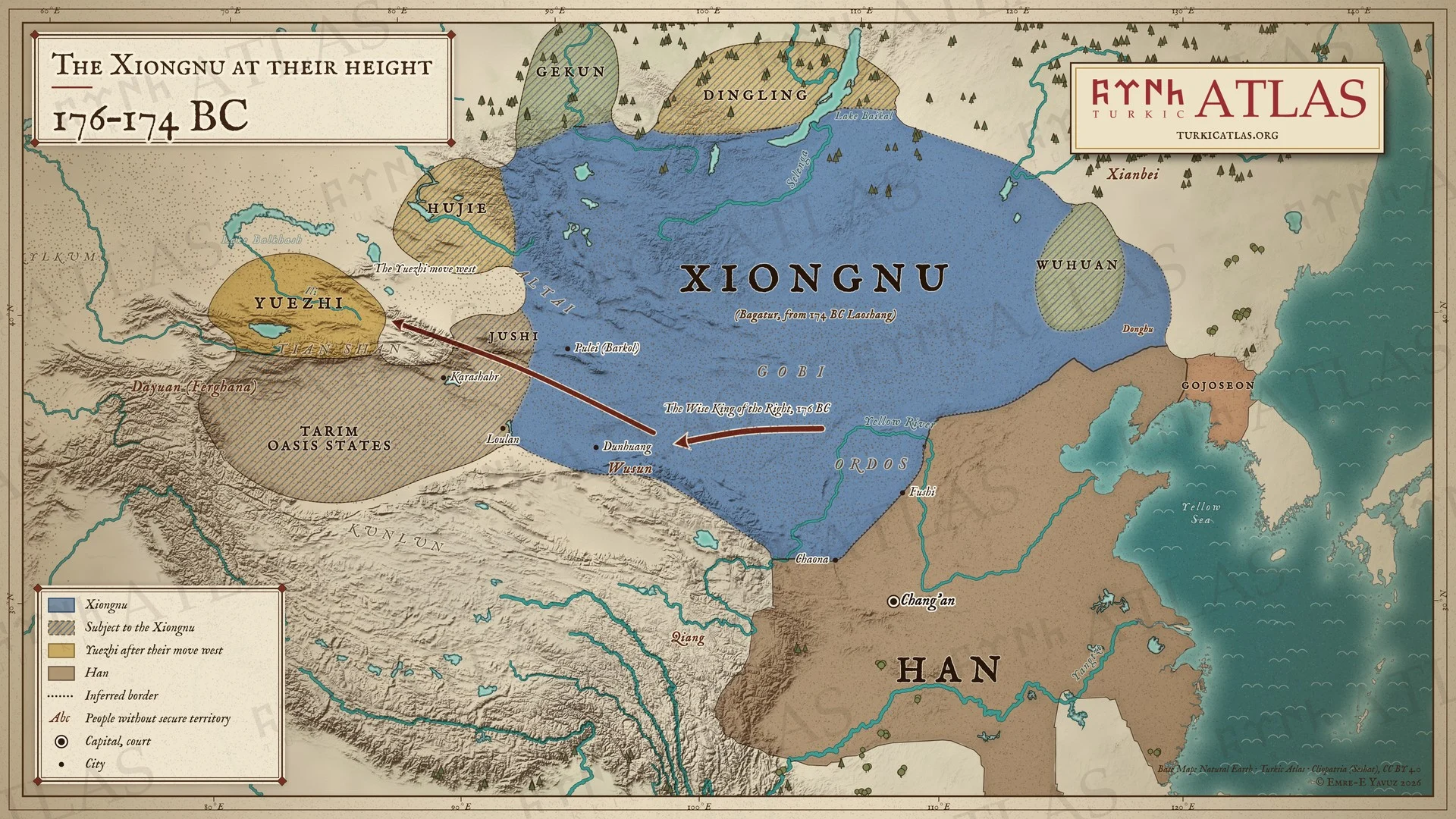
The letter of 176 BC is quoted in full. It is the longest utterance of a Xiongnu ruler that survives in any source.[1] It opens: the great chanyu of the Xiongnu, set up by Heaven, respectfully asks after the emperor’s health. The letter then reports four things. The Right Worthy King had broken the treaty without leave and had been punished by being sent west against the Yuezhi. By the favour of Heaven, with good officers and strong horses, the Yuezhi were destroyed. Loulan, the Wusun, the Hujie and twenty-six states beside them had been made Xiongnu. All the peoples who draw the bow were now one family.[1][33] One modern scholar emends the twenty-six states to thirty-six.[34] Others date the Yuezhi’s flight from the Dunhuang country to the Ili to this campaign of 177 to 176 BC, and not to the reign of Laoshang.[35] The Han council debated war. It concluded that a chanyu fresh from breaking the Yuezhi could not be attacked, and that the land was salt and not worth holding.[1]
The offence behind the letter is dated by the Shiji to the fifth month of the third year of Emperor Wen, 177 BC.[1] The Right Worthy King entered the land south of the Yellow River. He plundered the tribes that guarded the frontier posts of Shang commandery, and he killed and carried off people. Wen sent his chancellor Guan Ying with eighty-five thousand chariots and horse to Gaonu, and the king withdrew beyond the frontier.[1][36] Some scholars believe that the king was provoked by Xiongnu who had gone over to the Han and held the border posts for them.[37] The years before this raid are almost blank. The Han sources name Bagatur in no event between 192 and 177 BC.[38] Some scholars think that he spent these years bringing the peoples of the west into the Xiongnu order.[38]
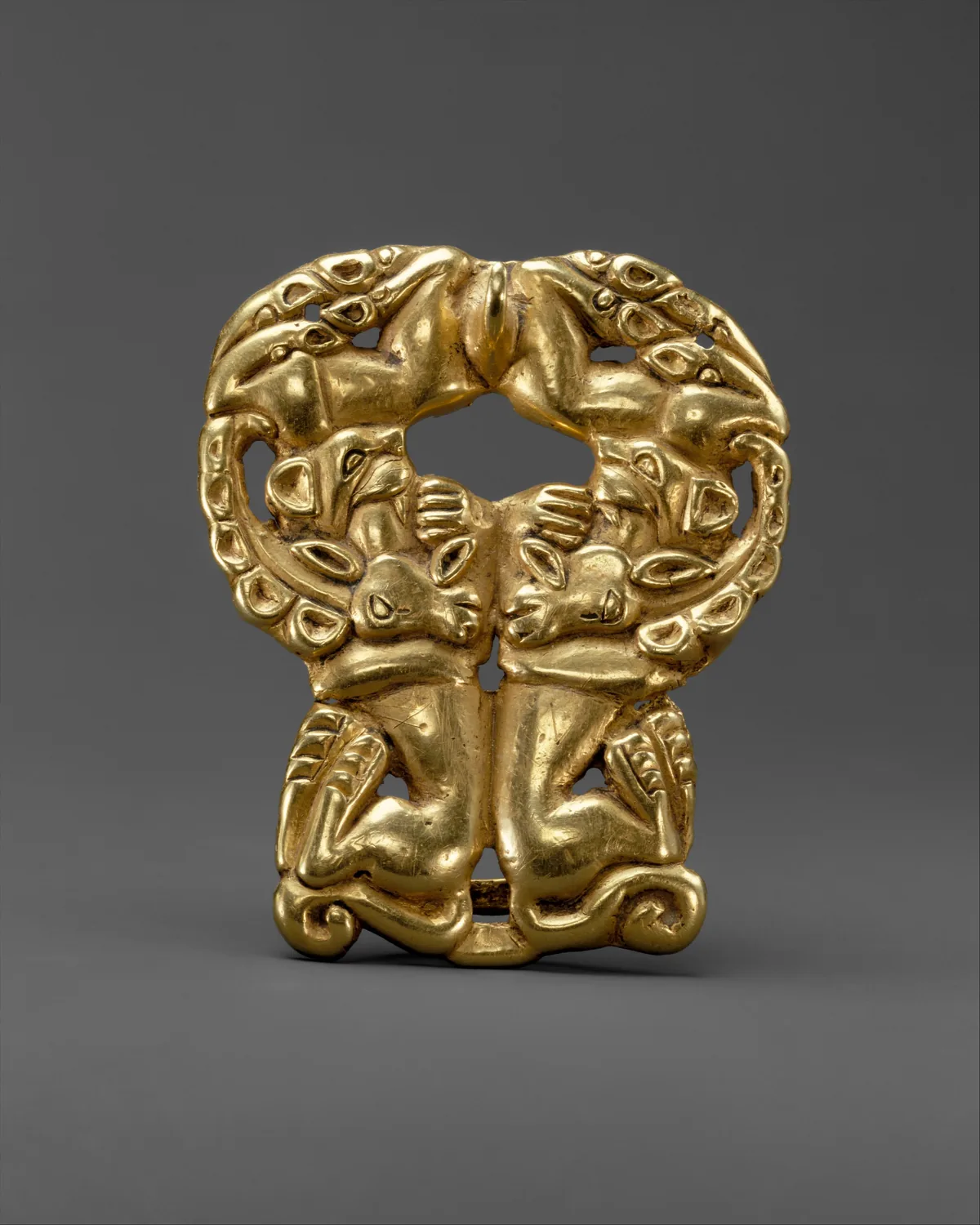
Emperor Wen answered in 174 BC. With his letter he sent robes of embroidered and patterned silk and a belt with gold fittings and a gold buckle: 黃金飾具帶一,黃金胥紕一.[1] Translators differ on the second item. One renders it as a belt and coat ornament.[31] Another takes it for a gold hair clasp, as the old commentaries describe it, used to fasten coiled and braided hair.[39]
Assessment
Bagatur died in 174 BC. His son Jiyu succeeded him as Laoshang.[1] The Shiji closes its account of his rise with a judgement that the chapter does not repeat for anyone else. From Chunwei down to Duman was more than a thousand years, and the line could not be set in order. Under Bagatur, by contrast, the Xiongnu were at their strongest. They subdued every people of the north and stood as an equal state against the south. From that point their succession, their offices and their titles can be written down.[1] That judgement records the moment a confederation became a state with a documented order. Every steppe empire after it inherited parts of that order: the Rouran, the Göktürks, the Uyghurs.[40]
Turkish scholarship has long counted Bagatur as the first great ruler of the Turks.[41] Some scholars argue that the Xiongnu were a mass of peoples that stretched from the eastern end of the Tian Shan to the west, and that the peoples between the Volga and Turkestan were their kin.[42] A Turkish national-historical interpretation regards the Xiongnu realm as the first of a single line of Turkic states and as the model of the later ones.[43] The left and right wings and the twenty-four commanders of the Xiongnu resemble the two branches and the twenty-four tribes of the Oghuz, and some writers have taken Oghuz Khan for Bagatur. The Oghuz epic was written about fifteen hundred years later, however, and knowledge of twenty-four Oghuz tribes goes back no further than the eleventh century.[44]
-
c. 215 BC Qin takes the Ordos
Around 215 BC the First Emperor of Qin sent Meng Tian north with a hundred thousand men. He took the land inside the great bend of the Yellow River, the Ordos, made the river the frontier and crossed it to hold the plain below the Yin mountains. According to the Shiji the Donghu north of Yan were strong at this time, and the Yuezhi flourished between Dunhuang and the Qilian mountains. The Xiongnu chanyu Duman could not withstand Qin and moved north. How far north, the source does not say. A second reading places the Qilian of this passage in the Tianshan; the hatched area shows it.
-
209–200 BC Modu unites the steppe
In 209 BC Modu killed his father Duman and became chanyu. Between the Xiongnu and the Donghu lay an empty strip more than a thousand li wide. When the Donghu demanded it, Modu struck east and destroyed their king. The Wuhuan held out at the Wuhuan mountain and paid the Xiongnu a yearly tribute of oxen, horses and sheepskins; the Xianbei withdrew far beyond the Liaodong frontier. Modu drove back the Yuezhi, took back the land Meng Tian had seized as far as Chaona and Fushi, and subjected the Hunyu, Qushe, Dingling, Gekun and Xinli in the north. In 200 BC he surrounded the Han emperor Gaozu for seven days on the hill of Baideng near Pingcheng.
-
176–c. 160 BC The height of the realm
In 176 BC Modu wrote to the Han court that the Wise King of the Right had destroyed the Yuezhi, and that Loulan, the Wusun, the Hujie and twenty-six states around them had all become Xiongnu: all the peoples who draw the bow were now one family. His son Laoshang killed the Yuezhi king and made a drinking cup of his skull. The Yuezhi left the Hexi and moved west into the land of the Saka. The Han Shu names a Xiongnu Commandant of Slaves who resided between Karashahr, Weixu and Weili and taxed the oasis states. In 162 BC the emperor Wendi confirmed the Long Wall as the line between the two realms. No source describes the northern edge of the realm in Tuva and beyond the Baikal.
-
127–121 BC The Han take the Ordos and the Hexi
In 127 BC the Han general Wei Qing drove the kings of the Loufan and the Baiyang out of the Ordos. Han founded Shuofang there and restored Meng Tian's wall along the river; in exchange it gave up the district of Zaoyang beyond Shanggu. In 123 BC the chanyu withdrew north across the Gobi on the advice of the defector Zhao Xin. In the spring and summer of 121 BC Huo Qubing struck into the Hexi corridor, and in the autumn the Hunye king killed the Xiutu king and went over to Han with more than forty thousand people. From then on, says the Shiji, the land from Jincheng and the Hexi west along the Southern Mountains to the Salt Marsh was empty of Xiongnu. By this time the Wusun held the land of the Saka, and the Yuezhi had moved on to the north bank of the Oxus.
-
119–c. 100 BC North of the Gobi
In 119 BC Wei Qing and Huo Qubing crossed the Gobi with separate armies. Huo Qubing marched more than two thousand li beyond Dai, sacrificed on Mount Langjuxu and turned back at the Hanhai. Afterwards, says the Shiji, there was no royal court south of the Gobi. Han settled soldiers and farmers from Shuofang west to Lingju and set up the commanderies of the Hexi, from Wuwei to Dunhuang; the Wuhuan were moved beyond the frontier of five eastern commanderies to watch the Xiongnu for Han. By 105 BC the chanyu had moved further north-west, his left wing facing Yunzhong and his right Jiuquan and Dunhuang. The southern edge of the realm ran somewhere in the Gobi.
-
60–51 BC The Western Regions lost, the realm divided
In 71 BC the Dingling struck the Xiongnu from the north, the Wuhuan from the east and the Wusun from the west, and the peoples bound to them fell away. In 60 BC the Rizhu king went over to Han. The Xiongnu Commandant of Slaves was abolished, and Zheng Ji became the first Protector-General of the Western Regions, with his seat at Wulei. In 57 BC five chanyus contended for the throne. In 54 BC Zhizhi took the royal court, and his younger brother Huhanye moved south to the Han frontier. In 51 BC Huhanye came before the emperor at Ganquan and was allowed to live below the Guanglu wall.
-
49–33 BC Zhizhi in the west, Huhanye in the north
Believing that Huhanye, weak and bound to Han, could not come back north, Zhizhi led his people west. He defeated the Wusun, received the surrender of the Wujie in the north, broke the Jiankun in the west and brought the Dingling under him, and made his seat in the land of the Jiankun. Around 44 BC he killed a Han envoy and went on to Kangju; of his people only three thousand arrived. In 36 BC the Protector-General Gan Yanshou and his deputy Chen Tang marched on Kangju and killed him. Huhanye meanwhile returned to the royal court in the north, and in 33 BC he received the palace lady Wang Zhaojun as his wife. From then on the land north of the Long Wall belonged to the Xiongnu again.
-
AD 48–50 Northern and Southern Xiongnu
Under Wang Mang the states of the Western Regions went over to the Xiongnu. In AD 48 the chiefs of eight southern tribes raised Bi, the Rizhu king, as chanyu under the name Huhanye; he came to the Wuyuan frontier and offered to shield Han against the northern Xiongnu for ever. The next year the northern chanyu fell back a thousand li. In AD 50 the southern court moved inside the frontier, first to Yunzhong and in the winter to Meiji in Xihe, and its chiefs were stationed along the frontier commanderies from Beidi to Dai. Beyond the Liaodong frontier the Xianbei sent their first envoys to Han in AD 49.
-
AD 87–93 The end of the Northern Xiongnu
In AD 87 the Xianbei entered the eastern lands of the Northern Xiongnu and killed the chanyu Youliu; fifty-eight tribes, two hundred thousand people, came to the frontier to surrender. In 89 Dou Xian marched out with the southern chanyu, defeated the northern chanyu at Mount Jiluo and had an inscription cut on Mount Yanran, more than three thousand li beyond the frontier. A rock inscription in the Gobi of central Mongolia is identified with this text; it lies much closer to the frontier than the figure of the source. In 91 Geng Kui defeated the northern chanyu at the Jinwei mountains, and the chanyu fled to the land of the Wusun. The Xianbei moved into the empty land, and more than a hundred thousand Xiongnu tents that stayed behind called themselves Xianbei.
-
c. AD 155–180 The Xianbei in the old Xiongnu land
The Xianbei leader Tanshihuai set his court on the Chuochou river below Mount Tanhan, more than three hundred li north of Gaoliu. According to the Hou Han Shu he raided the Han frontier in the south, held off the Dingling in the north, drove back the Fuyu in the east and struck the Wusun in the west, and held all the old Xiongnu land, fourteen thousand li from east to west. He divided it into an eastern, a central and a western part; the western reached Dunhuang and the Wusun. The Southern Xiongnu remained inside the Han frontier. One reckoning puts the last defeat of the Northern Xiongnu by the Xianbei in 155, a second puts their move west around 158; the hatched area north of Kangju shows where the second places them.
- Place named in a source (position as commonly identified)
- Position disputed or approximate
- Zone drawn after the Han histories
- Second reading or entirely uncertain position (hatched)
- People subject to the Xiongnu, or under Han protection
- Oasis states taxed by the Xiongnu
- Border that no source describes (drawn uncertain)
- Movement named in a source (route drawn)
References
- ^ a b c d e f g h i j k l m n o p q r s t u v w x y z aa ab ac ad ae af Shiji, juan 110
- ^ a b Golden 1992, p. 50
- ^ Schuessler 2007
- ^ a b Clauson 1972
- ^ a b c d Yavuz 2025, p. 74
- ^ Golden 1992, p. 249
- ^ Yavuz 2025, p. 73
- ^ a b Lattimore 1951, p. 451
- ^ Ögel 2015, p. 147–150
- ^ Ögel 2015, p. 152–156
- ^ Ögel 2015, p. 155–156
- ^ Ögel 2015, p. 152, 154
- ^ Lattimore 1951, p. 463–465
- ^ Ögel 1993, p. 8, 11
- ^ Ögel 2015, p. 158–159
- ^ Lattimore 1951, p. 463–464
- ^ Lattimore 1951, p. 524–525
- ^ Ögel 2015, p. 162
- ^ Kül Tegin inscription
- ^ Ögel 2015, p. 150–151
- ^ Ögel 2015, p. 151–152
- ^ a b c d e f Han Shu, juan 94
- ^ Kafesoğlu 1997, p. 60, 69
- ^ Ögel 2015, p. 286
- ^ Ögel 2015, p. 285
- ^ Ögel 2015, p. 281–286
- ^ Ögel 2015, p. 302–305
- ^ Ögel 2015, p. 303
- ^ Ögel 2015, p. 304–305
- ^ Ögel 2015, p. 306
- ^ a b Jagchid 1989, p. 27
- ^ Ögel 2015, p. 301–302
- ^ Ögel 2015, p. 309–311
- ^ Sinor 1990, p. 123
- ^ 内田吟風 1938a, p. 313
- ^ Ögel 2015, p. 307–309
- ^ Ögel 2015, p. 307
- ^ a b Ögel 2015, p. 306–307
- ^ Ögel 2015, p. 313–314
- ^ Golden 1992
- ^ Sümer 1972, p. 2
- ^ Ögel 1993, p. 2, 4
- ^ Kafesoğlu 1997, p. 61, 63
- ^ Sümer 1972, p. 2–3
Sources
- Shiji, juan 110
- Han Shu, juan 94 (after Shiji)
- Kül Tegin inscription
Literature
- Peter B. Golden, An Introduction to the History of the Turkic Peoples (1992)
- Emre-E. Yavuz, The Gokturk Empire: 2nd Edition (2025)
- Nicola Di Cosmo, Ethnogenesis, Coevolution and Political Morphology of the Earliest Steppe Empire: The Xiongnu Question Revisited (2011)
- Juhyeon Lee et al., Genetic Population Structure of the Xiongnu Empire at Imperial and Local Scales (2023)
- Gerard Clauson, An Etymological Dictionary of Pre-Thirteenth-Century Turkish (1972)
- Axel Schuessler, An Etymological Dictionary of Old Chinese (2007)
- Uchida Ginpū 内田吟風, 月氏のバクトリア遷移に關する地理的年代的考證(上) (1938)
- Denis Sinor (ed.), The Cambridge History of Early Inner Asia (1990)
- Bahaeddin Ögel, Büyük Hun İmparatorluğu Tarihi I (2015)
- Owen Lattimore, Inner Asian Frontiers of China (1951)
- Sechin Jagchid; Van Jay Symons, Peace, War, and Trade Along the Great Wall. Nomadic-Chinese Interaction through Two Millennia (1989)
- Bahaeddin Ögel, Türk Mitolojisi (Kaynakları ve açıklamaları ile destanlar) I (1993)
- Faruk Sümer, Oğuzlar (Türkmenler). Tarihleri, boy teşkilâtı, destanları (1972)
- İbrahim Kafesoğlu, Türk Millî Kültürü (1997)
What links here36
- Persons
- Dou Xian · Duman (Touman) · Emperor Gaozu of Han · Hulugu Chanyu · Laoshang Chanyu · Li Guangli · Meng Tian · Tanshihuai · Wang Zhaojun · Wei Lü · Zhizhi Chanyu · Zhonghang Yue
- States
- Five Divisions of the Xiongnu · Xiongnu · Xiongnu Han
- Conflicts
- The Xiongnu–Han Wars
- Battles & Events
- Siege of Baideng · The Han–Xiongnu heqin treaties
- Peoples
- Dingling · Donghu · Eurasian Nomads · History of the Turkic peoples · The Great Empires of the Steppe · Wuhuan · Yuezhi
- Lineages
- Luandi
- Institutions and Titles
- Army of the Steppe Empires · Chanyu · Diplomacy of the Steppe Empires · Skull Cup · Women among the Turkic Peoples · Xiongnu Herds
- Foods
- Millet
Cite this article
Yavuz, Emre-E. “Bagatur (Modu Chanyu).” Turkic Atlas, revised 8 November 2026. https://turkicatlas.org/persons/modu-chanyu/
Last revised: 8 November 2026

