
Tengrism is a modern name, not an ancient one. It does not occur in any source of the steppe empires. It gathers under one word material from four layers that lie centuries apart. The oldest is a Chinese transcription of a Xiongnu royal title from the first century. Then come the runiform inscriptions of the Göktürks from the eighth century, the later Turkic and Mongol texts, and the ethnography of the Altaian and Siberian peoples recorded from the eighteenth century onward.
There is a plain reason to keep these layers apart. What the Göktürks themselves say about their own religion amounts to a few dozen lines. Almost everything that gives Tengrism its familiar shape comes from the last layer and is a thousand years younger. This includes the tiered heavens, the lord of the dead and the tree between the worlds. The core is nonetheless real, and it is more than a name. It consists of a sky-god who installs rulers, a fortune he grants and takes back, a sacred land-and-water, and a right order that rule consists in holding.
Word before the Göktürks
The earliest thing that may be the word Teŋri is not Turkic but Chinese. It is a title. The Han Shu gives the full style of the Xiongnu ruler as Chengli Gutu Chanyu, 撑犁孤塗單于, and glosses it as “son of heaven”.[1] Chengli is generally taken to render Teŋri. That much is uncontroversial and would put the word in the eastern steppe some six centuries before the Orkhon monuments.
The second element, Gutu, decides the matter. The Han court understood it as “son”. This yields a title conveniently parallel to the Chinese emperor’s own, and that convenience is itself a reason to distrust the interpretation. A court that understood its own ruler as the son of heaven had every reason to hear the same thing in a foreign title. Chinese transcription of steppe words is elsewhere approximate enough that the gloss cannot outweigh what the word looks like.
The word itself looks like Kut. Kut is the fortune, the heavenly charge that the Göktürk inscriptions attach to rulers and to places six centuries later. Read that way, the Xiongnu style and the Göktürk style are the same formula: a ruler installed by the sky and holding a grant of fortune from it. The Xiongnu ruler’s full title then resolves as Teŋri Kut tanyu, the sky-granted fortune-bearing sovereign.
Three words then stand in that title. Two of them, Kut and the ruler-term itself, have no counterpart among the neighbouring peoples. They are Turkic and only Turkic. Other observations point the same way. The Xiongnu heartland lay between the Altai and Lake Baikal, where the Turkic-speaking peoples of that era lived. The names of the first two rulers can be read as Duman and Bagatur. A wing commander bore the title Turki. The Chinese histories themselves insist that the Ashina came out of the Xiongnu. From all of this, the most likely conclusion is that the Xiongnu ruling elite was Turkic, and that the Xiongnu belong in the line of Turkic states rather than beside it. A French survey of 1939 reached the same conclusion by a route it does not record.[2]
This concerns the ruling house, not a confederation of eighty-one tribes. It does not make the Xiongnu the Göktürks. The identity was neither as sharp nor as articulated in Bagatur’s century as it would be in Bumin’s. What can be said with more confidence is narrower. The conception of a sky that grants rule was in the eastern steppe long before the Göktürks. The Göktürks inherited the vocabulary they used rather than inventing it.
A Turkish history of culture draws the same line from religion. It regards the Xiongnu as followers of a single sky god, with the ruler as his son on earth and as the high priest of the state.[3] It adds that a people with one god can hardly be sought among totem-worshippers.[4] The Göktürks are set beside them: their wolf legend is counted free of totemism.[4] The work cites no passage for this, and it is an interpretation of the evidence, not a finding of the sources.
Tengri in the inscriptions
The earliest Turkic-language evidence is the runiform inscriptions of the Second Göktürk Khaganate, carved in the first half of the eighth century.[5] They postdate Bumin and the founding of the First Khaganate by nearly two centuries.[5]
The word carries two senses there. The text moves between them without marking the shift. In the opening formula it is the physical sky: when the blue sky above and the brown earth below were made, mankind was made between them.[5] A few lines later it is an agent that acts. Türük Teŋrisi, the Tengri of the Göktürks, takes a man and his wife up to the height of heaven so that the Göktürk people should not perish.[5] The runiform of that line contains the divine name and, immediately after it, the sacred Earth-and-Water: 𐱅𐰇𐰼𐰜 𐱅𐰭𐰼𐰃𐰾𐰃 𐱅𐰇𐰼𐰜 𐰃𐰑𐰸 𐰘𐰃𐰼𐰃 𐰽𐰆𐰉𐰃, in transcription türük teŋrisi, türük ıduq yiri subı.[5]
Rule comes from Tengri. The inscriptions say so repeatedly. The khan opens by calling himself Teŋri teg Teŋri yaratmış, which means like Tengri and made by Tengri.[5] He is set over the Tardush as shad at fourteen because Tengri willed it. He takes the throne because Tengri commanded it. His father’s men were as wolves and his enemies as sheep because Tengri gave them strength.[5] This is the premise of the political narrative rather than a decoration of it. Defeat is what happens when the Göktürks lose the order they were given. Restoration is Tengri’s doing.
Kut
The second attested term is Kut: fortune, charge, the thing that makes a man fit to rule. Unlike much of the later picture, it is not a modern reconstruction. It stands in the inscriptions in two places.
The khan says he ruled because Tengri commanded it and because his own Kut was there. Once, in the same breath, he says it was because he had his ülüg, his allotted portion.[6] Both times the word is his: a property of the man, named beside the divine command and on a level with it.
Ötüken stands beside this, but under a different word. The forest is ıduq, sacred, which is the same word the inscription gives the Earth-and-Water. It is the one place, the south face says, from which the realm can be held.[5] In a modern interpretation, Ötüken itself is a source of Kut. Holding the centre confers the fortune, and the fortune is what lets a man hold the centre. As a description of the politics of the place, this works well. The Ötüken region was the seat of Rouran power before it was the seat of Göktürk power. Each new confederation took it because it was where a khan sat. The text, however, says sacred, not fortunate. The two words are best kept apart.[7]
What is granted can be withdrawn. The inscriptions describe the fifty years under the Tang in exactly those terms. They describe it not as a defeat that came from outside, but as a fortune the Göktürks lost through their own khans, who were foolish and cowardly, and their own begs, who took Chinese names.[8]
Other terms in the sources
Beside Tengri the inscriptions name ıduq Yer-Sub, the sacred Earth-and-Water, in the same breath as the Tengri of the Göktürk. It is not a second god but the land itself under a sacred aspect, the thing a people can be deprived of.[5]
Umay stands beside them, invoked where the khan speaks of his mother. She is the protectress of the unborn and of women in childbirth, and by extension of the continuance of the people itself.[5] That she was current and not merely literary is suggested by something smaller: Umay was a name women bore.
The Chinese accounts add what the inscriptions leave out. The Sui Shu records that the Göktürks revered spirits and trusted in shamans, 敬鬼神,信巫覡.[9] The Zhou Shu, describing their customs, has the khan lead the nobles every year to sacrifice at the cave of the ancestors. In the middle of the fifth month, he gathers the people at a river to sacrifice to the spirit of heaven, 天神. It also names a bare high mountain some five hundred li from the seat, which the Göktürks called 勃登凝黎 and the Chinese glossed as the spirit of the earth, 地神.[10] Neither writes a name that can be read as Tengri. 天神 is what a Chinese writer would make of one. The two bodies of evidence are complementary. The Göktürks write about their god and not about their practices. The Chinese write about the practices and not about the god. Neither omission means absence. The two bodies of evidence cannot be added together as though they described the same thing from the same distance.
Equally important is what neither contains. There is no pantheon in them, no tiered heaven and underworld, no lord of the dead, no priesthood, no doctrine and no scripture. None of the figures of the later systematised picture (Erlik, Ülgen, Kayra, Kızağan, Mergen, Ak Ana) appears in the inscriptions or in the Chinese accounts of the Göktürks.
Törü
The inscriptions use one word for religion and another for order. They keep them apart. What Bumin and Istemi took in hand when they mounted the throne was the el and the törü of the Göktürk people, that is, the realm and its customary order together, held and set right.[5] The pair recurs. To lose the el is also to lose the törü. A people that has abandoned its törü is described as having ceased to be itself.
The content of that order is nowhere in the inscriptions, which are commemorative and have no room for the ordinary. It survives in the Chinese description of Göktürk law. Rebellion, murder, adultery with another man’s wife and the theft of a hobbled horse were punished by death. A man who seduced an unmarried girl paid a heavy fine in goods and was given her as his wife. Wounding in a brawl was compensated according to its gravity, and theft of horses or goods was repaid more than tenfold.[10] The banishment for cattle-raiding, the protection of a beaten enemy and of widows and orphans that are sometimes added to this list are not in the Zhou Shu.[7] The marriage rule is there too. It is a rule of taking, not of abstention. On the death of a father, an elder brother or an uncle, the sons, younger brothers and nephews took the widows as wives: stepmothers, aunts and sisters-in-law. The one limit was that a senior might not take a junior’s wife.[10]
The funeral is described in the same place. The body was laid in a tent. The sons, grandsons and kin of both sexes each killed sheep and horses and set them before it. Seven times they rode round the tent. Seven times they cut their faces at its door, so that blood and tears ran together. On a chosen day the horse the dead man had ridden and the things he had used were burnt with the body. The ashes were kept and buried in season: those who died in spring or summer when the leaves turned yellow, those who died in autumn or winter when the leaves came out. Excavation, however, finds burial with the horse rather than cremation. The account and the ground therefore do not agree.[10] Where a stone marker was set up, the number of stones recorded the number of men the dead man had killed, and the heads of the sacrificed sheep and horses were hung on it.[10]
Little of this is religious in a narrow sense. The missing boundary is itself the finding. The sources never separate belief from law, so a rule of this order belongs to both at once.
Ritual practice
For ritual the best evidence is an outsider’s. It is not Chinese. The embassy that Zemarchos led to the Göktürk court in 569 was purified before it was received. The Byzantines and their goods were passed between fires while the attendants made sounds and movements the report describes as those of possession. The purpose was to keep whatever the strangers might carry from entering the land with them.[11] In Menander the goods were set down in the middle and censed with burning branches of frankincense, while the men rang a bell and beat a drum over them. Working themselves into a frenzy, they drove off evil. Then they led Zemarchos himself through the flame.[12]
It is the only description of Göktürk ritual by an eyewitness. Short as it is, it establishes three things: purification by fire, a specialist performing it, and an understanding of the polity’s own ground as something that can be contaminated. All three fit the ıduq Yer-Sub of the inscriptions better than they fit any of the later systematised cosmology.
The Old Turkic word for the ritual specialist is qam. The earliest place where it can be caught is the eleventh-century dictionary of Mahmud al-Kashgari, five hundred years downstream of the men it is used to describe.[13] The word does not appear in the inscriptions at all. The khans of the Ashina describe their own installation at length. No ritual specialist installs them. Tengri does, directly.[5] In the Göktürk account the sky makes the khan and no priest consecrates him. That is why the qam held no political rank among the Göktürks, as he had among the Yueban and the Rouran, however much he mattered at births and burials and in the treatment of the sick.
Later Turkic and Mongol material
The Irk Bitig, a manuscript book of omens found at Dunhuang and dated to the ninth or tenth century, names Tengri and is the fullest Turkic-language text of the pre-Islamic period in which the name occurs.[14] It belongs to the Uyghur period, not to the Göktürk khaganates. It reflects a world in which Manichaean and Buddhist vocabulary was already present.
The afterlife terms usually given as Tengrist belong to this later stratum. They are uçmaq for the paradise the soul flies to and tamu for the place of purification. They passed into the Islamic-period lexicon, where they became the ordinary Turkish words for heaven and hell. They are not in the Göktürk-period material.
The Mongol chancery of the thirteenth century opened its letters to foreign rulers with an invocation of Eternal Heaven, möngke tengri. The formula is Mongol and lies five centuries after the Göktürk khaganates. Whether the Mongol tenger denoted a personal god or the sky as such is itself disputed. The difference is precisely what is at stake in projecting Mongol evidence back onto Turkic religion.
Both words stand in the Kutadgu Bilig of 1069–1070, paradise in the form uştmah: the poet places hell, tamu, on a man’s left and paradise on his right.[15] They are the words of a Muslim court. They show the vocabulary in use by the eleventh century, not that it belonged to the religion of the khans.
Modern systematisation
Almost everything that gives Tengrism its familiar shape comes from the last layer: the ethnography of Turkic-speaking peoples of the Altai and Siberia — Altaians, Yakuts, Tuvans, Teleuts, Khakas — recorded by Russian and Finnish scholars from the eighteenth century onward, Radloff and Harva among them. Turkish authors reworked this material in the twentieth century. Encyclopaedic compendia then consolidated it without a source apparatus, and most popular accounts now depend on them.[16][17][18][19][20]
From this layer come the seven or nine tiers of heaven and the whole pantheon. Kayra is the creator, and in his creation story the first man dives into the primal waters for a handful of earth and becomes Erlik. Ülgen brought men fire with a black stone and a white. Erlik is lord of the underworld. Mergen stands for wisdom and Kızağan for war. Ak Ana rose from the water to prompt creation. Aysit and the birth-goddesses belong to Yakut and Teleut tradition.[21][22][23] From it come also the world tree Ulukayın as the axis between the worlds, the household and water spirits called İye, and the whole apparatus of demons and omens.[24] In the account that Radloff took down from Altaian informants, Tengere Kaira Khan is the creator in the seventeenth heaven. Bai Ülgen, Kysagan Tengere and Mergen Tengere came forth from him. Erlik Khan rules the lower world from a black throne in its ninth layer.[25] The Altaians name the owner of a mountain, a forest or a water with the word ee, and the Tatar dialects with ee or öjä. The philology of the nineteenth century derived the Altaian ee from the Old Uyghur iti, owner.[26][27]
These are detailed and reliable evidence for what the Altaian and Siberian peoples believed in the nineteenth and twentieth centuries. Projecting them back onto the sixth century is a reconstruction. The distance is not merely temporal. The societies recorded were small, forest-dwelling and stateless. The Göktürks of the inscriptions were an imperial court speaking about the mandate to rule Eurasia. A religion of household spirits and a religion of imperial legitimacy can share a god and share very little else.
The fire ritual is the one element where the layers may genuinely touch. Zemarchos saw purification by fire at the Göktürk court in 569. The burning cloth passed around the sick is still practised among Bashkirs and Kazakhs, and survives in Anatolian Turkish as alazlama. Even there the continuity is of a practice, not of a doctrine. The practice is also widespread enough that shared origin is one explanation among several. The Zoroastrian fire cult lay directly on the Göktürk south-western frontier.
Two comparisons recur in the popular literature: Tengri with the Sumerian dingir, and with the Indo-European sky-god Dyeus. Neither is accepted as an etymological connection. Both are typological resemblances at most. The dingir comparison in particular has been carried far past what anyone has argued philologically.[28]
In the twentieth and twenty-first centuries Tengrism has also become the name of a revival movement in Turkic-speaking countries. That is a chapter of modern religious history and of national historiography, and Turkic Atlas treats it under that debate.
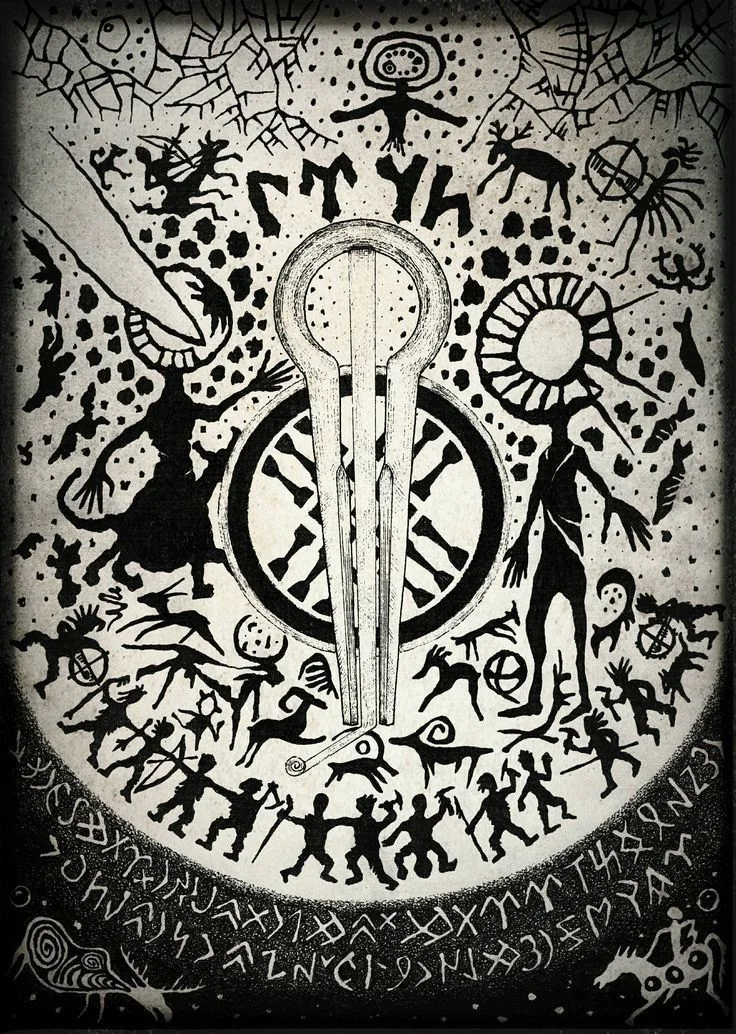
Tengrism and the Göktürks of the sixth century
Whether Bumin’s generation held the beliefs the eighth-century inscriptions attest cannot be established from any source of their own time. The inscriptions were carved by a later dynasty for its own purposes. The continuity they assert with the founders is part of what they were carved to assert.
What can be said is narrower. The vocabulary of a sky that grants rule was in the eastern steppe before the Göktürks, if the Xiongnu title is read as the turkologists read it. It is in the Göktürk inscriptions two centuries after Bumin. The First Khaganate was founded at Ötüken, which the inscriptions call sacred, and the choice of that place is itself a fact about what the founders thought was there. That Bumin’s Göktürks worshipped a sky-power called Tengri is the most economical interpretation of all of it. It is an interpretation, not a record.
Sources
Four layers, in order of their distance from the Göktürk khaganates.
The first layer is the Chinese transcription of the Xiongnu royal title, from the first century, at six centuries’ remove and through a foreign script and a foreign gloss. The second is the runiform inscriptions of the eighth century, the only Turkic-language evidence for the period, which name Tengri, Kut, ıduq Yer-Sub and törü. The third is the Chinese dynastic histories, compiled from the seventh century onward, which give an outsider’s summary of Göktürk custom, together with Menander’s report of the embassy of 569, which gives the one eyewitness description of Göktürk ritual. The fourth is the Irk Bitig of the ninth or tenth century, which belongs to the Uyghur period.
The two Orkhon monuments run parallel through their historical section. Where they share the same wording, they are therefore one witness and not two. Which of them is the source of a given shared line is a question treated separately.
Everything else rests on ethnography of the modern period and on twentieth-century synthesis. This covers the pantheon, the tiered cosmos and the ethics. It is reconstruction, not record.
References
- ^ Han Shu, juan 94
- ^ Grousset 1939
- ^ Ögel 1984, p. 46
- ^ a b Ögel 1984, p. 55
- ^ a b c d e f g h i j k l Kül Tegin inscription
- ^ Kül Tegin inscription; Akcan 2020, p. 310
- ^ a b Yavuz 2025
- ^ Ahmetbeyoğlu 2020, p. 33–34, 36
- ^ Sui Shu (Book of Sui), juan 84
- ^ a b c d e Zhou Shu (Book of Zhou), juan 50
- ^ Yavuz 2025, p. 145
- ^ Menander Protector
- ^ Dīvān Lughāt al-Turk
- ^ Tekin 1993
- ^ Kutadgu Bilig; Dankoff 1983, couplets 917, 3332
- ^ Ögel 2020, multi-volume; İnan 2017; first edition 1954; Karakurt 2012; Beydili 2005
- ^ Radloff 1893 (zweite Ausgabe), p. 1–16
- ^ Verbitskii 1893, scan 30–48
- ^ Potanin 1881, p. 81–92
- ^ Holmberg 1927, p. 299–305
- ^ Radloff 1893 (zweite Ausgabe), p. 3–6,10
- ^ Harva 1938, p. 94–95
- ^ Holmberg 1927, p. 314–316,404–406,449
- ^ Şenesen 2024, p. 1524–1525
- ^ Radloff 1893 (zweite Ausgabe), p. 3,6,10
- ^ Vámbéry 1879, p. 243
- ^ Holmberg 1927, p. 464
- ^ Şenesen 2024, p. 1520, 1522
Sources
- Kül Tegin inscription
- Bilge Khan inscription
- Zhou Shu (Book of Zhou), juan 50
- Irk Bitig
- Han Shu, juan 94 (after Shiji)
- Menander Protector
- Dīvān Lughāt al-Turk
- Sui Shu (Book of Sui), juan 84
- Kutadgu Bilig
Literature
- Emre-E. Yavuz, The Gokturk Empire: 2nd Edition (2025)
- Talat Tekin, Irk Bitig: The Book of Omens (1993)
- Uno Harva, Die religiösen Vorstellungen der altaischen Völker (1938)
- Abdülkadir İnan, Tarihte ve Bugün Şamanizm: Materyaller ve Araştırmalar (2017; first edition 1954)
- Ali Ahmetbeyoğlu, Eski Türklerde Kut ve Töre Bağlamında Hükümranlığın Hududları (2020)
- Ayten Akcan, Eski Türklerde Devlet Yönetiminde Hakimiyetin İlahi Temelleri (2020)
- İsmail Şenesen, Tengri İnancında Üç Dünya İle İlgili Ritüeller (2024)
- Wilhelm Radloff, Aus Sibirien. Lose Blätter aus meinem Tagebuche. Zweiter Band (1893 (zweite Ausgabe))
- Vasilii Ivanovich Verbitskii, Алтайские инородцы (Altai Foreigners) (1893)
- Grigorii Nikolaevich Potanin, Очерки Северо-западной Монголии. Вып. 2. Материалы этнографические (Ocherki severo-zapadnoi Mongolii, Bd. 2) (1881)
- Ármin Vámbéry, Die primitive Cultur des turko-tatarischen Volkes, auf Grund sprachlicher Forschungen erörtert (1879)
- Uno Holmberg (Harva), The Mythology of All Races, Volume IV: Finno-Ugric, Siberian (1927)
- Bahaeddin Ögel, İslâmiyetten Önce Türk Kültür Tarihi. Orta Asya Kaynak ve Buluntularına Göre (1984)
- René Grousset, L’Empire des steppes: Attila, Gengis-Khan, Tamerlan (1939)
- Ögel, Türk Mitolojisi (2020, multi-volume)
- Karakurt, Türk Mitoloji Ansiklopedisi (2012)
- Beydili, Türk Mitolojisi Ansiklopedik Sözlük (2005)
What links here30
- Persons
- Bilge Khan · Diwan · Taspar Khan
- States
- First Göktürk Khaganate · Xiongnu
- Places
- Cave of the ancestors
- Peoples
- Eurasian Nomads · History of the Turkic peoples · Rouran · Tiele
- Institutions and Titles
- Khan (Khagan) · Kut · Tuğ
- Religions
- Animism · Islam · Iye · Shamanism · Tengri · The three worlds · Turkic Mythology · Ülgen and Kayra Khan
- Customs & Pastimes
- Culture of the Turkic Peoples
- Sources
- Han Shu · Kül Tegin inscription · Nalaikh Inscription · Protobulgarian sign corpus · Shiji · Theophylact Simocatta · Tonyukuk inscription
- Controversies
- The making of Tengrism
Cite this article
Yavuz, Emre-E. “Tengrism.” Turkic Atlas, revised 8 November 2026. https://turkicatlas.org/religions/tengrism/
Last revised: 8 November 2026

