
- 400
- 500
- 600
- 700
- 800
- 900
- Rouran 400–554
- First Göktürk 552–630
- Tang rule 630–682
- Second Göktürk 682–744
- Uyghur 744–840
- Kirghiz 840–924
- Huns 370–469
- Western Göktürk 552–659
- Türgesh 699–766
- Karluk 766–800
- Khazar 650–969
The war of 588 and 589 was the first great Göktürk–Persian war. It was fought on the eastern frontier of Sasanian Persia.[1] Nineteen years after Istemi’s campaign against Persia, a Göktürk army crossed the Oxus. It took Balkh, Herat, Talakan and Badghis.[2] The Sasanian king Hormizd IV sent his general Bahram Chobin against it.[3] Bahram defeated the army and killed its leader with an arrow.[4] In 589 he retook Herat and reached the country around Bukhara.[5] The victory made Bahram strong enough to turn against his own king. Within two years Hormizd had lost his throne.[6]
The invasion of 588
In 588 Bagha, a lesser khan of the Göktürks, crossed the Oxus into Iran with a great army of Göktürks and Hephthalites.[2] He took Balkh, Herat, Talakan and Badghis, all cities of Bactria south of the river.[2] The army then marched west and reached Hyrcania. This province in Tabaristan on the Caspian was the one into which Istemi had once come.[7]
Tabari tells the invasion from two traditions. In the first, the Göktürks simply marched against Hormizd.[8] In the second, Šāba, “the over-king of the Turks”, came with three hundred thousand warriors in the eleventh year of Hormizd’s reign. He advanced as far as Badghis and Herat.[8] A more realistic figure for the Göktürk army lies between twenty and thirty thousand men. Hormizd’s first year is counted from 30 June 578.[9] His eleventh year therefore falls in 588 and 589.[10] At the same time, Tabari says, the Roman emperor moved into the Syrian desert with eighty thousand men. The king of the Khazars came to Derbent, and two Arab chiefs raided from the Euphrates.[11] Persia, surrounded on every side, was called a sieve with many holes.[11] The Roman campaign in this list is exaggerated, and the two Arab chiefs are probably invented.[9]
Šāba then sent word to Hormizd and the Persian nobles that he was coming.[3] They were to repair the bridges over the streams and rivers and to build bridges where there were none. He meant to march through Persia to the land of the Romans.[3]
Thaʿālibī wrote his Arabic history of the Persian kings in the time of Ferdowsi, and he used the same sources as the Shahnameh.[12] In his account the enemy is a khagan called Šāba-Šāh. He advanced on Balkh with a hundred thousand horsemen, meaning to take Iran from Hormizd.[13]
Bahram Chobin’s victory
According to Tabari, Hormizd, the son and successor of Khosrow I, was himself the son of a khagan’s daughter.[14] Sebeos, an Armenian historian of the seventh century, names her Kayēn, the daughter of the great khagan of the Tʿetals.[15] Hormizd took counsel and resolved to fight.[3] He sent against Šāba a man of Rayy, Bahram son of Bahram-Gushnasp, called Chobin. Bahram led twelve thousand soldiers whom he had chosen himself, all mature men and not one a youth.[4] Another account in Tabari has Hormizd muster seventy thousand.[16] Thaʿālibī also gives Bahram twelve thousand picked men.[17]
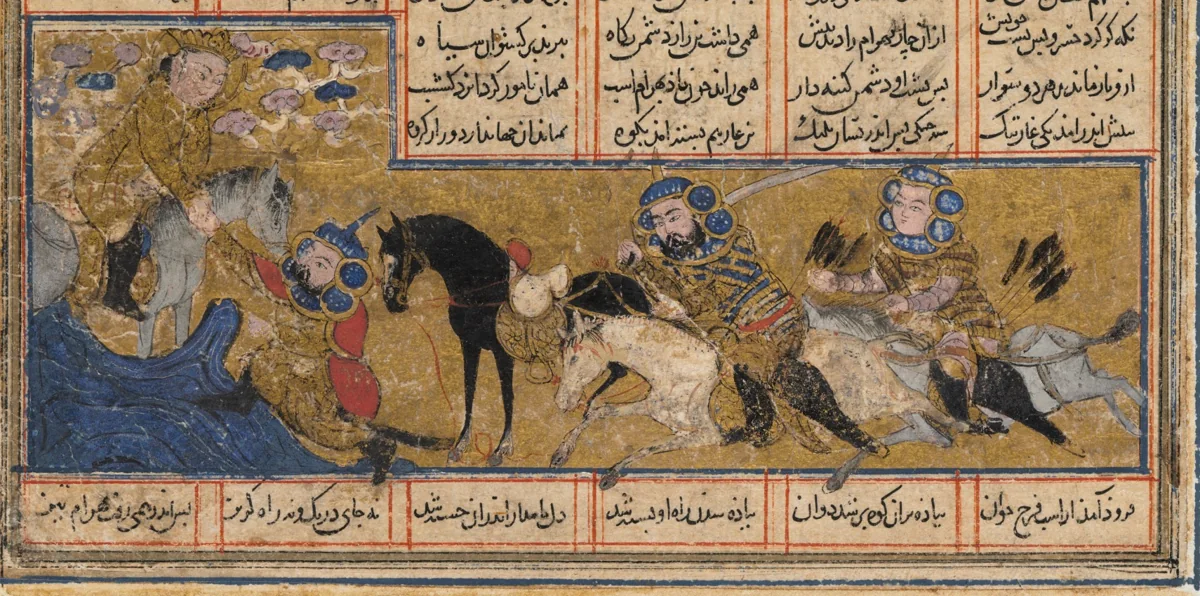
Bahram marched fast until he was beyond Herat and Badghis. Šāba noticed nothing until the Persians had built a fortified camp close to his own.[16] Negotiations and fighting followed. Then Bahram killed Šāba with an arrow.[16] The Persians counted it among the three famous shots of their history.[16]
Thaʿālibī tells the battle at greater length. Šāba-Šāh sent his brother Faghfūra to offer Bahram a safe return or high office in the khagan’s service. Bahram answered that his king had sent him for Šāba-Šāh’s head.[18] In the battle Bahram feigned retreat and then charged. Šāba-Šāh fled, and Bahram’s arrow passed through his armour and his body into the ground. Bahram cut off his head.[19] Faghfūra was found among the dead.[20]
Bahram took the enemy camp and held it. Šāba’s son Parmūdha, “who was his father’s equal”, came up.[21] Bahram beat him and shut him up in one of his fortresses. He pressed Parmūdha until he surrendered.[21] Bahram sent Parmūdha as a prisoner to Hormizd, together with the treasure of the fortress. By the account, the treasure was money, jewels, vessels and weapons to the load of two hundred and fifty thousand camels.[21] In one version of the story the fortress is Paykent near Bukhara.[22][23] Thaʿālibī’s account is such a version. His Barmūdha shut himself up in Paykent with the treasure. Bahram crossed the Oxus, beat him in the field and besieged him. He received his surrender on Hormizd’s guarantee of his life.[24] By that account the treasure included the crown, belt and earrings of Siyāwush, a prince of the Persian epic.[25]
Some scholars set the decisive battle in April 588 at the Hyrcanian rock. There Bahram defeated the Göktürks under Bagha, pursued them to the Oxus and, reportedly, killed Bagha with an arrow.[7] They call the arrow a typical topos of Persian storytelling.[7] Others have Bahram defeat the Göktürk army at Herat in 589.[26] A third holds that Bahram needed at least two seasons, 587 and 588, to raise an army strong enough to meet the Göktürks. With this army he then won back what they had taken around Balkh and Herat.[27] A fourth view also prefers 589. On grounds of terrain, it holds a battle near Herat more likely than one near Balkh.[28]
Theophylact Simocatta, the historian of the emperor Maurice, gives the Roman view of the same victory.[29] He calls the enemy the Huns of the north-east, “whom it is customary for Persians to call Turks”. He gives the victory to Hormizd, who defeated them so thoroughly that they became tributaries of Persia.[29] The same Huns, he adds, had once exacted forty thousand gold pieces a year from the Persians as the price of peace.[30] The Persians took as booty the couches, tables and thrones of gold and the horse-trappings that the Göktürks had made from Persian money.[31] Bahram appears only at the end of the passage, as the general who had distinguished himself in the Turkish campaign.[31] Theophylact places the victory before Bahram’s campaign against Suania, which he dates to the eighth year of Maurice.[30] That year began in August 589.[32]
Sebeos tells the campaign without naming the enemy king or giving a year. In his account a certain Vahram Merhewandak, prince of the eastern regions of Persia, attacked the army of the Tʿetals. He took Balkh and all the land of the Kushans as far as the far side of the Oxus.[33] Beyond the river he fought “the great king of the Mazkʿutʿkʿ”. He defeated his army, killed him and seized the treasures of his kingdom.[33] This Vahram is Bahram Chobin.[34] Tʿetal is the Armenian name of the Hephthalites. Here it stands for the Göktürks, who had taken the Hephthalites’ place as Persia’s nomad enemy in the east.[27] Some scholars think that the text has run two campaigns together, so that the Mazkʿutʿkʿ, a people of the Caucasus, have been moved beyond the Oxus.[27] Others argue that Sebeos keeps the fighting in the land of the Kushans apart from the battle beyond the river.[35]
Leadership of the Göktürk army
The Persian and Arabic tradition names the Göktürk king Šāba. In the Arabic texts the name reads Šāba, in the Persian Sāwa.[9] Thaʿālibī calls him Šāba-Šāh and a khagan. He gives him a brother, Faghfūra, and a son, Barmūdha.[36] The Chinese histories do not know that name. The Sui Shu says of Chuluohou, the Chinese name of Bagha Khan, that he campaigned in the west a second time, was struck by a stray arrow and died.[37] It names no enemy and no place.[37]
There are four theories about who led the army. The first makes Bagha, the brother of Ishbara, the commander of the army of 588. It has him beaten in the battle at the Hyrcanian rock and, reportedly, killed on the Oxus.[38]
The second makes the army Tardush’s, led by his son Šāba, “the greatest king of the Turks” of the Perso-Islamic tradition.[26] Lev Gumilev identified this son with Shir-i Kishvar, the younger son of Qara Churin in the Bukharan tradition, and with a figure of the Chinese sources.[26] On the second theory, this identification cannot be established.[26] Another view takes no notice of the identification. It counts the twenty years that the Bukharan tradition gives Shir-i Kishvar from the conquest of the Hephthalites, between 562 and 568.[39] On a strict count he then cannot be the king whom Bahram killed, though this view doubts that the figure is exact.[39]
The third regards Šāba as a prince of the small states on the Oxus, whose rulers the Chinese records name by the family name Zhaowu.[9] In that case he was a vassal of the Göktürk khagan and not the khagan himself. Whether he was a Turk in the strict sense is very doubtful.[9] Tabari’s Šāba and his son Parmūdha would then be kings of one of the small dynasties of Sogdiana subject to the Göktürks.[40] The same scholars set aside the older equation of Šāba with Bagha. Bagha belonged to the northern branch of the Göktürks and could not have resided at Paykent.[40]
The fourth theory holds that the Persian romance of Bahram merged two events. One was Bahram’s killing of the king of the Mazkʿutʿkʿ. The other was the subjugation, some years later, of two Kushan kings.[41] Sebeos names these two kings Shawk and Pariovk. Vstam, a rebel against Khosrow II, subjected them to himself, and Pariovk later had him killed.[42] On the fourth theory, Šāba and Parmūdha are these two kings under the names the romance gave them.[41][43] The king of the Mazkʿutʿkʿ whom Bahram killed beyond the river then stays without a name.[43]
A more recent view leaves the name open and speaks only of the Göktürk khagan. It holds Bagha possible, because both men died by an arrow at about the same time. It excludes Tardush, who died in 603 and not by an arrow.[44]
All these views keep the event. An army of the Göktürks or of their vassals crossed into Khorasan in 588, Bahram Chobin beat it, and its king died in the field.
Causes
Tabari gives Šāba’s own announcement: he meant to march through Persia to the land of the Romans.[3] Theophylact gives a cause of his own. In his account the Göktürks had grown rich on Persian payments. They then broke the treaty and demanded more than the customary sum. The Persians were unwilling to bear the tribute and chose war.[31] Some scholars name two causes inside the khaganate. The civil war had drained food and gold from the western Göktürks, and a raid on the rich cities south of the Oxus promised relief.[45] Extreme weather in the years 581 to 583 pressed in the same direction, so that Bagha did not march entirely of his own will.[45] The same scholars hold that both sides wanted the war. They add that the Persians claimed Transoxiana on historical grounds.[46]
Others see the attack as part of a concerted effort by the western Göktürks, the Romans and their Arab allies against Persia.[47] Gumilev held that the war was meant to break the Sasanian hold on the trade between east and west.[47] This second view calls that claim interesting and in need of proof.[47] A third explanation takes up the trade argument and holds the rivalry for the Silk Road to be the weightiest cause.[48]
Counter-campaign and aftermath
In 589 Bahram marched east and retook Herat, where he appears to have taken the golden throne of the Göktürk khan.[5] He reached the country around Bukhara.[5][49] The Göktürks had lost Bagha, the last of the four great princes of the civil war, and important settlements along the Oxus.[50] These later passed back to them.[50] In Thaʿālibī, Bahram himself made peace with the khagan, Barmūdha’s son. He gave him back his country and concluded a pact of friendship with him.[51] A second war followed in 606 and 607, in which a Göktürk army reached Rayy and Isfahan.[52]
The victory then turned against the king who had won it. Tabari says that Bahram and his troops came to fear Hormizd’s violence after the treasure had been sent.[21] Sebeos gives the reason in its Persian form. Bahram had sent the king only a small part of the booty and divided the rest among his troops. Hormizd found the share too small and sent guards to seize the whole treasure. The army killed them and made Bahram its king.[53] Thaʿālibī tells the same quarrel with the details of the romance. The earrings and golden shoes of Siyāwush were missing from the treasure, and Barmūdha accused Bahram of keeping back more than he had sent. Hormizd sent him cotton, a spindle and women’s clothes.[54]
Theophylact gives another reason. After the Göktürk war Bahram raided Suania and sent its booty to Babylonia. Then a Roman army under Romanus beat him in the plain of Albania. Hormizd dismissed him and sent him women’s clothes as the prize of his disgrace.[55] The Persian and Arabic accounts know nothing of a Roman defeat of Bahram at this time.[56] In a later chapter Theophylact himself traces the revolt to Bahram’s pride in his victories over the Göktürks.[57] That chapter rests on what a Persian official told him.[58] Some scholars prefer the eastern account of the quarrel to the Roman one.[59]
Hormizd was deposed and blinded.[60] As Theophylact reports, he named the tribute of the Göktürks among the proofs of his good rule before the assembly that had deposed him. Bindoes, a Persian noble, answered that Persian deaths and the courage of generals had won it.[61] Bahram proclaimed himself king of kings, and the young Khosrow II, supported by the Romans, defeated him.[5] Among the prisoners taken from Bahram’s army in that battle were men “of the Turkish race”. Khosrow sent them to Maurice.[62] Bahram fled to the Göktürks.[5] Tabari has him go first to Khorasan and from there to the Göktürks.[63] He rose to be a respected general at Suyab and uncovered a conspiracy within the Ashina dynasty.[5] Soon afterwards Khosrow had him poisoned by a Persian agent.[5] Tabari tells the end in his own way. Bahram lived highly honoured with the Göktürk king until Khosrow sent a man named Hormizd to the Göktürks with a precious jewel.[64] Hormizd won over the khatun, the king’s wife, and she set assassins on Bahram.[64] In Thaʿālibī the khagan who received Bahram was Barmūdha’s son, and he refused to give him up. The khatun hired a Turk of the court for a hundred thousand dirhams. The Turk stabbed Bahram with a dagger dipped in poison.[65] Sebeos has Bahram flee to Balkh. According to him, its people put Bahram to death there on Khosrow’s order.[66]
Some scholars conclude from the war that the border between the Göktürks and the Sasanians was unclear.[46] If so, a second Göktürk army, advancing west into Tabaristan, shows that the Göktürks planned the campaign with care.[46] They also conclude that there was no real cultural enmity between the two peoples.[46] Bahram’s own life bears this out: the general who had beaten the Göktürks spent his last years in their service.
Sources
Tabari, who wrote his universal history in Arabic in the early tenth century, gives the fullest narrative of the war.[67] Masʿudi tells it as well.[26] Much of Tabari’s account comes from a Pahlavi romance of Bahram Chobin.[68] It was translated into Arabic and passed into Dinawari, the Persian version of Tabari, Yaʿqubi and the Shahnameh of Ferdowsi.[68] The author of the romance had good historical knowledge, and the historical core of the story can be read fairly well from Tabari.[69] Thaʿālibī belongs to the same tradition. Like Tabari, Dinawari and Masʿudi, he did not draw on the first Arabic translation of the Persian royal chronicle but on reworked versions of it. In other places he quotes Tabari by name.[70] Where Tabari, Thaʿālibī and the epic agree, they are one tradition and not three witnesses.
Sebeos wrote in Armenian in the middle of the seventh century, more than two hundred years before Tabari. He already gives the Persian reason for Bahram’s revolt, the quarrel over the booty.[71] Theophylact stands outside the Persian tradition. He wrote in Greek at the Roman court and knows the victory, the tribute and the quarrel between Bahram and Hormizd from the Roman side. For the eastern war his main source was the lost history of John of Epiphania, a lawyer of Antioch who had served on an embassy to Persia in the 590s.[72] Theophanes, who wrote in Greek in the early ninth century, took his account of the war from Theophylact.[73] In shortening it he set the defeat of the Göktürks in Suania.[74] On this war he is no independent witness. The Sui Shu adds the death of Bagha by an arrow on a western campaign and names no enemy.[37]
The Persian, Arabic, Armenian, Greek and Chinese accounts agree on the core of the war. A Göktürk army crossed the Oxus in 588 and reached Balkh and Herat, and Bahram Chobin destroyed it. His victory began the crisis that cost Hormizd IV his throne.
-
588 Persia attacked from four sides
In the eleventh year of Hormizd IV, Tabari reports, Šāba, “the over-king of the Turks”, advanced with three hundred thousand men as far as Badghis and Herat. In Thaʿālibī the khagan Šāba-Šāh marches on Balkh with a hundred thousand horsemen. At the same time the Roman emperor moved into the Syrian desert with eighty thousand men, the king of the Khazars came to Derbent, and two Arab chiefs camped on the Euphrates and raided the Sawād. Persia was called a sieve with many holes. The Roman march is exaggerated, and the two Arab chiefs are probably invented. One reading has the Göktürk army cross the Oxus, take Balkh, Herat, Talakan and Badghis, and march on west into Hyrcania. The sources name the goals; the way to them is drawn, and the leg into Hyrcania follows that reading.
-
588–589 Bahram Chobin against Šāba
Hormizd sent against Šāba a man of Rayy, Bahram son of Bahram-Gushnasp, called Chobin, with twelve thousand men he had chosen himself. In Tabari he marched fast until he was past Herat and Badghis, and Šāba noticed nothing until the Persians had built a fortified camp close to his own. After negotiations and fighting Bahram killed Šāba with an arrow. In Thaʿālibī, Šāba-Šāh sends his brother Faghfūra to offer Bahram a safe return or high office; Bahram answers that he has come for Šāba-Šāh's head, and Faghfūra is found among the dead. One reading sets the decisive battle in April 588 at the Hyrcanian rock, where Bahram beat the Göktürks under Bagha, pursued them to the Oxus and, reportedly, killed Bagha there with an arrow; a second places the defeat at Herat in 589. Tabari's march is drawn to the place he gives; the pursuit of the first reading is dotted, and where it reached the river is not recorded.
-
589 Beyond the Oxus: Parmūdha and the treasure
Šāba's son Parmūdha, “who was his father's equal”, came up next. Bahram beat him, shut him up in one of his fortresses and pressed him until he surrendered. In Thaʿālibī, Bahram crosses the Oxus, routs Barmūdha in a night attack and besieges him in Paikent, near Bukhara, until he gives himself up on Hormizd's guarantee of his life. Bahram sent the prisoner to the king with the treasure of the fortress, by Tabari's account two hundred and fifty thousand camel loads; Thaʿālibī counts among it the crown, belt and earrings of Siyāwush. One reading has Bahram retake Herat in 589 and reach the country around Bukhara. Sebeos tells the campaign as the conquest of Balkh and of the land of the Kushans to the far side of the Oxus, where Bahram killed the great king of the Mazkʿutʿkʿ. The stations are those Thaʿālibī and Sebeos name; the way between them is drawn, and so is the road to the capital at Ctesiphon.
-
589 The break with Hormizd
Theophylact sends Bahram from the war against the Göktürks to the Caucasus. In the eighth year of Maurice he ravaged Suania, sent its booty to Babylonia and moved camp to the Araxes. The Roman general Romanus came from Lazica into Albania; Bahram drew back towards Ganzak, crossed the river again and was beaten in the plain of Albania. Hormizd dismissed him and sent him women's clothes as the prize of his disgrace. One reading holds that the Mazkʿutʿkʿ whom Sebeos puts beyond the Oxus belong to this campaign. The Persian and Arabic accounts know nothing of a Roman defeat. In them the quarrel is over the booty: in Sebeos the army killed the guards whom Hormizd sent for the whole treasure and made Bahram its king, and in Thaʿālibī the king sends him cotton, a spindle and women's clothes. Theophylact names Suania, the Araxes and Albania; the way between them is drawn.
-
590 Bahram takes Ctesiphon; Khosrow II flees
In Thaʿālibī, Bahram made peace with the khagan, Barmūdha's son, gave him back his country and raised the revolt in Khorasan. The rebels declared Hormizd deposed and marched on Ctesiphon, in the Persian and Arabic accounts from Khorasan. In Theophylact they wait at the crossing of the Zab, and the army sent against them goes over to Bahram. In the capital the nobles deposed Hormizd and blinded him, and his son Khosrow II took the throne; Hormizd was killed soon after. Bahram came on fast. After a meeting on the Nahrawan and a night attack, Khosrow fled across the Tigris. Theophylact takes him through the desert and along the Euphrates past Anatha to Circesium, and on to the Roman general at Hierapolis; Sebeos has him stop at a city he calls Khaab, read as Aleppo, and Tabari has him write to the emperor Maurice from Antioch. Bahram took the palace and at the great festival put on the royal diadem. The stations are those Theophylact names; the way between them is drawn.
-
591 The battle of 591
Maurice sent Khosrow back with a Roman army. It set out from Dara, crossed the Tigris and the Zab, and joined a second Roman army that came from Armenia. Bahram marched from Ctesiphon into Atropatene. Theophylact puts the battle near Ganzak, on the river Blarathos, with more than sixty thousand men on Khosrow's side and forty thousand on Bahram's; Tabari and Sebeos also place the fighting in Atropatene. Bahram's army broke, and he escaped. Among the prisoners were men “of the Turkish race” with a cross tattooed on their foreheads, and Khosrow sent them to Maurice. The stations are those Theophylact names; the way between them is drawn, and so is the meeting of the two Roman armies south of Lake Urmia.
-
from 591 Bahram's flight and death
Tabari has Bahram escape to Khorasan and go on to the Göktürks, whose king received him with high honour. In Thaʿālibī he halts at Nishapur and crosses into Transoxiana to the khagan, Barmūdha's son, who meets him as an equal and refuses to give him up. Khosrow sent an envoy with a precious jewel who won over the khatun, the khagan's wife, and she had Bahram killed; in Thaʿālibī a man of the court stabbed him with a dagger dipped in poison. Sebeos has Bahram flee to Balkh and be put to death there by its people on Khosrow's order. One reading makes him a respected general at Suyab who uncovered a conspiracy within the Ashina before a Persian agent poisoned him. The flight is drawn through the stations Thaʿālibī names; the way on to Suyab follows that reading and is dotted.
-
606 or 614 The host of the great khagan
Khosrow II sent the Armenian Smbat Bagratuni east against the Kushans. Smbat called up his old troops from Hyrcania, beat the Kushan raiders and camped at Apr Shahr near Nishapur, in the province of Tus, with three hundred men in the walled village of Khrokht. The kings of the Kushans called on the great khagan, king of the regions of the north. A host of three hundred thousand, thirty thousand in an older translation, crossed the Oxus. It surrounded Khrokht, from which Smbat broke out, and routed the Persian relief force under Datoyean; its raids reached the borders of Rayy and of the province of Isfahan. Then an order of the great khagan reached its commander, the Chembukh, and the host recrossed the river and went home. Sebeos gives no year. One reading dates the war to 606 and 607 and has the western yabgu Shegui withdraw the army; a second places it in 614 and 615, counting back from Smbat's death in the twenty-eighth year of Khosrow II; a third dates it to 597 and 598. Khrokht is not located; the routes between the named places are drawn.
-
607 or 615 Smbat's counter-campaign
Khosrow's inquiry blamed Datoyean, who was put to death, and cleared Smbat. With fresh troops Smbat marched against the Kushans and the Hephthalite king. The Kushan king challenged him to single combat between the lines, and Smbat's lance split his armour and killed him. Smbat's horsemen pursued the fleeing army as far as Balkh, the capital of the Kushans, and plundered Herat, Badghis, Tokharistan and Talaqan. He came back with great booty and camped in the province of Merv. In the reading that dates the war to 606 and 607, the Hephthalites he beat near Balkh were still vassals of the Göktürks; in the second the campaign falls in 615. Sebeos names Balkh and Merv; the way between them is drawn.
- Place named in a source (position as commonly identified)
- Position disputed or approximate
- Extent of a realm, inferred; border uncertain (soft edge)
- Tokharistan between Persia and the Göktürks, its overlord contested (hatched)
- Movement named in a source (route drawn)
- Route between the stations a source names (way inferred)
- Route after a modern reconstruction
References
- ^ Yavuz 2025, p. 325,359
- ^ a b c Yavuz 2025, p. 323
- ^ a b c d e Tabari; Nöldeke 1879, p. 270
- ^ a b Tabari; Nöldeke 1879, p. 270-271
- ^ a b c d e f g Yavuz 2025, p. 325
- ^ Chavannes 1903, p. 243-244
- ^ a b c Yavuz 2025, p. 324
- ^ a b Tabari; Nöldeke 1879, p. 269
- ^ a b c d e Nöldeke 1879, p. 269
- ^ Chavannes 1903, p. 242
- ^ a b Tabari; Nöldeke 1879, p. 269-270
- ^ Zotenberg 1900, xix
- ^ aṯ-Ṯaʿālibī; Zotenberg 1900, p. 642
- ^ Tabari; Nöldeke 1879, p. 252
- ^ Sebeos, ch. 10; Howard-Johnston 1999, p. 14
- ^ a b c d Tabari; Nöldeke 1879, p. 271
- ^ aṯ-Ṯaʿālibī; Zotenberg 1900, p. 643
- ^ aṯ-Ṯaʿālibī; Zotenberg 1900, p. 645-646
- ^ aṯ-Ṯaʿālibī; Zotenberg 1900, p. 647
- ^ aṯ-Ṯaʿālibī; Zotenberg 1900, p. 648
- ^ a b c d Tabari; Nöldeke 1879, p. 272
- ^ Chavannes 1903, p. 242-243
- ^ Markwart 1938, p. 141–143
- ^ aṯ-Ṯaʿālibī; Zotenberg 1900, p. 648-654
- ^ aṯ-Ṯaʿālibī; Zotenberg 1900, p. 655
- ^ a b c d e Golden 1992, p. 132
- ^ a b c Howard-Johnston 1999, p. 168
- ^ Toğay 2023b, p. 296
- ^ a b Theophylact Simocatta; Whitby 1986, p. 80
- ^ a b Theophylact Simocatta; Whitby 1986, p. 80-81
- ^ a b c Theophylact Simocatta; Whitby 1986, p. 81
- ^ Whitby 1986, p. 80
- ^ a b Sebeos, ch. 10; Howard-Johnston 1999, p. 15
- ^ Howard-Johnston 1999, p. 15
- ^ Marquart 1901, p. 83
- ^ aṯ-Ṯaʿālibī; Zotenberg 1900, p. 642-648
- ^ a b c Sui Shu (Book of Sui), juan 84
- ^ Yavuz 2025, p. 324-325
- ^ a b Markwart 1938, p. 151
- ^ a b Chavannes 1903, p. 243
- ^ a b Marquart 1901, p. 83-84
- ^ Sebeos; Howard-Johnston 1999, p. 45
- ^ a b Markwart 1938, p. 142
- ^ Toğay 2023b, p. 294
- ^ a b Yavuz 2025, p. 323-324
- ^ a b c d Yavuz 2025, p. 326
- ^ a b c Golden 1992, p. 133
- ^ Toğay 2023b, p. 299
- ^ Markwart 1938, p. 153
- ^ a b Yavuz 2025, p. 332
- ^ aṯ-Ṯaʿālibī; Zotenberg 1900, p. 658
- ^ Yavuz 2025, p. 359
- ^ Sebeos, ch. 10; Howard-Johnston 1999, p. 15-16
- ^ aṯ-Ṯaʿālibī; Zotenberg 1900, p. 656-657
- ^ Theophylact Simocatta; Whitby 1986, p. 81-83
- ^ Nöldeke 1879, p. 272
- ^ Theophylact Simocatta; Whitby 1986, p. 102
- ^ Whitby 1988, p. 237-238
- ^ Howard-Johnston 1999, p. 169
- ^ Chavannes 1903, p. 244
- ^ Theophylact Simocatta; Whitby 1986, p. 109-110
- ^ Theophylact Simocatta; Whitby 1986, p. 146
- ^ Tabari; Nöldeke 1879, p. 287
- ^ a b Tabari; Nöldeke 1879, p. 289
- ^ aṯ-Ṯaʿālibī; Zotenberg 1900, p. 674-682
- ^ Sebeos; Howard-Johnston 1999, p. 23
- ^ Tabari
- ^ a b Nöldeke 1879, p. 474-476
- ^ Nöldeke 1879, p. 476-477
- ^ Zotenberg 1900, xix,xliii-xliv
- ^ Nöldeke 1879, p. 272-273
- ^ Whitby 1986, xxi-xxii
- ^ Scott 1997, lxxxi,385
- ^ Theophanes the Confessor; Scott 1997, p. 385
Sources
- Tabari
- aṯ-Ṯaʿālibī
- Theophylact Simocatta
- Theophanes the Confessor (after Theophylact Simocatta)
- Sebeos, ch. 10
- Shahnameh
- Sui Shu (Book of Sui), juan 84
Literature
- Emre-E. Yavuz, The Gokturk Empire: 2nd Edition (2025)
- Peter B. Golden, An Introduction to the History of the Turkic Peoples (1992)
- Theodor Nöldeke, Geschichte der Perser und Araber zur Zeit der Sasaniden. Aus der arabischen Chronik des Tabari übersetzt und mit ausführlichen Erläuterungen und Ergänzungen versehn (1879)
- Édouard Chavannes, Documents sur les Tou-Kiue (Turcs) occidentaux (1903)
- Michael Whitby, Mary Whitby (trans.), The History of Theophylact Simocatta (1986)
- Michael Whitby, The Emperor Maurice and His Historian (1988)
- R. W. Thomson (trans.), James Howard-Johnston (commentary), The Armenian History attributed to Sebeos (1999)
- Hermann Zotenberg (ed., trans.), Histoire des rois des Perses par Abou Mansour ʿAbd al-Malik ibn Mohammad ibn Ismaʿil al-Thaʿalibi (1900)
- Cyril Mango, Roger Scott (trans.), The Chronicle of Theophanes Confessor: Byzantine and Near Eastern History AD 284–813 (1997)
- Josef Marquart, Ērānšahr nach der Geographie des Ps. Moses Xorenacʿi (1901)
- Ali Hüseyin Toğay, Behram Çubin’in Göktürkler Üzerine Seferi Hakkında Bir Değerlendirme (2023)
- Josef Markwart, Wehrot und Arang. Untersuchungen zur mythischen und geschichtlichen Landeskunde von Ostiran (1938)
What links here35
- Persons
- Bagha Khan · Bahram Chobin · Faghfura · Hormizd IV · Kayen · Khosrow I · Parmudha · Šāba · Tardush
- Conflicts
- Göktürk Expansion along the Silk Road · The Göktürk Civil War · The Göktürk–Hephthalite war, 555–563 · The Göktürk–Sasanian Trade Conflict
- Battles & Events
- Abrui and Shir-i Kishvar · Istemi's campaign against Persia, 569 · Murder of Bahram Chobin
- Peoples
- Hephthalites
- Institutions and Titles
- Göktürk Weapons
- Sources
- Shahnameh · Tabari · Theophylact Simocatta
- Controversies
- Climate and the steppe empires
Cite this article
Yavuz, Emre-E. “Göktürk–Persian war, 588–589.” Turkic Atlas, revised 8 November 2026. https://turkicatlas.org/conflicts/turk-persian-war-588/
Last revised: 8 November 2026

