
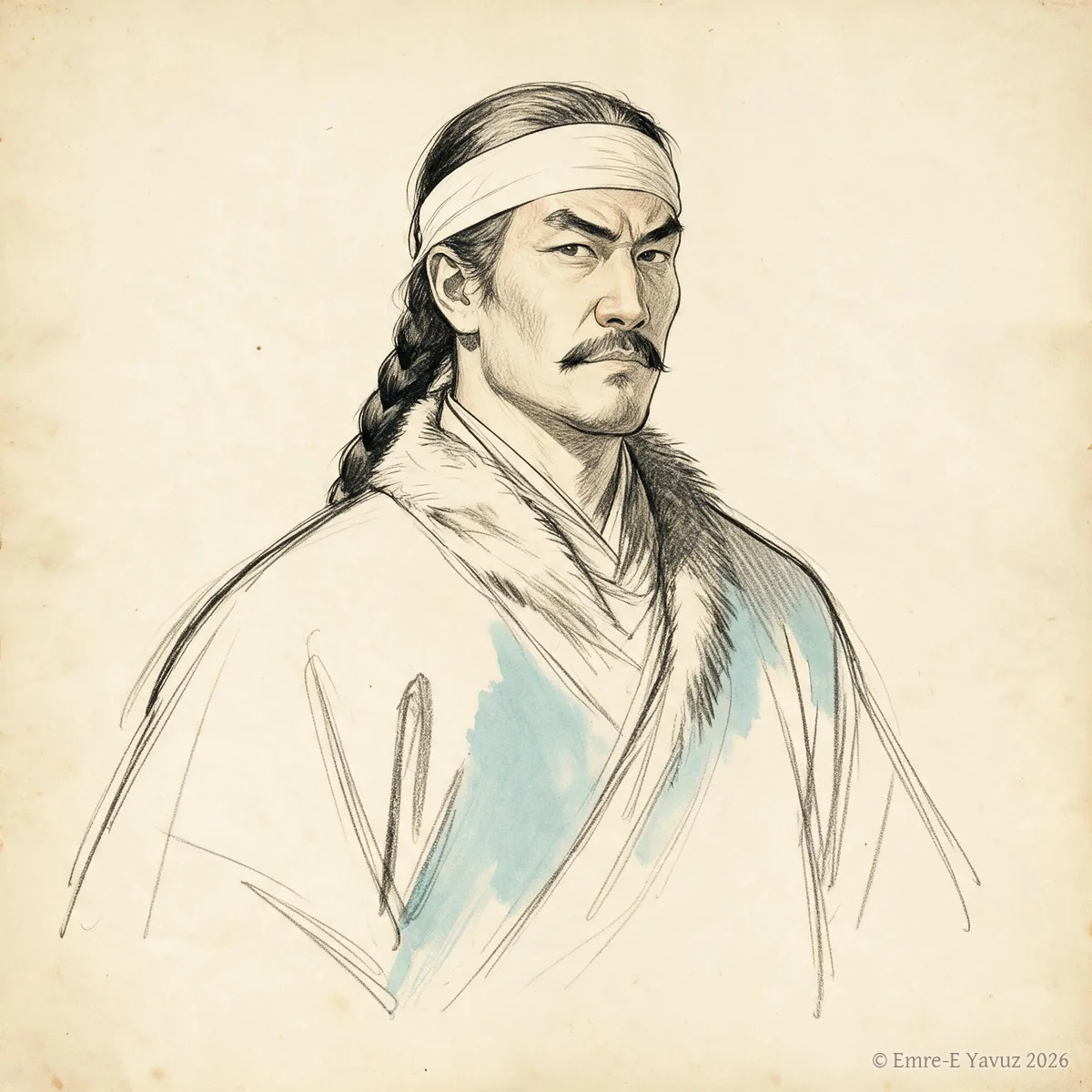
Bilge Khan ruled the Second Göktürk Khaganate for eighteen years, from 716 to his death by poison in 734. In the coup of 716, his brother Kül Tegin killed their uncle’s heirs and set him on the throne.[1] He is the speaker of the Kül Tegin inscription. It is the fullest statement the Göktürks ever made of what their state was and how it could be lost. He is also the subject of the second Orkhon monument. He is the one khan of his line whom the Tang history describes with something like affection: “humane and brotherly by nature”. He offered the throne to the brother who had won it for him.[1] His reign turned the khaganate from a raiding empire into a trading one, on his own terms and from Ötüken. The monuments say why. Turkic Atlas says how long the khaganate lasted.
Names and early life
- Türük Bilge KaganOld TurkicBilge Khan inscription
- 默棘連ChineseJiu Tangshu 194
- 毗伽可汗ChineseJiu Tangshu 194
- 小殺ChineseJiu Tangshu 194
- Bilge KhaganEnglish
His people called him the Little Shad, after the office he held as a boy under his uncle. The Tang wrote his personal name as Mojilian and his title as Pijia, which is Bilge, “the wise”.[1] He was eight when his father Ilterish died, which puts his birth about 683. He was fourteen when his uncle Kapgan set him over the Tardush as shad. His own inscription gives both ages.[2][3] “When my uncle was khan, I myself was shad over the Tardush people. Together with my uncle the khan we campaigned eastward as far as the Green River and the plain of Shantung; westward as far as the Iron Gate; crossing the Kögmen as far as the country of the Kırgız. Twenty-five times in all we went out, and thirteen times we fought pitched battles.”[4] On the Tonyukuk stone, the Tardush Shad rides at the head of the army to Bolchu and leads the charge that scatters the Türgesh. If the office was still his, that shad was Bilge. The inscription’s ages say that it was.
Coup of 716
After a straggler of the Bayirku killed Kapgan, Kül Tegin “gathered the old followers, killed Mochuo’s son the Lesser Khan and his brothers and his trusted men almost to a man, and set up his own elder brother Mojilian, Prince of the Left, as khan”.[1] Bilge, according to the history, held that the state was Kül Tegin’s achievement, and he firmly offered it to him. Kül Tegin refused. He was made Prince of the Left with sole command of the army.[1] The inscription tells the accession in the voice of Heaven.[4] The same Heaven that had raised his father and mother set him on the throne “so that the name and fame of the Göktürk people should not perish”. It set him over a people “who had no food inside them and no clothes on their backs, a wretched and broken people”.[4]
The first act of the reign was the recall of Tonyukuk. Kül Tegin had killed Kapgan’s whole court. He had spared only the old counsellor, because his daughter was Bilge’s katun, and had sent him home to his tribe. At that time the Xi and Khitan were going over to the Tang, Sulu of the Türgesh was setting himself up as khan in the west, and the Göktürk tribes were wavering. Bilge called Tonyukuk back as chief counsellor. Tonyukuk was over seventy.[1]
Early reign (716–721)
The surrendered tribes that had gone over to the Tang under Kapgan began to come back. The Tang commander Zhang Zhiyun had disarmed them and marched them south of the river.[1] An inspector took pity on them and gave them their bows back. They rose and beat Zhiyun at Qinggangling. They captured him and were carrying him to the Göktürks when a second Tang force scattered them.[1] They let Zhiyun go and made for the Black Mountains. The emperor had Zhiyun beheaded for losing his army.[1] Bilge, “having got the surrendered households”, wanted to strike south. Tonyukuk told him that the Tang ruler was able, the year was good and the people were united. A newly gathered army, he said, was still weak. It should rest for some years and watch its chance.[1] Bilge also wanted to build walled towns and found Buddhist and Taoist temples. Tonyukuk talked him out of that too. His argument was that the Göktürks survived by having no fixed dwelling and no soft teaching. The khan “thought the counsel deeply right”.[1] Twelve years later, the south face of the Kül Tegin inscription states the same counsel in Bilge’s own voice. The advice is to stay in Ötüken, trade with China from there, and not go and live in the south.[4]
The inscription counts his wars: “I went out on campaign twelve times: northward against the Oguz, eastward against the Kıtañ and the Tatabı, southward against China”.[4] The Bilge Khan inscription counts his wars by his age. At seventeen he marched against the Tangut and took their herds. At eighteen he marched against the six districts of the Sogdians. Then the Chinese Ong Tutuk came with fifty thousand men, and Bilge destroyed that army at Iduk Baš.[5] At twenty he marched against the Basmïl. At twenty-two he fought a Chinese general with eighty thousand men.[5] At twenty-six he fought the Čik, who had turned against him together with the Kırgız. At twenty-seven he marched against the Kırgız and the Türgesh, and at thirty against Beshbalik. At thirty-one he fought the Karluk.[6] It records the year in which the Nine Oguz, “my own people”, fought him five times and were beaten five times by Kül Tegin.[4] It records the wintering at the fortress of Amga. It also records the day when the Oguz fell on the royal camp while the khan was away. Kül Tegin held the camp.[4] The Tang planned his destruction for 721. The plan was a three-sided attack, with the Basmïl from the west and the Xi and Khitan from the east.[1] Tonyukuk read the plan correctly. Only the Basmïl came.[1] Tonyukuk’s advice, in the Jiu Tang Shu, was to wait until the Tang army came near and then move the khan’s tent three days north, so that the Tang soldiers would run out of food and leave of themselves.[1][7] The Xin Tang Shu has the whole people move north three days ahead of the army.[8] The Göktürks followed them home and took them all, together with the city of Beiting.[1] “From this the Little Shad’s power grew greatly, and he had the whole of Mochuo’s following.”[1]
Peace with the Tang (721–734)
He asked for peace at once, offering to be the emperor’s son. He also asked for a princess. The emperor accepted the sonship and sent rich gifts instead of the bride.[1] In 725, Xuanzong went east to sacrifice on Mount Tai. The chancellor Zhang Yue named the three men who made the Göktürks dangerous: the khan, Kül Tegin and Tonyukuk. He also had a Göktürk minister summoned to attend the emperor as surety.[1] Bilge sat in his tent with his wife, Kül Tegin and Tonyukuk. He put to the envoy the question that had been refused for thirty years.[1] Tibet, “a race of dogs”, had a Tang bride. The Xi and Khitan, “old slaves of the Türk”, had Tang princesses. The Göktürks alone, who had asked again and again, were refused. Why?[1] The envoy said that a father does not marry his son. The minister went and attended the emperor at Mount Tai. He was feasted and sent home. The marriage was refused again.[1]
What he got instead was trade. In 727, the Tibetans wrote to him proposing a joint invasion of China. He sent the letter to Chang’an with thirty fine horses.[1] The emperor feasted the envoy and granted a market at the western Shouxiang city. Every year, several hundred thousand bolts of silk were sent to the frontier there as gifts to the Göktürks.[1] One survey puts the gift of 727 alone at a hundred thousand pieces of silk, for a token tribute of thirty horses.[9] The inscription’s “they give gold and silver and raw silk and figured silk in such quantity, and without our having to ask” is the same arrangement described from Ötüken. The same is true of its warning that Chinese words are sweet and Chinese silk is soft.[4] The Turkish edition renders the last words of that line as “without making difficulty”.[10]
In 733 the Tatabı broke away from the Khitan. At the age of fifty, Bilge says, an army of forty thousand under General Ku came against him. He attacked on Mount Töngker and killed thirty thousand of its soldiers.[11] When his eldest son fell ill and died, he set up General Ku as a balbal.[11][12]
Death of Kül Tegin and of Bilge Khan
Kül Tegin died in 731, in the Year of the Sheep. Bilge expressed his grief on the north face of the monument he raised: “My seeing eyes became as though they did not see; my knowing mind became as though it did not know.”[13] The Tang sent envoys with a sealed letter of condolence and a stele whose text the emperor composed himself. Chinese craftsmen built the tomb.[1] The monument was finished in 732.[1] On one reckoning Kül Tegin died on 27 February 731 and was buried on 1 November.[14][15][16] The emperor’s letter of condolence to Bilge Khan is dated 13 May 731, so the news had reached Chang’an by then. The Jiu Tang Shu’s year 732 for the death is therefore a mistake for 731.[17] The Tang records add that Bilge himself had asked the court for skilled craftsmen to draw his brother’s portrait. The emperor sent six painters. At the end of 733 Bilge sent them home with thanks and fifty horses.[18][19]
Two years later, a minister, Meilu Chuo, poisoned him. “When the poison took effect, before he died, he first had Meilu Chuo executed and wiped out his whole faction.”[1] His own inscription, in his son’s voice, gives the date of his death. It was the Year of the Dog, tenth month, twenty-sixth day. The funeral followed in the fifth month of the following Year of the Pig.[20] In the Gregorian calendar, on one reckoning, he died on 25 November 734 and was buried on 22 June 735.[14] The Chinese text is dated 19 August 735. The Turkic text took a month and four days to cut, and so the stone was raised on 24 September 735, after his death, by his son Tengri Khan.[14] Vilhelm Thomsen equated the Year of the Dog and the Year of the Pig with 734 and 735. The Jiu Tang Shu’s year-count puts the poisoning in the same year as Kül Tegin’s death. It is the looser of the two.[21] The Tang Huiyao places the poisoning in the twelfth month of the twenty-second year of Kaiyuan, a year that corresponds to 734.[22] The Jiu Tang Shu’s number may be a copyist’s slip for the twenty-second year. The emperor’s edict of January 735 would then mark the day the news reached the court, not the day of the death.[23] The Tang sent an envoy to sacrifice, to invest his son Yiran and to build a stele and shrine.[1] The envoy was Li Quan, a member of the imperial clan with the rank of grand general of the Left Jinwu guard.[24] The Chinese text on Bilge’s monument was composed by the court historian Li Rong, and it was cut in 735. It records that Li Quan raised a statue of the khan in his funerary temple, as one had been raised for Kül Tegin. The Tang histories do not say so.[25] One edict, dated to the first month of 735, is already addressed to Tengri Khan. This may be a sign that Yiran died within months of his accession.[26] The murder was a portent of the dynastic instability that toppled the state within eight years.[27] Turkic Atlas tells those years under the khaganate.
Inscriptions
Bilge Khan is the speaker of the Kül Tegin inscription from the first line to the last. He is also the subject of his own inscription. It runs parallel to the Kül Tegin inscription in the historical section and adds his ages, his enthronement and his death.[2] The last lines of the south face of the Bilge Khan monument and a short text on its west face are spoken by his son Tengri Khan, who had the stone raised.[28] The part spoken by the son names the great men of Bilge’s reign: Kül Čor at the head of the lords of the Tardush in the west, Apa Tarkan at the head of the lords of the Tölis in the east, Ataman Tarkan, Tonyukuk Boyla Baga Tarkan, and Sebig Kül Irkin at the head of the commanders.[29] What the two inscriptions say about Bumin and Istemi, about the fifty years under China, and about Heaven, Kut and Ötüken is treated in the source articles and in the articles on Tengrism and Kut. About Bilge himself, they say that he took the throne over a wretched people and made the poor rich and the few many. They say that he came within a little of the sea in the east and within a little of Tibet in the south.[4] He made peace with China and took its silk without settling in its country. In his words, “so long as the Göktürk khan sits in the Ötüken forest, there is no trouble in the realm”.[4] His son’s regents left Ötüken’s throne to a boy. That statement was tested within a decade.
References
- ^ a b c d e f g h i j k l m n o p q r s t u v w x y z aa Jiu Tangshu (Old Book of Tang), juan 194
- ^ a b Bilge Khan inscription
- ^ Tekin o. J., p. 66–67
- ^ a b c d e f g h i j Kül Tegin inscription
- ^ a b Tekin o. J., p. 71–72
- ^ Tekin o. J., p. 72
- ^ Ögel 2000, p. 46–48
- ^ Xin Tangshu (New Book of Tang), juan 215
- ^ Litvinsky 1996, p. 336
- ^ Tekin o. J., p. 36
- ^ a b Tekin o. J., p. 79
- ^ Taşağıl 2004, p. 52
- ^ Kül Tegin inscription; Tekin 1968, p. 271
- ^ a b c Tekin o. J., p. 11–13
- ^ Kafesoğlu 1997, p. 126–128
- ^ Roux 1994, p. 223
- ^ Pelliot 1929, p. 246
- ^ Cefu yuangui
- ^ Pelliot 1929, p. 246–248
- ^ Bilge Khan inscription; Tekin 1968, p. 279
- ^ Bilge Khan inscription; Tekin 1968, p. 10, 279
- ^ Tang Huiyao (Institutional History of the Tang), juan 94
- ^ Pelliot 1929, p. 229–230
- ^ Pelliot 1929, p. 233–236
- ^ Pelliot 1929, p. 231–235
- ^ Pelliot 1929, p. 236–246
- ^ Golden 1992
- ^ Tekin o. J., p. 13, 78–81
- ^ Tekin o. J., p. 79–80
Sources
- Kül Tegin inscription
- Bilge Khan inscription
- Jiu Tangshu (Old Book of Tang), juan 194
- Xin Tangshu (New Book of Tang), juan 215 (after Jiu Tangshu)
- Tonyukuk inscription
- Cefu yuangui (after Tongdian and Jiu Tangshu)
Literature
- Peter B. Golden, An Introduction to the History of the Turkic Peoples (1992)
- Emre-E. Yavuz, The Gokturk Empire: 2nd Edition (2025)
- E. Denison Ross (after Vilhelm Thomsen), The Orkhon Inscriptions; The Tonyukuk Inscription. Being a Translation of Professor Vilhelm Thomsen's Final Danish Rendering (1930)
- Talât Tekin, A Grammar of Orkhon Turkic (1968)
- Talât Tekin, Orhon Yazıtları. Kül Tigin, Bilge Kağan, Tunyukuk (o. J.)
- Paul Pelliot, Neuf notes sur des questions d'Asie Centrale (1929)
- İbrahim Kafesoğlu, Türk Millî Kültürü (1997)
- Jean-Paul Roux, Türklerin ve Moğolların Eski Dini (1994)
- Bahaeddin Ögel, Türk Kültür Tarihine Giriş VII: Türklerde ordu, ordugah ve otağ (2000)
- B. A. Litvinsky; Zhang Guang-da; R. Shabani Samghabadi (ed.), History of Civilizations of Central Asia, Vol. III (1996)
- Ahmet Taşağıl, Gök-Türkler, Bd. III (2004)
What links here62
- Persons
- Bars Beg · Ilterish Khan · Kapgan Khan · Kül Tegin · Ozmish Khan · Pofu Katun · Right Shad (d. 741) · Sulu Khan · Tengri Khan · Tonyukuk · Yiran Khan
- Conflicts
- Fall of the Second Khaganate, 741–744 · Kapgan's wars with the Tang, 698–716 · The revolt of the subject peoples, 714–716
- Battles & Events
- Bilge Khan's Tent Banquet (725) · Horse Market at the Western Shouxiang City (727) · The coup of 716
- Places
- Beshbalik · Khöshöö Tsaidam · Kögmen
- Peoples
- Bayirku · Eurasian Nomads · History of the Turkic peoples · Tatars · The Great Empires of the Steppe · Toquz Oghuz
- Lineages
- Ashina
- Institutions and Titles
- Army of the Steppe Empires · Buyruk · Chinese Craftsmen at the Orkhon Monuments · Chur · Furs and Musk among the Turkic Peoples · Gold and Silver in the Orkhon Inscriptions · Katun · Külüg Chur · Kut · Livestock Losses in the Annals · Ordu · Raw Materials and Trade among the Turkic Peoples · Shad · Tegin · The Economy of the Steppe Empires · Tölis and Tardush · Women among the Turkic Peoples
- Religions
- Burial and the balbal · Iye · Stone Figures · Tengri · Yer-Su Spirits
- Customs & Pastimes
- Er At · Hunting among the Göktürks · Mounted Archery · Seating at the Feast · The New Year on the Steppe
- Sources
- Bilge Khan inscription · Bilge Khan's Golden Crown · Kül Tegin inscription · Ongi inscription · Tonyukuk inscription
- Controversies
- The Göktürks and the Xiongnu
Cite this article
Yavuz, Emre-E. “Bilge Khan.” Turkic Atlas, revised 8 November 2026. https://turkicatlas.org/persons/bilge-khan/
Last revised: 8 November 2026

