
- 400
- 500
- 600
- 700
- 800
- 900
- Rouran 400–554
- First Göktürk 552–630
- Tang rule 630–682
- Second Göktürk 682–744
- Uyghur 744–840
- Kirghiz 840–924
- Huns 370–469
- Western Göktürk 552–659
- Türgesh 699–766
- Karluk 766–800
- Khazar 650–969
When Göktürk power in the western steppe broke apart in the middle of the seventh century, it left two states behind it: the Bulgar union and the Khazars. By the 670s the Khazars had beaten the Bulgars and controlled the Ponto-Caspian steppe.[1] They controlled it for three hundred years, longer than either Göktürk khaganate and longer than the Uyghurs. They are the reason the history of the Göktürks does not end in the east. The house that ruled them is held, on grounds set out below, to have been the Ashina. If that is right, the family that took Ötüken in 552 was still reigning on the Volga when the Rus came in 965.
They are the third of four true steppe empires, after the Rouran and the Göktürks and before the Mongols.[2]
Name and origins
- *QazarOld Turkic
- XazarArabic
- 可薩Chinese
Neither question has an answer. The name appears in a dozen traditions: Arabic and Persian xazar, Hebrew, Syriac Kazārāyē, Greek Χάζαροι, Slavonic, Georgian, Armenian, Latin, Hungarian, and Chinese forms that came through an Iranian intermediary. Behind them all stands a Turkic *Qazar whose meaning is argued.[3] One derivation traces it to qaz-, “to wander”. The form of the verb is itself uncertain. Louis Bazin read it as an Oghuric variant of Qasar, a name known from the Uyghur runic inscriptions. He made the Khazars an Uyghur splinter that went west before 555. Toru Senga answered that Qasar was not an ethnonym at all but the surname of a chief of the Sïkari. In his view, the search for Khazar origins among the Uyghurs is not plausible. András Róna-Tas derived the name from Caesar, by way of Middle Persian kēsar. The name therefore offers few reliable clues.[4] Khazar was first a political name and only afterwards the name of a people. In the Göktürk period, down to about 650, the sources use Khazar and Göktürk so freely for each other that there may have been no difference between the two.[5]
The hypotheses about the people are just as many. One makes the Khazars the Akatzirs. A second makes them a union of Oghuric tribes and Sabirs with a western Göktürk ruling stratum over them. A third makes them Turkicised Ugrians. A fourth makes them Uyghurs. A fifth makes them Hephthalites who came to the Caucasus about 500 and joined with the Sabirs there. Modern accounts have rejected the first of the five. No unimpeachable source puts Khazars in the area before the Göktürks came, and the Akatzirs are not to be identified with them.[5] If a Khazar people existed in those years, it was a group of the Göktürks or a tribe closely tied to them. Alternatively, it was a new union formed in the turmoil of the Avar and Göktürk incursions, whose beginnings no source records.[5] Of the five hypotheses, the second, a union of Oghuric tribes and Sabirs under a Western Göktürk ruling stratum, is the likelier. With the Göktürk conquest the Sabir union was reorganised, and the Khazars emerged at its head. Masʿūdī’s remark that the Khazars are called Sabīr in Turkic is a hint of it.[6] The Göktürks took the Sabirs and various Oghur tribes into their empire as a subject tribal union under Western Göktürk heads. This union developed into the Khazar khaganate.[7] That leaves open who these Khazars were before that and where they came from.
The notices on the Khazar language are few and contradict one another. The geographer al-Iṣṭakhrī says in one place that it resembles the language of the Bulghars. In another place he says that it is unlike any other human tongue.[5] The words that survive in names, titles and place-names come down in poor transcription and with scribal errors. They look mostly Turkic, of the Common Turkic type or at least a neutral one. However, no proof is to be had of an Oghuric or a Common Turkic speech.[8]
Question of Ashina descent
This is the question that ties them to the Göktürks. It is worth setting out exactly what supports it and what does not.
The ruler who was Heraclius’s ally in the Byzantine–Sasanian war of 602 to 628 is named in the sources as the Yabgu Khan: Pahlavi (Sin)jēpīk, Arabic Sinjibū, Armenian Jebu Xakʿan, Georgian Jibgu, Greek Ziebēl. That man is Tong Yabgu. The Khazars of those years were still part of the Göktürk polity, and in all likelihood the Göktürks had brought them into being.[6] The same event can be viewed from the other end. The Armenian historian Movses Kaghankatvatsi, writing under the later Khazar state, calls the Göktürks of 627 “Khazars”. This is an anachronism with a true core. The campaign of Tong Yabgu and Börü Shad through Derbent and Tiflis laid the ground on which the Khazar empire was built.
For the dynasty itself there are three arguments and three objections. Mikhail Artamonov proposed that Irbis Shegui, a defeated khan of the Nushibi, moved to the Khazar lands about 651 and founded the ruling house there.[9] It remains a hypothesis, and there are many problems with it.[9] The Ḥudūd al-ʿālam says the Khazar king is “one of the descendants of Ansā”. Artamonov read this as a garbling of A-shih-na, that is Ashina. Minorsky, the translator of the Ḥudūd, was uneasy about the reading. He preferred to see in ʾnsā a corruption of ʾysā, the title išād, which would fit only if “king” there meant the sub-ruler and not the khagan. The Chinese transcription A-shih-na is itself of uncertain reading, and may stand for *Āršila.[9]
The conclusion is nevertheless positive. It rests less on any single text than on how the steppe worked.[9] The khaganal rank itself, and the close connection of the Khazars with a ruler bearing that title in the Göktürk period, strongly suggest that their ruling house was of Göktürk royal origin. The reason is that this was the only source of legitimation the steppe had.[9] The investiture of the Khazar khagan points the same way. It included ritual strangulation and the ceremonies that the Chinese sources describe for the Ashina. That is a tie to the Göktürks of Inner Asia.[9] Turkic Atlas sets out the same rite for the Göktürk khans under the title. Turkic Atlas sets out what the Khazar khagan was thought to hold under Kut.
Double kingship
Executive power in Khazaria sat in a double khaganate. It is the sharpest surviving picture of what a steppe khaganate could become.
The khagan, the “supreme king” of the Arabic sources, was a sacred ruler chosen from a royal clan. He reigned and did not govern. He was a living talisman whose presence secured Kut, the fortune of heaven, for the realm. His person was holy, no blood could be shed in his presence, and he could order the death of any of his servants. If he appeared to have lost the mandate, he could be killed. That is the doctrine of the Kut carried to its conclusion. Outsiders stated it more plainly about the Khazars than the Göktürks did about themselves.
The man who actually ruled was the qagan-beg, also called beg, shad or yilig. Beneath him, in Ibn Faḍlān’s account, stood a kündü qagan and a jāwshïghïr.[10] The Muslim writers give the title of the day-to-day ruler as Ishad, Qagan-Beg or simply Beg. The kündü has a counterpart in the Hungarian kende.[11] He had a paid guard of Muslim Khwarazmians, the Ors, beside the tribal levies. The well-to-do carried the cost of the army. The state taxed its subjects and took a tithe on everything that crossed its land, which is why it could pay a guard at all. Ibn Faḍlān counts twenty-five subject peoples, each of which sent a bride to the Khazar ruler. They included Volga and Pontic Bulgars, the North Caucasian Huns, the Iranian Alano-As, Hungarians, Burtas and others. The realm reached from the middle Volga and Kiev to the Crimea, to Bab al-Abwab in the Caucasus and to the Khwarazmian steppe. Its heartland was the Volga delta and the steppe of the North Caucasus. The eastern edge was never clearly drawn, and it is doubtful that Khazar power was often effective as far as the Ural river. In the west the Don–Donets country was firmly Khazar. From the middle of the ninth century at the latest, perhaps earlier, the Eastern Slav lands including Kiev lay within the realm.[8] The word elteber, the title the Göktürks gave to the kings of subject peoples, went with the institution. The Khazars took it over.
Capital and trade
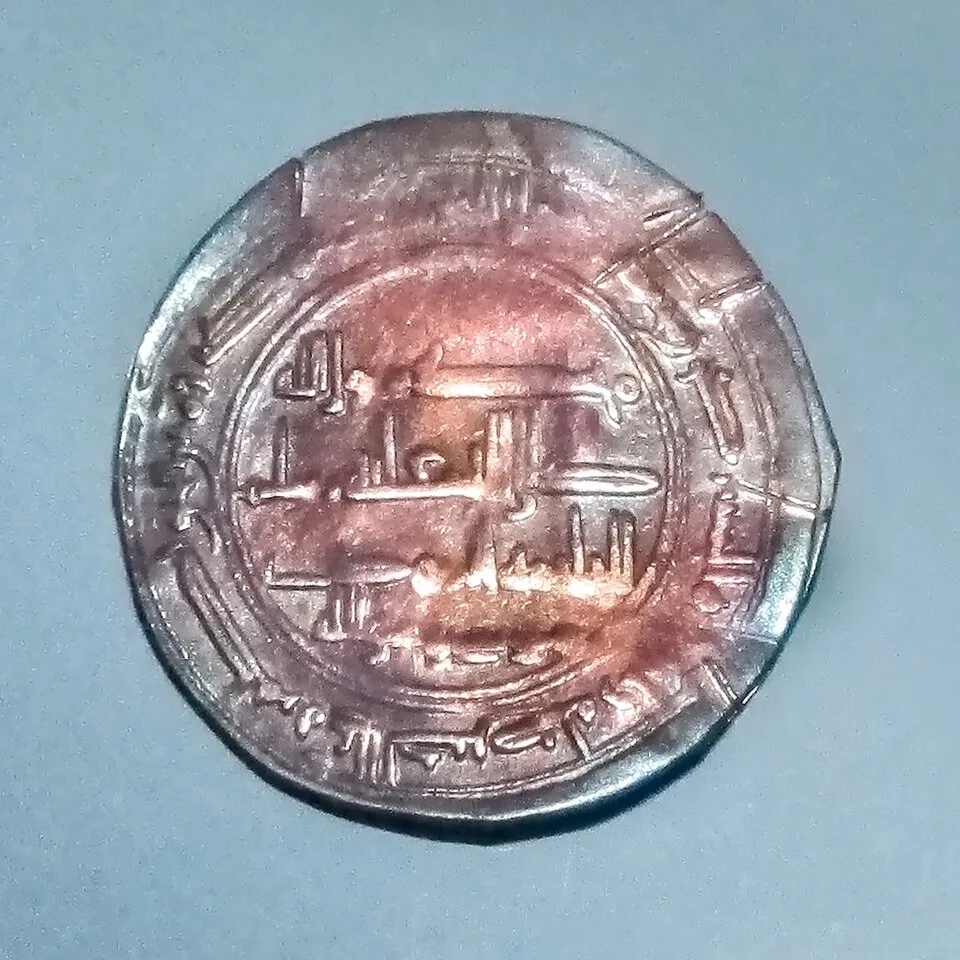
The Khazar capital, called Atil or Itil in some sources and Sarighshin in others, was a double city. The ruler, the government and the guard were in one part, the merchants in the other.[11] Most dwellings were felt tents with a few houses of clay. The king’s castle was the only building of brick. A wall with gates to the steppe and to the river surrounded the whole.[11] Ruler and people wintered in the towns and went out to the steppe again in spring.[11] The revenue came from a tithe on the trade that passed through the city and from other taxes. It paid a permanent standing army, the Ors.[11] Whether the Khazars struck coins of their own is still debated.[11] Fish and rice were the staples of the table. Isinglass was the one export that the Khazars produced themselves.[11] The rest of what crossed Khazar land was other peoples’ goods, on roads that led to the Islamic world. That is why the Arabic and Persian geographers describe the Khazars in such detail.[11]
Wars with the Arabs and the Byzantine marriage
The first enemy was the Bulghar state between the Kuban and the Sea of Azov. The Khazars fought it from about 630 until it broke up in the 670s. Since the ruling strata on both sides came from the Western Göktürks, these wars may reflect the larger struggle between the Duolu and the Nushibi.[12]
For a century the northern Caucasus was a war zone. Between 642 and 737 Arab and Khazar armies fought there almost without pause, and the goal on both sides was the passes. Neither side was simply the aggressor. The Khazars raided, but the Umayyads were at the same time taking North Africa and Spain, pressing into Central Asia and raiding Anatolia every year, and were every bit as rapacious.[13] The pressure told. Masʿūdī says that the Khazars moved their capital from Samandar to Atil on the lower Volga because of it.
The war ended in 737 with the victory of the Umayyad general Marwan over the khagan, who was forced to convert to Islam. That conversion lasted about as long as the Arab soldiers stood on Khazar ground. The Arabs controlled Transcaucasia but never got past Bab al-Abwab. In the same year they broke the Türgesh at Kharistan in Central Asia. Marwan had pursued the fleeing khagan to the land of the Burtas on the Volga. The khagan renounced Islam and the caliph’s overlordship as soon as the Arab army had gone.[14] The fighting went on during the eighth century on a smaller scale. Neither side proved able to defeat the other.[14]
With Byzantium the relation was older and easier. It was inherited from the Göktürk period and held together by a common enemy. In 732 Constantine, son and heir of Leo III, married Čiček, the daughter of the Khazar khagan. Čiček is Turkic for “flower”. The Byzantines conceded such marriages to outsiders very rarely. Their son Leo, who also became emperor, was known as “the Khazar”.[14] In 786 the Khazars helped Leon II of Abkhazia, a grandson of a Khazar khagan, to end Byzantine suzerainty over his land.[14] In 838 the Byzantines helped the Khazars build the fortress of Sarkel on the Don, to watch the Hungarians moving into the Pontic steppe and the Pechenegs behind them. Constantinople sent Petronas Kamateros to oversee the work. Byzantine writers call the fortress a bulwark against the Pechenegs. It stood on the left bank of the Don near Tsimlyansk, behind a deep moat.[15]
Conversion to Judaism
The Khazar court took up Judaism. The Khazars are the only steppe power of which that is true. The choice belongs in its context rather than in the class of riddles.[16] After the forced conversion of the khagan to Islam in 737 the religious question was open among the elite.[16] Judaism, unlike Islam or Christianity, carried no implication of subordination to the caliph or the emperor.[16] It is also cautioned against making that the whole explanation, and against the assumption that the whole people followed. The Muslim merchants and the Ors guard were substantial, and the Jewish communities of the Crimea were influential. Beyond that, it says, the evidence does not go.[16] What can be said is that the Hebrew alphabet was used in Khazaria beside a variant of the Turkic runic script. The courts also reflected the mixture, with seven judges: two each for Jews, Muslims and Christians, and one for the pagans.
Masʿūdī places the conversion of the khagan in the reign of Hārūn al-Rashīd (786 to 809), that is, in the last decades of the eighth century or the first years of the ninth. The work in which he told it at length is lost.[17] Nothing shows that Judaism became the state religion, and a state religion as such seems not to have existed. Nevertheless, outsiders, among them Jews in Spain and Egypt, identified Khazaria with Judaism. Christianity, Islam and pagan cults stood beside it.[17] After the conversion only members of the royal clan who had taken up Judaism could become khagans, it seems. The office that corresponded to a vizier fell to the Muslim Ors.[17] Jews came to Khazaria from Byzantium and the Islamic lands. Jewish colonies in the Crimea were older than the conversion. How many came, and how far they mixed with Judaised Khazars, is not known.[17] The Khazar Judaism was not of the Karaite kind. The descent of the Karaites of Eastern Europe from the Khazars cannot be shown.[18] The spread of the three monotheist religions can be taken as a sign that part of the Khazar union was settling.[17]
The Uyghurs took up a world religion as well, within a century of the Khazars. For them, by contrast, the choice was political. The Tang had condemned Manichaeism in 732. Bögü adopted it in part to show that he stood independent of the Tang.[19]
Decline and fall
The state lived on trade. The Ḥudūd says plainly that the wealth of the king of the Khazars came mostly from the maritime customs. When that declined, the state was exposed. The signs accumulate through the ninth and tenth centuries: the revolt of the Qabars, Volga Bulgaria going over to Islam, annual war with the Pechenegs, Rus raids down the Volga that the Khazars apparently permitted. The Qabars broke away in the early ninth century and went with the Hungarian union to Pannonia. What caused the revolt is not known. Ascribing it to feeling against the Judaised Khazars rests on a strained use of the Khazar–Hebrew correspondence.[20]
The Rus enter the story earlier. In the 830s part of the Rus seem to have stood within the Khazar orbit. They were a mixture of Scandinavian, Slavic and Finnic people organised for trade and plunder. They may have had dynastic ties with the Khazar royal house. The memory of a “Rus khagan” lived on among the Eastern Slavs for centuries.[21] In the early spring of 861 a Byzantine mission under Constantine, later called Cyril, came to the Khazar capital on the lower Volga, ostensibly for a religious debate at the khagan’s court.[15] The Rus attack on Constantinople of June 860 was probably another subject of the talks.[15] By 885 the Rus had united the Eastern Slav tribes. Their expansion brought them into conflict with the Khazars.[20] Their raids down the Volga to the Caspian began in the reign of the Tabaristan amir Hasan b. Zayd (864 to 884) and went on in 910 and the following years. The khagan took half the booty. In 922 the enraged Muslims of Khazaria killed the Rus on their return from a raid.[20] Why the khagan allowed raids that cut into his own trade is unclear. A Khazar war with the ruler of Bab al-Abwab, going on since 901, may have played a part.[20] Byzantium changed partners in the steppe, from Khazaria to the Pechenegs. About 960 the Khazar ruler Joseph wrote to a Jewish courtier of the Spanish Umayyads that he was constantly at war with the Rus. In 965 the Rus, allied with Oghuz, overran Atil and probably Sarkel. The Rus chronicles name only this campaign, of Sviatoslav of Kiev. They say that he “took their city and Biela Vezha”, that is, Sarkel. Ibn Miskawayh and Ibn al-Athir give the Oghuz a part in it.[22] A khaganate of a kind survived a few years more. Its end is usually set in 969. The Khazars did not vanish. In a much reduced form they remained a client state of Khorezm. Other Khazar lands fell to the Muslim rulers around them. The bulk of the people merged with the surrounding, mostly Turkic peoples, and the nomads were absorbed by other tribes.[22] Three causes of the fall have been named. They are the Qabar civil war, domestic troubles that the sources do not record, and the pressure of steppe peoples whom the khagans on the lower Volga were less and less able to repel.[22]
Sources
The Khazars are known through Ibn Faḍlān, Masʿūdī, Ibn Rusta, al-Iṣṭakhrī, the Ḥudūd al-ʿālam, Theophanes, Constantine Porphyrogenitus and the Khazar Hebrew documents.[23]
Runiform inscriptions of the seventh to the ninth century have been found in the old Khazar lands: on two flasks from Novocherkassk, on a wall at Mayatskoye Gorodishche and on a bull’s skull near Elista. They are not deciphered. Their script follows the Göktürk letters in some thirteen signs, and the language behind them is probably Turkic.[24] The Kiev letter of the tenth century is in Hebrew.[25] A runiform word once read in it is now taken for a later Hebrew note, and its place name has been read as Canopus in the Nile delta, not as Kiev.[26] The Fihrist of al-Nadim says that the Khazars write Hebrew.[25]
Relations with other states
Red is war, blue alliance, gold trade. Where several held at once, the line shows what prevailed; alliance and trade can run side by side. Each line rests on an article. Point at a state to see its weightiest relation, select it to see its events. The slider shows what stood in a given year, and Play runs through the years.
The Umayyad Caliphate661 to 737
- War661 to 737Arab–Khazar Wars (642–737)
- War730Battle of Ardabil (730)
- War737Campaign of Marwan (737)
References
- ^ Ögel 1984, p. 229, 234, 239–240
- ^ Golden 1992; Yavuz 2025
- ^ Golden 1992, p. 233–234
- ^ Golden 1992, p. 234
- ^ a b c d Sinor 1990, p. 263
- ^ a b Golden 1992, p. 236
- ^ Sinor 1990, p. 260
- ^ a b Sinor 1990, p. 264
- ^ a b c d e f Golden 1992, p. 237
- ^ Golden 1992, p. 240
- ^ a b c d e f g h Sinor 1990, p. 270
- ^ Sinor 1990, p. 264–265
- ^ Golden 1992, p. 238
- ^ a b c d Sinor 1990, p. 265
- ^ a b c Sinor 1990, p. 267
- ^ a b c d Golden 1992, p. 242
- ^ a b c d e f Sinor 1990, p. 266
- ^ Sinor 1990, p. 266–267
- ^ Sinor 1990, p. 330–331
- ^ a b c d Sinor 1990, p. 268
- ^ Sinor 1990, p. 267–268
- ^ a b c Sinor 1990, p. 269
- ^ Golden 1992
- ^ Vásáry 1993, p. 57–58
- ^ a b Vásáry 1993, p. 57
- ^ Zieme 2000, p. 377
Literature
- Peter B. Golden, An Introduction to the History of the Turkic Peoples (1992)
- Emre-E. Yavuz, The Gokturk Empire: 2nd Edition (2025)
- Denis Sinor (ed.), The Cambridge History of Early Inner Asia (1990)
- Bahaeddin Ögel, İslâmiyetten Önce Türk Kültür Tarihi. Orta Asya Kaynak ve Buluntularına Göre (1984)
- István Vásáry, Doğu Avrupa'nın Runik Alfabe Sistemleri Üzerine (1993)
- Peter Zieme, Runik Harfli Birkaç Pasaj Üzerine Kimi Yorum Önerileri (2000)
What links here56
- Persons
- Barjik · Bulan · Busir Glavan · Chorpan Tarkhan · Heraclius · Irbis Shegui Khan · Marwan ibn Muhammad · Theodora of Khazaria · Tong Yabgu · Tzitzak
- Conflicts
- Göktürk Expansion along the Silk Road · Göktürk Expansion into Europe · The Caucasus campaign, 627–629
- Places
- Balanjar · Cherson · Derbent · Gate of Sul · Gurgan · Itil · Khorezm · Samandar · Sarkel · Volga
- Peoples
- Akatziri · Avars · Bulgars · Eurasian Nomads · History of the Turkic peoples · Kabars · Sabirs · The Great Empires of the Steppe · Turkic Tribes in Europe
- Lineages
- Ashina
- Institutions and Titles
- Ilteber · Khazar Customs and Tribute · Khazar Dual Kingship · Women among the Turkic Peoples
- Religions
- Islam
- Languages
- The Khazar language · The Turkic languages
- Customs & Pastimes
- Funeral Games of the Caucasian Huns
Cite this article
Yavuz, Emre-E. “Khazar Khaganate.” Turkic Atlas, revised 8 November 2026. https://turkicatlas.org/polities/khazar-khaganate/
Last revised: 8 November 2026


