
Tardush was the son of Istemi. He ruled the western wing for twenty-seven years and tried to make the two halves of the khaganate one under himself. He succeeded his father as yabgu in 576. He moved the western seat from the Altai to Suyab on the Chu. In the war that followed 581, he took Apa’s side against Ishbara. He drove Ishbara into the arms of the Sui, lost an army to Persia and recovered. For about three years around 600 he held supreme power over east and west. About 603 a rising of the Tiele, which the Sui had encouraged, destroyed him. Tardush was active on a pan-Eurasian scale. He attempted to do too much.[1] Tardush may have broken an unwritten rule of the house by intervening in the affairs of the khan east of the Altai. If so, the four princes of the civil war, Tardush among them, did what no foreign power had done.
Names
- TardušOld Turkic
- 達頭可汗ChineseSui Shu 84
- 玷厥ChineseSui Shu 84
- 步迦可汗ChineseSui Shu 84
- ΤάρδουGreekMenander Protector
- TarduEnglish
- Qara ČurinPersian
The Chinese histories give him as Datou Khan.[2] The Sui Shu gives his personal name as Dianjue. In 599 he took the title Bujia Khan.[2] Menander, who records him in 576, writes Tardu.[3] The usual modern form is Tardu. Modern accounts take the name as Tarduš and connect it with the Tarduš, the people or wing that the Kül Tegin inscription pairs with the Tölis. The founders gave this wing a yabgu and a šad.[1] Tarduš is also taken to be the name of the western or right wing of the Göktürks.[1] In the Bukharan tradition the Göktürk ruler of these years is called Qara Čurin. Lev Gumilev identifies him with Tardush, but the identification cannot be established.[1]
Yabgu of the west (576)
Valentinos, the Roman envoy, reached the Göktürks in 576. Istemi had just died, and his son Türk-shad was mourning him.[3] Tardush succeeded his father as yabgu of the west.[4] Türk-shad received the envoy first and threatened to kill him.[3] After the burial Türk-shad sent the envoy on to the Göktürk leaders of the interior, and above all to his brother Tardu. Tardu had his dwelling on the mountain Ektel. Menander adds that Ektel means golden.[3] Theophylact Simocatta says that the Göktürks call a mountain in the east golden and by custom cede it to the most powerful khagan.[5]
As the envoy left, Türk-shad swore to take Bosporos in the Crimea.[3] Bochan went against the city with a very large Göktürk force. Anagai already lay encamped nearby with another.[3] The town was taken while the Roman envoys were still among the Göktürks. The fragment says that this made it plain that the Göktürks had been provoked into war with the Romans.[6] Türk-shad held the envoys and mocked them before he let them go.[6] Three years later, the emperor Tiberius told Avar envoys that the Göktürks were encamped at Cherson.[7] The embassy may have ended differently. Tardush then confirmed the alliance with Byzantium, and the Göktürks kept the Crimea.[8] The fall of the town is dated by others to about 579.[4] If the embassy ended that way, the encounter with Valentinos was the moment Tardush conceived the ambition to grow from a viceroy into a khan.[9]
Tardush did not sit where his father had. Istemi had held court in the Altai, a neighbour to the khans in the east. Tardush resided at Suyab in what is now Kyrgyzstan. Suyab was the Ordukent of the Göktürks, a city of the army. The tarkhans had their quarters there, and the officers gathered there when war was decided. The fixed seat has been read as a sign that the western Göktürks were beginning to settle. It has also been seen as the distance that made the west a state.
Revolt against Ishbara (582–585)
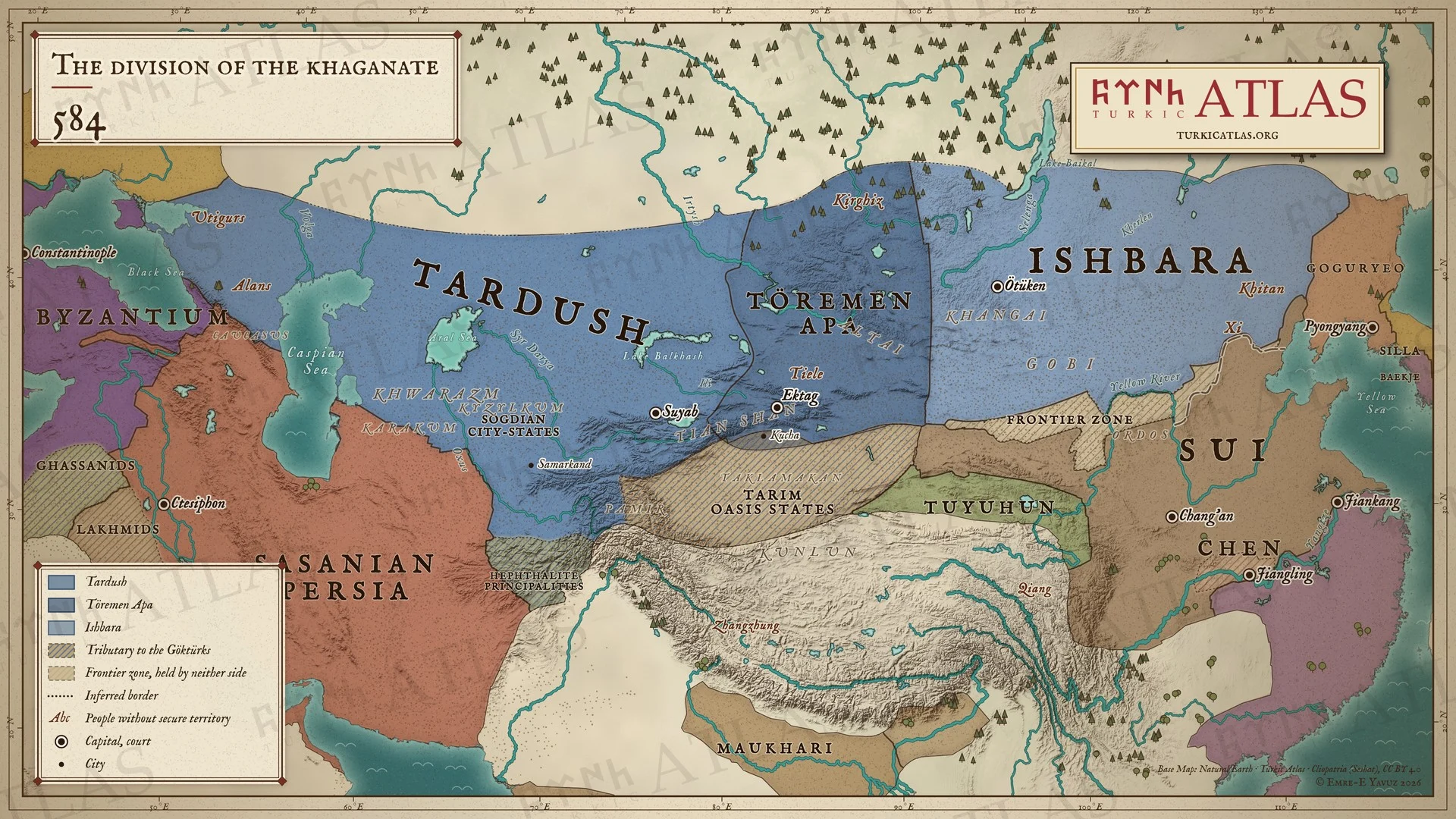
Tardush’s revolt against the eastern khan began about 582. It was the most serious and direct threat the khaganate faced. It aimed at nothing less than the complete takeover of the eastern and western khaganates.[1] The occasion was the succession quarrel. In 583 Ishbara raided Apa’s camp and killed his mother. Apa fled west to Tardush, whom the Sui Shu calls Ishbara’s uncle and the former khan of the western side.[2] Tardush was enraged. He sent Apa back east with troops, and close to a hundred thousand horsemen of Apa’s people came over to him.[2] Tanhan Khan, a friend of Apa whose people Ishbara had taken, fled to Tardush. Ishbara’s cousin Diqincha went over to Apa with his people.[2] The begs who were appalled by Ishbara’s purge followed.
Tardush had ridden into China with Ishbara, Apa and Bagha in the joint invasion that took a broad strip of the north.[10] He withdrew west at the news of a Tiele rising at home. In June 583 the Sui surprised the Göktürks who had stayed at the front.[10] Two years later Tardush turned the same army on his cousin. In 585, pressed by an attack from Tardush, Ishbara declared himself a vassal of the Sui.[2] In September the western army marched on Ötüken. Ishbara had already fled to China. Tardush’s host is put at a hundred thousand, with the forcibly recruited Tiele in it. Ishbara had thirty or forty thousand. The struggle went on as the civil war of 584–603.
War with Persia (588–589)
The war’s western chapter is the war with Persia. Whose war it was is disputed. The army that crossed the Oxus in 588, took Balkh and Herat and was destroyed by Bahram Chobin at Herat in 589 may have been Tardush’s. It was led by his son Šāba, “the greatest king of the Turks” in the Perso-Islamic tradition.[1] A different explanation makes it the army of Bagha, Ishbara’s brother, and puts the destruction at the Hyrcanian rock in April 588.[1] The attack belongs to a concerted effort by the western Göktürks, Byzantium and its Arab allies against the Sasanians.[1] Whoever led it, the defeat was the west’s. Tardush recovered from it, and from various domestic disturbances, by 598. Bahram Chobin lost his own war for the Persian throne. He fled to the Göktürks and rose to be a respected general at Suyab. An agent of Khosrow II poisoned him.[11] Suyab was then Tardush’s seat. The court Bahram Chobin served was Tardush’s.
Supreme khan (about 600–603)
After 588, with Ishbara dead, Apa a captive and Tulan on the eastern throne, Tardush moved to establish his dominion over the whole steppe empire. From about 600 to 603 he held supreme power in the united khaganates. He was the only man after Taspar to do so.[1] Other accounts of these years differ. Tardush’s plan to win support by a victory over China failed. His army suffered massive losses on the long march from west to east and from poisoned wells, without fighting the Sui emperor once. The Tiele and other tribes revolted and drove him out. In 602 he defeated Yami, Ishbara’s son and the Sui’s client. In 603 Yami, with Chinese help, defeated him.[2]
Theophylact Simocatta records a letter to the emperor Maurice from the ruler “who is celebrated by the Turks as Chagan in the east”. The ruler styled himself “the great lord of seven races and master of seven zones of the world”.[12] The khagan listed his victories over the Hephthalites, the Avars, the Ogur and the Kolch, and an alliance with a Stembischagan.[13] The khagan also told of a civil war. In it a kinsman named Turum rose against him and fell at a place called Ikar, after three other great khagans had come to his aid.[14] Tardush may be the author, writing about 598 as the strongest claimant to rule over all the Göktürks. Stembischagan would then be his father Istemi.[15] A different dating puts the letter in 581 or 582, at the start of Maurice’s reign. The reason is that the victories the letter lists end with the defeat of Turum about 580.[16]
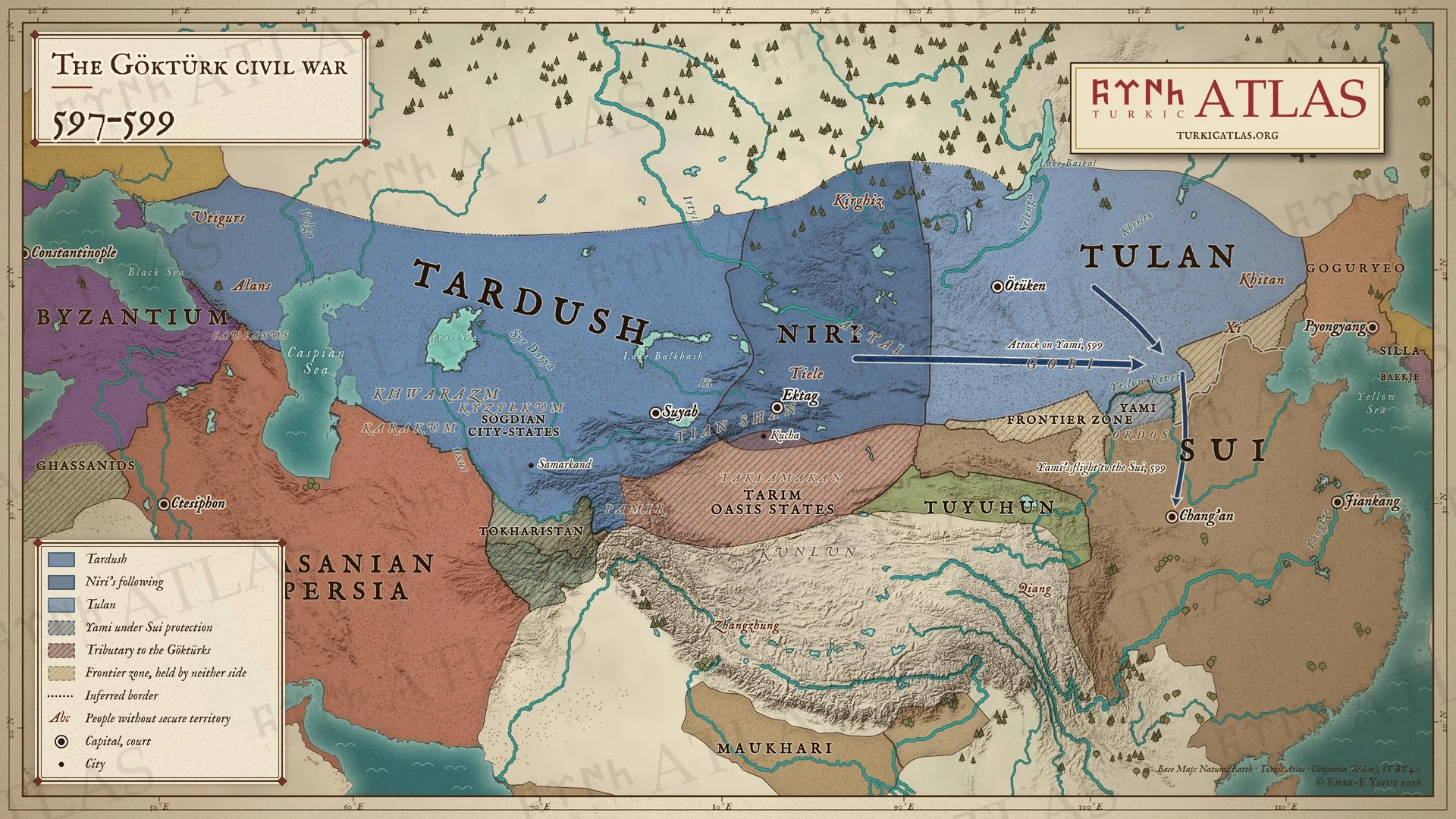
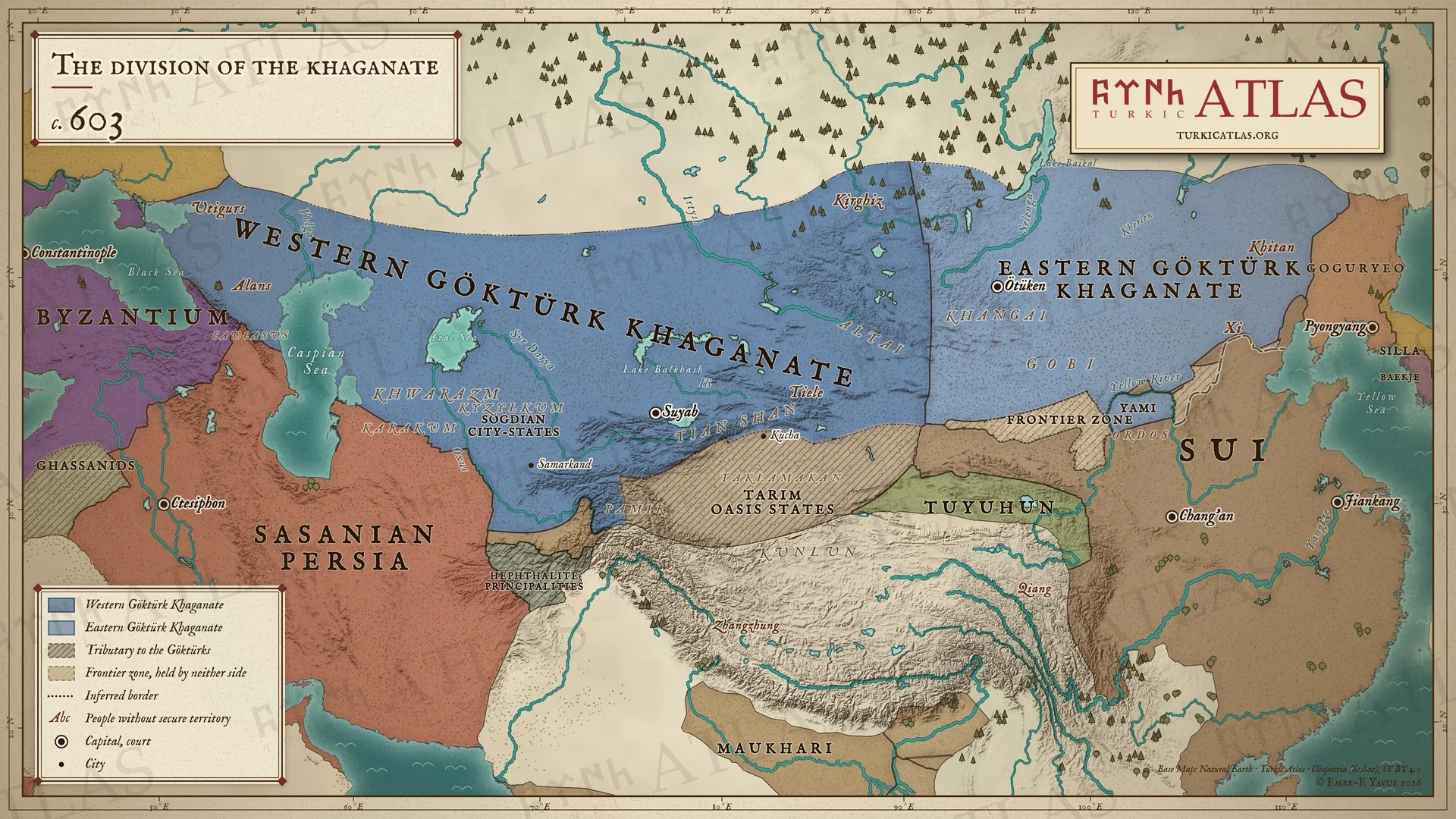
The two accounts share the end. About 603 the Tiele and other tribes rose in a massive revolt. The Sui Shu names them as the Sijie, Fuliju, Hun, Xiesa, Apa and Pugu. The Sui had instigated or encouraged the revolt. Tardush was forced to flee to the Tuyuhun and thereafter disappeared.[17] He may have died in the same year in exile in northern Tibet, which is the Tuyuhun country. His successor in the west was Heshana. From whom the later western khans descended, from Istemi through Tardush or from Apa, is a question the sources leave open.
Assessment
Modern accounts credit Tardush with great political ambitions and a pan-Eurasian scale. They also say he tried to do too much.[1] Another judgement charges him with breaking the rule of the house and with greed for power. He is counted with Ishbara, Apa and Amrak among the men who put the khaganate at risk when no foreign power had.[1] The sources show a yabgu who inherited the larger half of the Göktürk world and held it for a generation. He lost it in the year he had all of it.[1] The western khaganate that came after him was shaped throughout by the dislocations his policies caused.[1]
References
- ^ a b c d e f g h i j k l m Golden 1992
- ^ a b c d e f g Sui Shu (Book of Sui), juan 84
- ^ a b c d e f Menander Protector; Blockley 1985, fr. 19.1
- ^ a b Golden 1992, p. 131
- ^ Theophylact Simocatta; Whitby 1986, VII.8.12
- ^ a b Menander Protector; Blockley 1985, fr. 19.2
- ^ Menander Protector; Blockley 1985, fr. 25.2
- ^ Yavuz 2025, p. 321
- ^ Yavuz 2025, p. 313
- ^ a b Yavuz 2025, p. 318
- ^ Yavuz 2025, p. 325
- ^ Theophylact Simocatta; Whitby 1986, VII.7.7–8
- ^ Theophylact Simocatta; Whitby 1986, VII.7.8–8.6
- ^ Theophylact Simocatta; Whitby 1986, VII.8.8–11
- ^ Chavannes 1903, p. 249
- ^ Whitby 1988, p. 316
- ^ Sui Shu (Book of Sui), juan 84; Mau-tsai 1958, Turkish edition, p. 146
Sources
- Sui Shu (Book of Sui), juan 84
- Xin Tangshu (New Book of Tang), juan 215 (after Jiu Tangshu)
- Menander Protector
- Theophylact Simocatta
- Tabari
Literature
- Emre-E. Yavuz, The Gokturk Empire: 2nd Edition (2025)
- Peter B. Golden, An Introduction to the History of the Turkic Peoples (1992)
- R. C. Blockley, The History of Menander the Guardsman: Introductory Essay, Text, Translation, and Historiographical Notes (1985)
- Michael Whitby, Mary Whitby (trans.), The History of Theophylact Simocatta (1986)
- Michael Whitby, The Emperor Maurice and His Historian (1988)
- Édouard Chavannes, Documents sur les Tou-Kiue (Turcs) occidentaux (1903)
- Liu Mau-tsai, Çin Kaynaklarına Göre Doğu Türkleri (1958, Turkish edition)
What links here87
- Persons
- Arsilas · Awusili Irkin · Bagha Khan · Baghatur Khan · Bahram Chobin · Diqincha · Duliu · Dusuliu · Istemi · Lady Xiang · Lijicha · Niri Khan · Pei Ju · Poshi Tegin · Šāba · Shegui Khan · Silifa · Tanhan Khan · Tardu Shad · Töremen Apa · Tulan Khan · Türk-shad · Turum · Valentinos · Yami Khan · Yangsu Tegin · Yintou Tegin
- States
- Byzantium · First Göktürk Khaganate · Sui · Western Göktürk Khaganate
- Conflicts
- Göktürk Expansion along the Silk Road · Göktürk Expansion into Europe · Göktürk–Persian war, 588–589 · The Göktürk Civil War · The Göktürk–Sui wars, 582–603
- Battles & Events
- Abrui and Shir-i Kishvar · Battle of Baidao (583) · Battle of Mount Dajin (600) · Battle of Zhoupan (582) · Capture of Apa (587) · Death of Princess Dayi · Death of Tulan Khan · Edict of Emperor Wen against the Göktürks (583) · Embassy of Valentinos (576) · Fall of Heshana Khan (611) · Fall of Tardush (603) · Funeral of Istemi (576) · Göktürk Succession Crisis (581) · Maniakh's embassy to Constantinople, 568 · Revolt of Turum · Siege of Bosporos, 576 · Submission of Ishbara (585) · The Archery Match at the Wu'an Hall (599) · The Attack on Yami Khan (599) · The Göktürk–Byzantine alliance · The khan's letter to Maurice · The Siege of Jiuquan (578) · The Sui Campaign of 599 · Yang Su's Northern Campaign (601–602)
- Places
- Baidao Plain · Dali City · Dingxiang · Dujin Garrison · Heng'an · Ikar · Jiuquan · Lingzhou · Mount Dajin · Qikou · Sanmi Mountain · Shuozhou · Suyab · Yiwu
- Peoples
- Tiele
- Lineages
- Ashina
- Institutions and Titles
- Diplomacy of the Steppe Empires · Drums and Banners for the Khans · Ishbara (Title) · The Göktürk Oath · The Western and Southern Khans · Tölis and Tardush
- Religions
- Asena the She-Wolf (Gök Börü)
- Customs & Pastimes
- Göktürk Games
- Sources
- Cefu yuangui · Tariat inscription · Tongdian
Cite this article
Yavuz, Emre-E. “Tardush.” Turkic Atlas, revised 8 November 2026. https://turkicatlas.org/persons/tardush/
Last revised: 8 November 2026

