

Bumin was a member of the Turkic Ashina clan, and he became the leader who broke the subjection of his people to the Rouran Khaganate. In 552 he assumed the title of khan over a new realm in the eastern steppe.[1] He died within months of that victory.[1] The sources therefore preserve almost entirely the record of the decade before it: a raid into Chinese territory, an embassy from the Western Wei, an unlikely victory over the Tiele, a refused marriage with the Rouran and, finally, the Göktürk War of Independence.
The sources are accordingly one-sided. Almost everything known about him comes from the perspective of states that had an interest in portraying him and his people as hostile barbarians. Even so, several Old Turkic sources name him. The Kül Tegin and Bilge Khan inscriptions in the Orkhon valley, written nearly two centuries later, open their historical part with Bumin and his younger brother Istemi as the first rulers of the Göktürks. They give Istemi the same title as Bumin.[2] There the two are honoured as the men whom Tengri, the god of the Göktürks, set up to free the Ashina clan from foreign rule and, with it, to bring freedom to the Göktürks of the Altai.
A good twenty years after the Orkhon stones, Bumin’s name stands on stone once more, in the Tariat inscription of the Uyghur Khaganate. The Uyghurs had overthrown the Göktürks in 744. The stone opens with the earlier rulers of the steppe, and Bumin is among them.[3] The founder of the Uyghur order began his own stone with the founder of the Göktürk order. This may be a claim to succession and not a claim of conquest.[3]
Because the sources are so thin, many myths and claims have grown up around Bumin Khan in particular. Turkic Atlas sets out what has come down to posterity in accounts that can be tested. On that foundation it offers a reasoned reconstruction of his life and marks it as inference.
Name and titles
- 𐰉𐰆𐰢𐰣BumınOld TurkicKül Tegin inscription
- 土門ChineseZhou Shu 50
- 伊利可汗ChineseZhou Shu 50
The Chinese sources give Bumin’s name as 土門, that is, Tumen.[1] The normal form Bumın, accepted by Turkologists, is a reconstruction. It rests on the phonetic value assigned to those characters in the sixth century. That value differs between reconstruction systems, so the equation, though generally accepted among historians, is not undisputed. One edition of the inscriptions goes further and holds that the form Bumın in them is a mistake for Tumen, the form the Chinese histories give.[4]
The runiform spelling in the Kül Tegin inscription of 732 is the earliest attestation of the name in a Turkic script.[2] Written out in runes, it reads 𐰉𐰆𐰢𐰣.[5] It preserves the form current in the eighth century.
After his victory in 552, Bumin took the title written 伊利可汗 and conventionally rendered as Illig Khan.[1] The meaning of the first element is contested. The translations that modern accounts offer for it are speculation. For the years before the war, he appears without a title. Modern history books give Bumin the title yabghu. This is plausible, given the rank of earlier Ashina leaders such as his father Tuwu. The sources, however, do not use the word of him. Turkic Atlas treats khan and khagan under the titles.
Background: the Ashina Göktürks under the Rouran
The Chinese histories place the Ashina as subjects of the Rouran in the region of the Altai Mountains, between present-day Mongolia, China, Kazakhstan and Russia. They also associate this Turkic people with metalworking.[1][6] The Ashina were skilled smiths. They probably supplied their overlords and other buyers in the region with iron goods such as weapons and armour. The accounts of how and from where the Ashina came to the Altai do not fully agree. One version brings them from the region of Gaochang in the Turfan Depression, in the north-west of present-day China, after a defeat. It sets their settlement in the middle decades of the fifth century.[7] Another version has them come from Pingliang in Gansu. When the Wei emperor Taiwu destroyed the Juqu, five hundred Ashina families fled to the Rouran and lived on the Golden Mountain as ironworkers.[8] The article on the Ashina clan treats the competing versions, among them descent from the Xiongnu and the story of the she-wolf Asena.
Their position mattered more than their origin. Like many of their neighbours, these smiths were bound to serve the Rouran Khaganate. If the association with metalworking is taken at its word, they were also bound to deliver goods. Their seat in the Altai gave them access to ore. It also placed them on routes running west and south, away from the Rouran centre in present-day Mongolia. The Ashina Göktürks were accordingly involved in the trade on the northernmost fringe of the old Silk Road.
According to the Xin Tang Shu, Bumin’s father was Tuwu. The Zhou Shu names no father.[9] Tuwu appears to have died in 542. Bumin, the elder of two sons, then took over the leadership of the clan.
Date of birth
This encyclopedia places Bumin’s birth in the years 510 to 515. That makes him a good thirty to thirty-five years old at the time of the Western Wei embassy, and thirty-seven to forty-two at his death.
This reconstruction rests on three assumptions. His first recorded act falls in 542 and presupposes that he was an adult by then. His brother Istemi is regarded as clearly the younger of the two. Istemi outlived Bumin by more than two decades. That sets a lower bound for Bumin’s age, unless Istemi is assumed to have been implausibly old at his own death. The interval between the brothers must be wide enough to account for the difference in how they are described. It must also be narrow enough for them to have acted together throughout the 540s. A birth around 500 is sometimes encountered. It would make Bumin older than fifty during the Tiele campaign, and it rests on rounding rather than on any of these conditions. A birth as early as 489 circulates above all in Turkish-language media. It moves him still further from a realistic age. Bumin was a man of drive, and his patient planning overwhelmed his opponents within a very short time. This too speaks for a year of birth in the early 510s.
Bumin Khan would thus have been thirty-seven to forty-two years old at his death.
Succession to Tuwu (542)
Bumin succeeded to his father’s office and to his father’s title. Tuwu had borne the yabgu title, 大葉護, Great Yabgu, the style of the Ashina chief under the Rouran. From 542 Bumin bore it. He was raised to it at a toy of the inner circle of the clan in the Altai.[10] He was yabgu for ten years and khan for one.[11]
With the succession of Bumin, the clan’s external posture changed. Under Tuwu the Ashina appear in the sources as Rouran subjects. The winter raids on the Wei frontier that the Zhou Shu reports for the years before 542 fall in his time.[12] From 542 they act on their own account. They receive and return embassies directly, and they intervene in a conflict between the Rouran and the Tiele on terms of their own choosing. The sequence of Bumin’s recorded actions is consistent throughout with a deliberate loosening of the Rouran connection rather than with a series of improvisations.
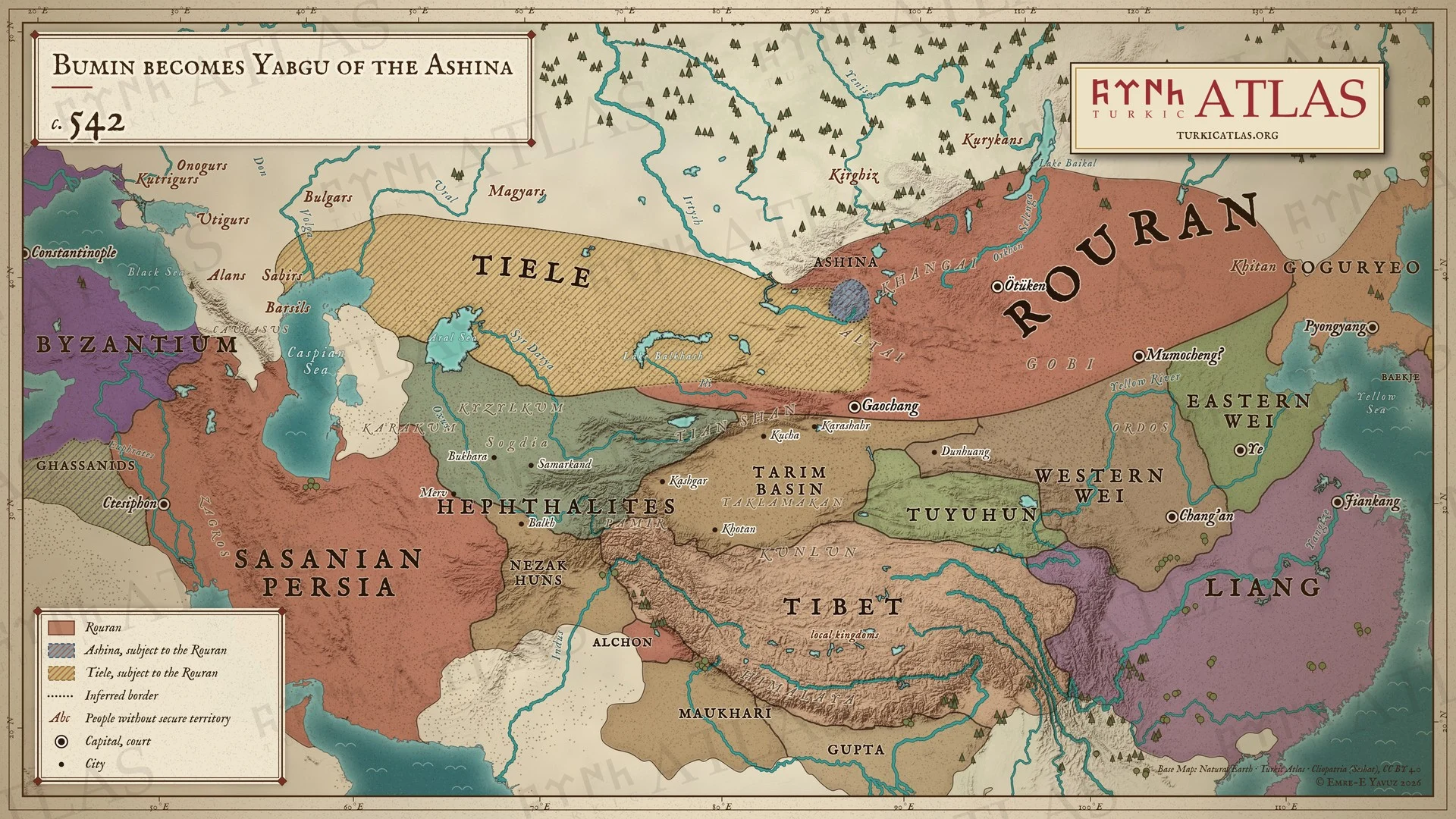
Raid of 542
Every year, once the river had frozen, Göktürk horsemen crossed it on the southern edge of the Rouran Khaganate to raid Western Wei territory. The villagers were sent into the walled forts ahead of them.[12] In 542 the new acting governor, Yuwen Ce, let them stay in their homes. He had firewood piled at several hundred places along the main roads, and he sent his scouts far out.[12] In the twelfth month of that year, hundreds if not thousands of Göktürk horsemen came in by Liangu, some tens of li from the border. All the piles were fired at once. The Göktürks took this for the approach of a large army. They fled in disorder and trampled one another. They left behind more livestock and baggage than could be counted. Yuwen Ce gathered it and gave it out to the people.[12] From then on the Göktürks did not dare to come again. Yuwen Ce asked for a garrison on the frontier.[12]
The Chinese book Zhoushu (Book of the Zhou Dynasty) names no Göktürk commander. The raid is attributed to Bumin because he led the Ashina from 542. It was not the first: the same chapter says the Göktürks had come every winter before.[12] What was new in 542 was the Wei defence.
The raid failed without a battle and cost the Göktürks their livestock and baggage.[12] Three years later the Wei sought them out with an embassy.[1]
Political situation of the 540s
The situation Bumin moved into was unusually favourable. Northern China was divided. The Western Wei and the Eastern Wei were rival successor states, and each had reason to seek allies against the other and against the Rouran.[1] The Rouran under Anagui had held the steppe for decades. Relations with the Hephthalites to the southwest had cooled, however. This left Anagui without an external counterweight at the moment his subjects became restive. The Tiele were preparing a further revolt.
Bumin had made none of this. What the sources show is a leader positioned to take advantage of it. He was close enough to the Tiele to learn their plans. He was close enough to the Wei frontier to be worth an embassy. He was far enough from the Rouran centre to act before being called to account. The stars had aligned for the leader of the Ashina Göktürks.
Western Wei embassy (545)
The Zhou Shu introduces Tumen with a purchase. When his tribe had grown stronger, his people came to the frontier to buy silk and wished to open relations with China.[1] The text gives no year. Its next sentence is the embassy of 545.[1] In 545 the Western Wei chancellor Yuwen Tai sent a mission to the Göktürks under An Nuopantuo, a Sogdian.[1] The young Göktürks received it with open satisfaction at being approached by a great state.[1] In the following year Bumin sent an embassy of his own in return, with gifts.[1]
The choice of a Sogdian intermediary reflects the position that Sogdian merchants held on the routes between China and the steppe. The name behind the transcription 安諾槃陀 has been identified as the Sogdian Anāhitā-banda, servant of Anāhitā.[13]
The exchange gave the Ashina direct access to Chinese goods, silk above all, without the intermediaries who had stood between them and the south. It gave them something less tangible as well. A Chinese state addressed them as a party in its own right, rather than as a component of the Rouran realm. This is the first sign in the sources that the Ashina were regarded from outside as an independent actor.
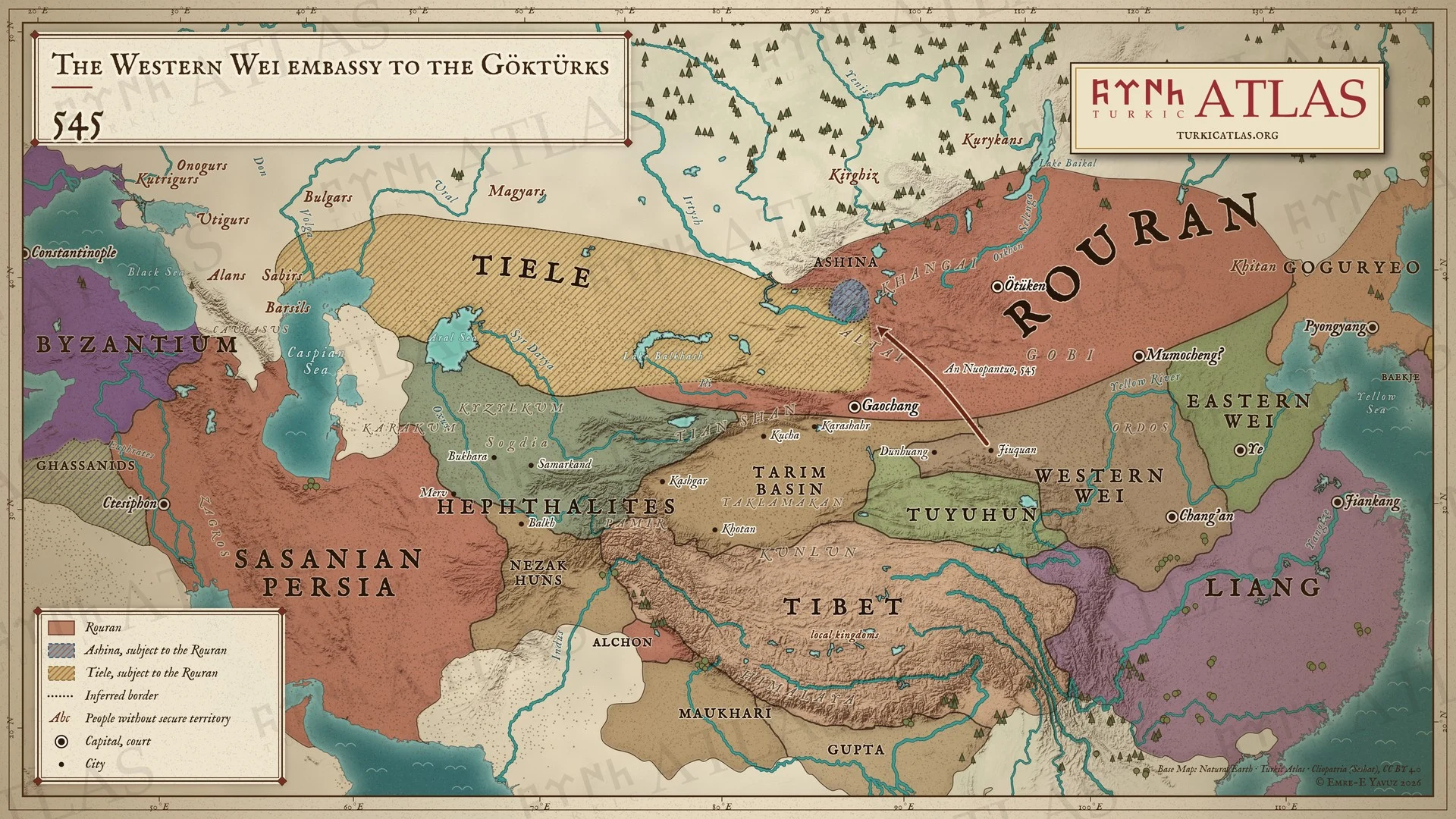
Tiele campaign (546)
In 546 the Turkic Tiele, who lived west of the Altai across modern-day Kazakhstan, moved against the Rouran. Their constituent groups were dispersed across a wide belt of the steppe. They had to assemble before they could strike. The Ashina lay close enough to learn of the plan. Bumin intercepted them on the march and defeated them. More than fifty thousand Tiele submitted to him.[1] The figure counts households or tents. Conversions into a total population are modern extrapolations that vary by a factor of five. It could be that up to 250.000 Tiele people came under rule of the Ashina.
Bumin took no Tiele territory. The tribal leaders submitted to him personally. Their followings were simply added to his own. The campaign transformed his standing without altering his formal rank. He had put down a rebellion against his overlord unasked. He had spared the Rouran the cost of doing it themselves. He had kept the participants as his own.
Marriage request and break with the Rouran
For this, Bumin sent to Anagui to ask for a Rouran princess. The Zhoushu records the refusal in direct speech: Anagui called him his blacksmith slave and asked how he dared speak so.[1][14] Bumin killed the envoy who brought Anagui’s answer. He broke off relations.[1]
Marriage into the ruling house would have given Bumin a claim on the Rouran succession. This is the usual explanation for both the request and the vehemence of the refusal. The insult itself can be understood as a statement about the Ashina’s occupation, as a statement about their political subordination, or as both at once. Elsewhere the Zhoushu associates the Ashina with metalworking. This lends the first interpretation some support.[1]
Killing an envoy allowed no retraction. Whatever the request had been intended to achieve, the response closed the matter. It made war inevitable.
Preparations (547–550)
Bumin spent the years after the break assembling support among other Turkic groups. This is an inference from the size of the force he commanded in 552. The sources do not say how that support was obtained or which groups joined.
Western Wei marriage (551)
Suddenly, in 551, Bumin married a princess of the Western Wei ruling house. The Zhoushu names her as Changle.[1] Her parentage is disputed. She does not appear among the daughters of either emperor reigning that year. Yuwen Tai, now chancellor of the Western Wei, secured the alliance. He was the same man who had agreed to a trade deal in 546.[1] The marriage served both parties. It secured Bumin’s Ashina against a Rouran response. It also gave the Western Wei a threat in the Rouran rear. Marriage between a Chinese court and a steppe leader was an established instrument of frontier policy. Its use in 551 says as much about Wei calculation as about Bumin’s standing.
War of 552
By this time, the Ashina Göktürks and the Rouran were in a state of undeclared war. The situation escalated in early 552 with two engagements. The first took place in January in the Dzungarian region where the Tiele dwelled. The second took place north of Huaihuang.[15] The Chinese histories record only the second and date it to the first month of the year, which ran from 11 February to 10 March. By early March 552 at the latest, the war reached its culmination.[1] After the second defeat, Bumin and his Göktürk (and Tiele) troops were marching on Mumocheng, the then-capital of the Rouran. Either before or after his arrival, Anagui took his own life. A direct confrontation between Bumin and Anagui seems likely, yet is not attested. Following Anagui’s death, the Rouran nobility, including his sons, scattered. Part of it went south into the Northern Qi, and part went west across the steppe.[1] Bumin then entered the holy Ötüken forest, the center of the steppe imperial tradition. After that, he assumed the title Illig Khan.[16]
Doubt has been raised about Anagui’s suicide. The grounds are that no comparable case is recorded for a steppe ruler of the period and that a defeated ruler was more usually killed by his own court. Some modern accounts add that Bumin had a drinking cup made from Anagui’s skull.[17][6] The Chinese histories record no such cup.
Foundation of the khaganate
Bumin did not dismantle the Rouran state. The structures of the khaganate passed to him largely intact, with a different ruling lineage at the head. The centre of the new polity lay not at the Altai Mountains but in the Ötüken region, as the Rouran centre had.[1]
Later material attests Tengri worship for the Göktürks as a group.[2] It is likely that Bumin consciously combined inherited Rouran institutions with Turkic customary law and with Tengri worship.
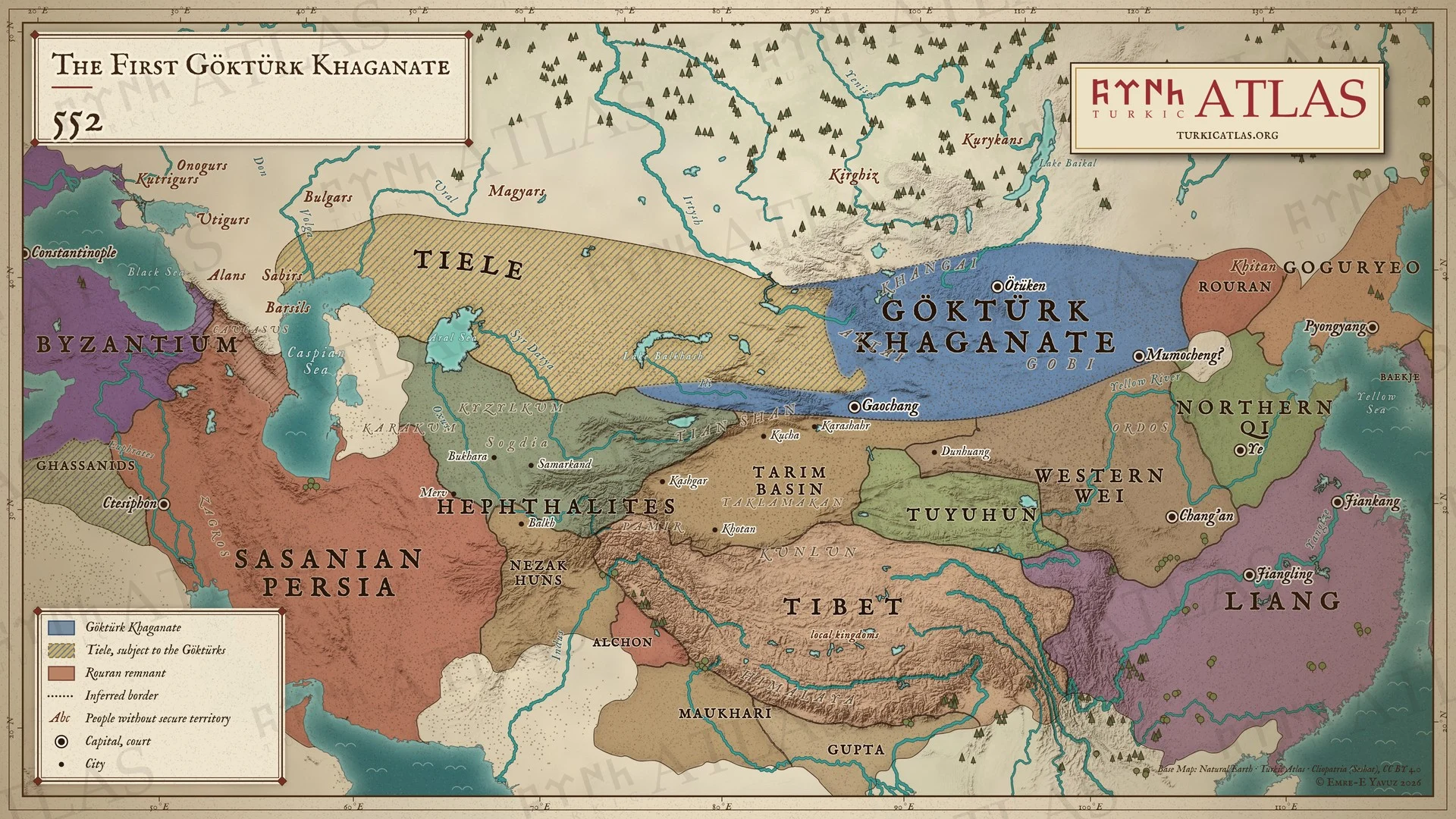
Death and succession
Bumin died in 552, within the same year as his victory. The Zhou Shu tells of his death directly after the proclamation and gives no year.[1] The Zizhi tongjian enters the death at the beginning of 553, before the third month.[18] That entry may be the place where the annalist put an undated event. The same passage runs on through the whole reign of Bumin’s son Issik to the accession of Mukan, which cannot have fallen within the span of one date. The Zhou Shu, moreover, follows the victory with the death at once. Bumin would then have died in 552.[19] The manner and month of his death are not recorded.
His son Issik Khan succeeded him. Mukan Khan and Taspar Khan came after Issik.[1] His brother Istemi controlled the western wing. He did not contest the succession.[1] Whether this arrangement amounted to a division of the polity at Bumin’s death, or was a standing structure that only became visible afterwards, remains disputed. The division may fall in 552 itself.[20]
Istemi and the western wing
The Turkic tradition ranks Istemi beside his brother rather than beneath him. The Kül Tegin inscription opens its historical section by naming Bumin Khan and Istemi Khan together as the ancestors who took the throne over the Göktürks. It accords Istemi the same title it gives Bumin.[2] The Chinese histories describe the arrangement differently. They style Istemi yabghu and treat the western command as a subordinate office of the eastern court.[21]
Istemi carried the new polity west. Over the following two decades, the territory he brought under Ashina control far exceeded what Bumin had held. Acting in concert with the Sasanian king Khosrow I, he destroyed the Hephthalite realm around 560 and divided its lands along the Oxus. This carried the Göktürks to the frontier of Iran and gave them the trade of Sogdiana.[21] The Sasanians then closed the overland silk route to Sogdian merchants. Istemi turned to the other end of it. In 568 he sent the Sogdian Maniakh to Constantinople. The embassy of Zemarchos travelled to his camp in return. This opened direct relations between the Göktürks and Byzantium.[22] By his death in 576 the western wing reached the Volga and the northern Caucasus.
This westward extension roughly doubled the reach of the polity Bumin had founded. It is what the Kül Tegin inscription means when it sets the limit of Göktürk rule at the Iron Gate. It also established the western command as a standing institution. This institution outlasted the eastern court and became the Western Göktürk Khaganate.
Legacy
The Kül Tegin inscription, carved in 732, opens its historical section with Bumin and Istemi as the first rulers of the Göktürks. It credits Bumin with establishing order over the people between the Kadırkan forest and the Iron Gate.[2] This is the earliest surviving Turkic-language statement about him. It postdates his death by almost two centuries.
The inscription is a monument of the Second Göktürk Khaganate. It presents Bumin as the founder of a continuous political tradition. This presentation served the purposes of the eighth century. Later claims about his place in the history of Turkic peoples generally belong to the historiography of the modern period. Turkic Atlas treats them under that debate.
Sources and their dependence
Bumin’s history rests on a narrow and partly interdependent body of texts. The dependencies matter for how much weight the agreement between them can bear.
Zhoushu 50 is the principal account and the earliest, compiled in 636. Suishu 84 covers the same material for the later period. Beishi 99, completed in 659, draws substantially on both. It is not an independent witness. Zizhi tongjian 164 compiles from all three in the eleventh century. Where three or four of these texts report the same thing, that constitutes one line of transmission, not three.
Zhoushu 27, the biography of Yuwen Ce, stands apart from the Göktürk chapters. It records the raid of 542 from the side of the Wei frontier governor.
The Old Turkic inscriptions are the only non-Chinese sources for Bumin himself: the Kül Tegin and Bilge Khan stones and, a generation later, the Uyghur Tariat inscription. They belong to a different genre and a different century. They are commemorative monuments rather than chronicles. They are evidence for eighth-century memory.
References
- ^ a b c d e f g h i j k l m n o p q r s t u v w x y z aa ab Zhou Shu (Book of Zhou), juan 50
- ^ a b c d e Kül Tegin inscription
- ^ a b Saadettin 1995, p. 76
- ^ Tekin o. J., p. 9
- ^ Kül Tegin inscription; Tekin o. J., p. 38, 62
- ^ a b Ögel 1978, p. 101
- ^ Bei Shi (History of the Northern Dynasties), juan 99
- ^ Sui Shu (Book of Sui), juan 84; Bei Shi (History of the Northern Dynasties), juan 99
- ^ Xin Tangshu (New Book of Tang), juan 215
- ^ Sui Shu (Book of Sui), juan 84; Xin Tangshu (New Book of Tang), juan 215
- ^ Zhou Shu (Book of Zhou), juan 50; Sui Shu (Book of Sui), juan 84
- ^ a b c d e f g Zhou Shu (Book of Zhou), juan 27
- ^ de la Vaissière 2005a, p. 205
- ^ Jagchid 1989, p. 146
- ^ Yavuz 2025, p. 225
- ^ Yavuz 2025, p. 227
- ^ Ögel 2015, p. 251
- ^ Zizhi tongjian (Comprehensive Mirror in Aid of Governance), juan 165
- ^ Ecsedy 1968, p. 155
- ^ von Gabain 2025, p. 109
- ^ a b Sui Shu (Book of Sui), juan 84
- ^ Menander Protector
Sources
- Zhou Shu (Book of Zhou), juan 27, 50
- Sui Shu (Book of Sui), juan 84
- Bei Shi (History of the Northern Dynasties), juan 99 (after Wei Shu, Zhou Shu and Sui Shu)
- Zizhi tongjian (Comprehensive Mirror in Aid of Governance), juan 164, 165 (after Wei Shu, Zhou Shu, Sui Shu and Bei Shi)
- Kül Tegin inscription
- Menander Protector
- Xin Tangshu (New Book of Tang), juan 215 (after Jiu Tangshu)
Literature
- Gömeç, Saadettin, Terhin Yazıtı'nın Tarihi Açıdan Değerlendirilmesi (1995)
- Étienne de la Vaissière, Sogdian Traders: A History (2005)
- Liu Mau-tsai, Die chinesischen Nachrichten zur Geschichte der Ost-Türken (T'u-küe) (1958)
- Peter B. Golden, An Introduction to the History of the Turkic Peoples (1992)
- S. G. Klyashtorny, The Royal Clan of the Turks and the Problem of Early Turkic-Iranian Contacts (1994)
- Sören Stark, Türk Khaganate – Ethnogenesis (2016)
- Ahmet Taşağıl, Gök-Türkler, Bd. III (2004)
- Emre-E. Yavuz, The Gokturk Empire: 2nd Edition (2025)
- Annemarie von Gabain, Eski Türk Edebiyatı (2025)
- Ildikó Ecsedy, Trade-and-War Relations between the Turks and China in the Second Half of the Sixth Century (1968)
- Talât Tekin, Orhon Yazıtları. Kül Tigin, Bilge Kağan, Tunyukuk (o. J.)
- Sechin Jagchid; Van Jay Symons, Peace, War, and Trade Along the Great Wall. Nomadic-Chinese Interaction through Two Millennia (1989)
- Bahaeddin Ögel, Türk Kültür Tarihine Giriş III: Türklerde ev kültürü (1978)
- Bahaeddin Ögel, Büyük Hun İmparatorluğu Tarihi I (2015)
What links here80
- Persons
- Afuzhiluo · An Nuopantuo · Anagui · Axian Shad · Bilge Khan · Ilterish Khan · Ishbara Khan · Issik Khan · Istemi · Mukan Khan · Nadulu Shad · Princess Changle · Taspar Khan · Tuwu
- Conflicts
- Gaoche secession (487) · Hegemony Wars in Northern China · Rouran Domination of the Turkic Peoples · The Göktürk–Rouran Wars · The Turkic War of Independence
- Battles & Events
- Battle of Dzungaria, 552 · Battle of Huaihuang, 552 · Battle of Mount Mulai (553) · Defeat of the Tiele, 546 · Göktürk raid of 542 · Proclamation of Bumin Khan (552) · Rise of Anagui Khan · The Flight of the Ashina (439) · The Göktürk–Wei alliance · The Rouran Marriage Refusal (546) · Western Wei embassy of 545
- Peoples
- Hephthalites · History of the Turkic peoples · Kurykan · Sogdians · The Great Empires of the Steppe · Tiele
- Institutions and Titles
- Border Markets · Buyruk · Diplomacy of the Steppe Empires · Envoys and Embassies · Göktürk Ironworking · Illig · Khan (Khagan) · Kut · Raw Materials and Trade among the Turkic Peoples · Silk in the Steppe · The Economy of the Steppe Empires · Töre · Toy · Women among the Turkic Peoples · Yabgu
- Religions
- Asena the She-Wolf (Gök Börü) · Tengri · Tengrism
- Foods
- Ayran
- Sources
- Bilge Khan inscription · Han Shu · Kül Tegin inscription · Old Tibetan report on the northern kings · Ongi inscription · Tariat inscription · Tongdian · Zhou Shu (Book of Zhou)
- Controversies
- The Göktürks and the Xiongnu · The origin of the title Khan
Cite this article
Yavuz, Emre-E. “Bumin Khan.” Turkic Atlas, revised 8 November 2026. https://turkicatlas.org/persons/bumin-khan/
Last revised: 8 November 2026

