
- 400
- 500
- 600
- 700
- 800
- 900
- Rouran 400–554
- First Göktürk 552–630
- Tang rule 630–682
- Second Göktürk 682–744
- Uyghur 744–840
- Kirghiz 840–924
- Huns 370–469
- Western Göktürk 552–659
- Türgesh 699–766
- Karluk 766–800
- Khazar 650–969
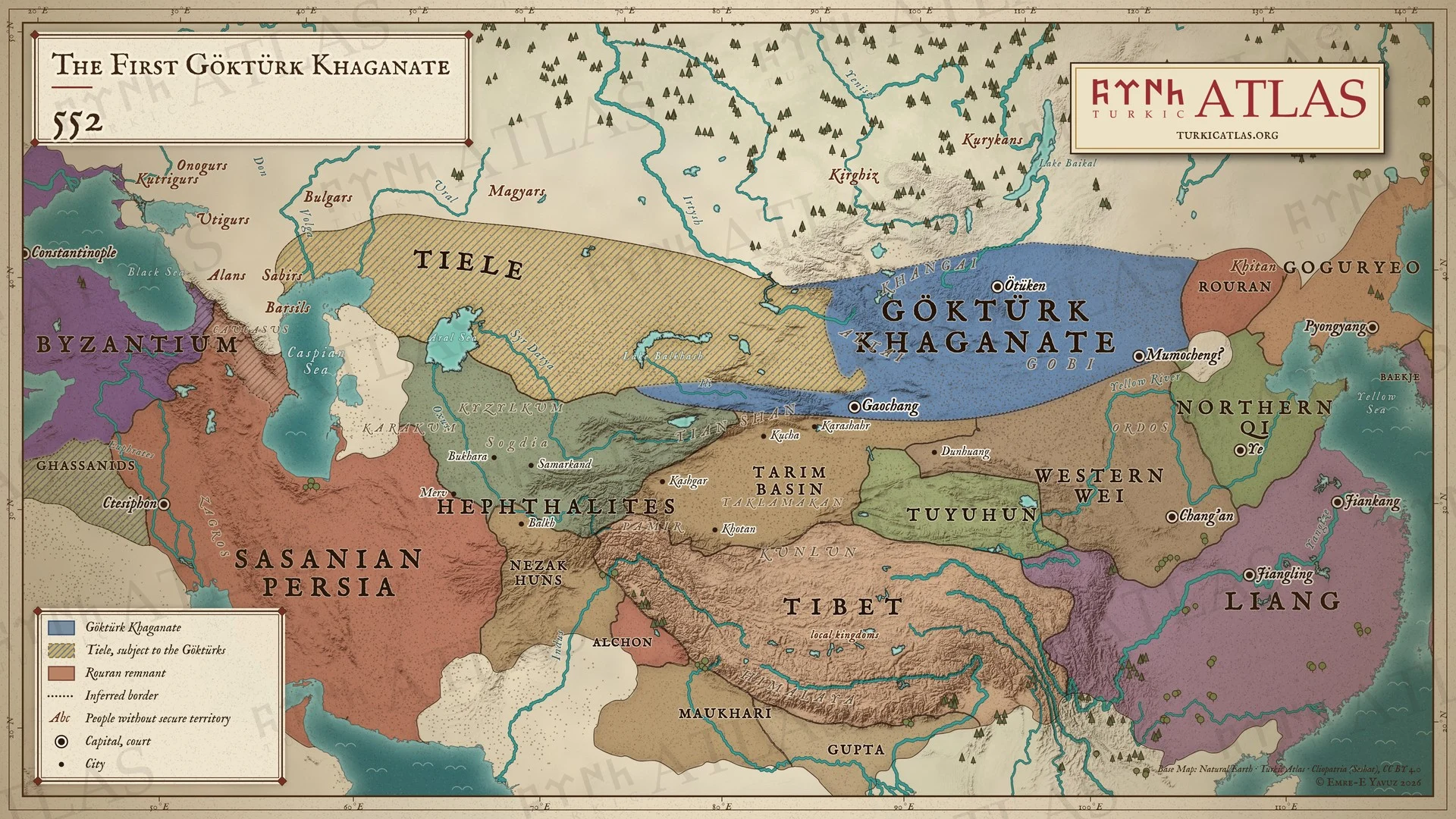
The First Göktürk Khaganate was the empire of the Ashina dynasty. It brought much of the Eurasian steppe, from Mongolia to the Black Sea, under one rule. It made the name Türk an enduring presence in Eurasian political history. Bumin founded it in 552, after his victory over the Rouran. From its centre at Ötüken, it grew into an empire that reached Central Asia and the approaches to Iran and Byzantium. Its conquests brought steppe armies and the trading cities of Sogdiana into one imperial order. They also gave its rulers a stake in the silk that moved between China and the western markets. Sogdian merchants served it as diplomats and opened direct relations with Constantinople. The Bugut monument, set up for the dynasty, is written in Sogdian, an Iranian language. War, trade and the exchange between them made the khaganate a major power in the politics that connected China, Iran and Byzantium.
The empire was governed through eastern and western wings held by members of the ruling house. This arrangement enabled expansion, but it also created competing centres of power. Succession struggles and civil war in the late sixth century weakened the empire’s unity. As a result, the wings developed into separate eastern and western khaganates. The eastern khaganate fell to the Tang in 630, and the western followed in the 650s. In 682, a second Göktürk khaganate restored independent dynastic rule in Mongolia. It claimed the inheritance of the first.
Name
- 𐱅𐰇𐰼𐰜: 𐰉𐰆𐰑𐰣𐱅𐰇𐰼𐰜: 𐰃𐰠türk el, türk bodunkök türkTürük ElOld TurkicKül Tegin inscription · Tonyukuk inscription
- 突厥ChineseZhou Shu 50
- Göktürk KhaganateEnglish
“First Göktürk Khaganate” is the modern name that distinguishes Bumin’s empire from the second khaganate established in 682. The eighth-century inscriptions that recall its founders call the people Türk or Türük and their realm el. The expression türk bodun means “the Türk people”. The word el describes the realm or political order rather than supplying a distinctive state name.[1] Chinese histories call the people Tujue and use the same designation for their polity.[2]
The modern form Göktürk derives from kök türk, an expression found in the Kül Tegin inscription in a passage that describes the ancestral realm between the Kadırkan forest and the Iron Gate.[1] It is often translated as “Celestial Türks”. The significance of kök in this passage remains disputed. Göktürk is therefore a conventional historical label. The names Türk and Türük are the forms of the sources.
Foundation
The Zhou Shu places the origin of the Göktürks among the Xiongnu. They were, it says, probably a separate branch of the Xiongnu, with the surname Ashina, and they formed a tribe of their own.[2][3] One survey adds that the factual evidence on their origin is very limited.[4]
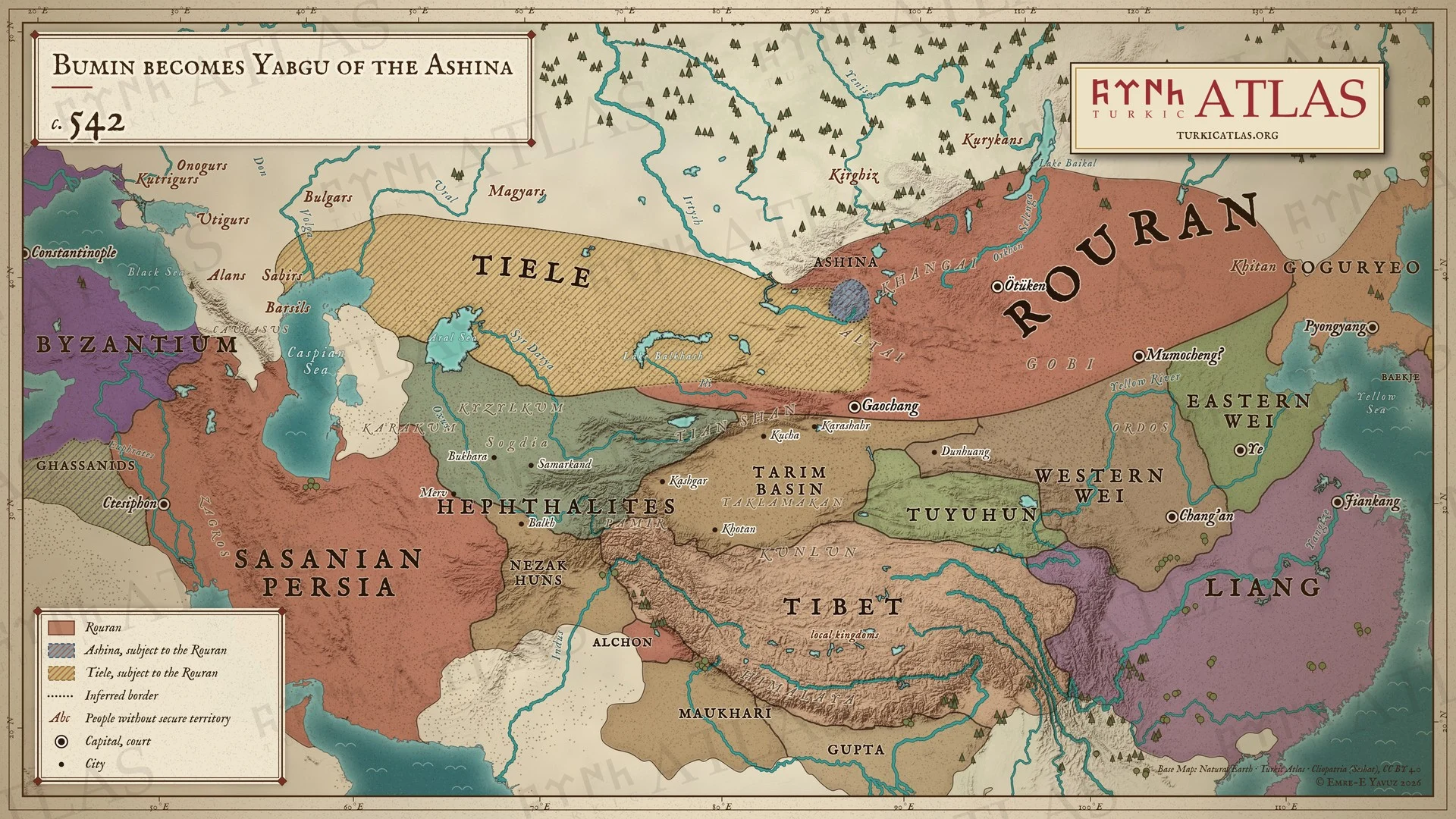
The Göktürk rise began within the political world of the Rouran. In 546, Bumin suppressed a Tiele uprising against Rouran rule and strengthened his own position.[2] He then asked to marry a Rouran princess. The khan Anagui rejected the request, and the relationship turned to open conflict.[2] Bumin’s victory in 552 made his house the new imperial power of the steppe.[2] It closed the war of independence of 546 to 552.
The Göktürks built their empire on foundations laid by the Rouran. They adopted the title of khan and asserted their own claim to supremacy across the steppe.[5] This was a change of ruling dynasty. It also involved continuity in the institutions and traditions through which steppe rulers exercised power.[5] The Ashina may have been hardly distinguishable from the rest of the Rouran realm in language or descent. Their one particular trait would then be their craft, the working of iron, which may have given them a hold on the making of arms.[6] Once they ruled, they appear to have left part of the smithing to the Kirghiz, who delivered arms of good iron to them.[7]
At its founding, the khaganate extended from eastern Mongolia through the Altai to Lake Alaköl. The Tiele groups that Bumin had brought under his rule in 546 formed an important part of this new political order. Yet the collapse of Rouran power did not give the Göktürks control over all its former dependencies. The Kirghiz to the north, the Khitan to the east and surviving Rouran groups to the south remained beyond their effective authority. Campaigns during the following decade sought to extend Göktürk rule over them.
Government and structure
The khaganate developed an eastern and a western wing. The origins of this arrangement remain disputed. After Bumin’s death, his son Issik succeeded him at Ötüken.[8] The Xin Tang Shu places Bumin’s younger brother Istemi at the head of the western line.[9] Istemi is sometimes described as a yabgu subordinate to the eastern ruler.[10] The later Göktürk inscriptions, by contrast, remember Bumin and Istemi together as khans and founders of the realm.[1] These accounts leave open whether Bumin established the two wings or whether they took shape after his death. Some scholars favour the first view: Bumin entrusted western expansion to his brother while retaining authority in the east, and Istemi held the rank of Sır Yabgu as the second man in the state.[11] The division between their spheres of authority is reconstructed as running from the Altai through Dzungaria to the Dzungarian Gate. A different count has four commands and not two. These were the Central Region, under the Great Khan and holding the sacred forest of Ötüken; the Eastern and the Western Regions; and the Western Frontier Region, which was Istemi’s.[12] This count rests on the four rulers of whom Menander writes and on the four regions of the Chinese annals.[12]
Power within the two wings rested with members of the Ashina dynasty and other leading families. Dynastic princes bore the title tegin. The shads exercised military authority over a wing or a subject population. Eltebers governed subordinate peoples as tributary rulers. Tarkhans, buyruks and begs also held positions within the ruling elite. These titles should not be understood as a single, fixed ladder of offices. The Kül Tegin inscription associates the appointment of yabgus and shads with the organisation of the Tölis and the Tardush, the two wings of the realm.[1] Under Taspar, further members of the dynasty held regional commands with the title khan. His nephew Ishbara held the command in the east as Erfu Khan. In the west, a son of his brother Rudan Khan held it as Buli Khan.[8] Administration and diplomacy also drew on people outside this dynastic elite. Sogdians established at Ötüken and in the Altai during the 550s served the khan in administrative and diplomatic roles. Sogdian writing contributed to the development of written government in the west.
Further studies address the character of the state. One typology sorts nomadic states by what the conquerors made of the conquered. A state of the first type took tribute and left the settled lands as they were. A state of the second type joined nomads and farmers in one order. A state of the third type rested on a division of labour between herdsmen and peasants. On this reckoning the Xiongnu and the Göktürks belonged to the first type.[13] The same account sets the Göktürk aristocracy between its predecessors, the Xiongnu, and its distant successors, the Mongols, in the aim of building farming and craft sectors in its own realm.[14] It notes that the inscriptions use the word Türk also for the subjugated units that the khaganate tried to bring into its military and political organisation.[15] It states that the Göktürks encouraged large Sogdian colonies on their territory, which farmed, made crafts and traded, and even founded towns.[14] For the Sogdians, it adds, Göktürk power was no great burden, because its strength guaranteed safe passage along the trade routes.[16] The Chinese counted the Göktürks by tents and not by families, and they distinguished tribe, clan and tent.[17]
The inscriptions describe successful rule as the preservation of both the realm and its törü, the customary political and legal order.[1] They present the khan’s authority as sanctioned by Heaven and sustained by Kut. They also make the conduct of the begs and the people central to the survival of the state.[1] Sacred authority thus stood beside a practical need. The khan had to keep the support of the ruling elite. He had to keep it within the customary law and before an assembly that could withdraw it. The religion sanctioned both.
The mountain-forest Ötüken, in the wooded uplands of the Orkhon region, was the eastern centre of rule. The later inscriptions give it a sacred and political significance. They present possession of Ötüken as essential to holding the realm.[1] Chinese accounts describe the khan leading the nobility in an annual sacrifice at the ancestral cave. They also describe a sacrifice to Heaven that he held beside a river in the fifth month.[2] In the west, Istemi’s centre of power is placed in the Altai. From about 576, the western seat is placed at Suyab on the Chu. Suyab has been identified with Ordukent, “city of the army”.
Founding generation (552–572)
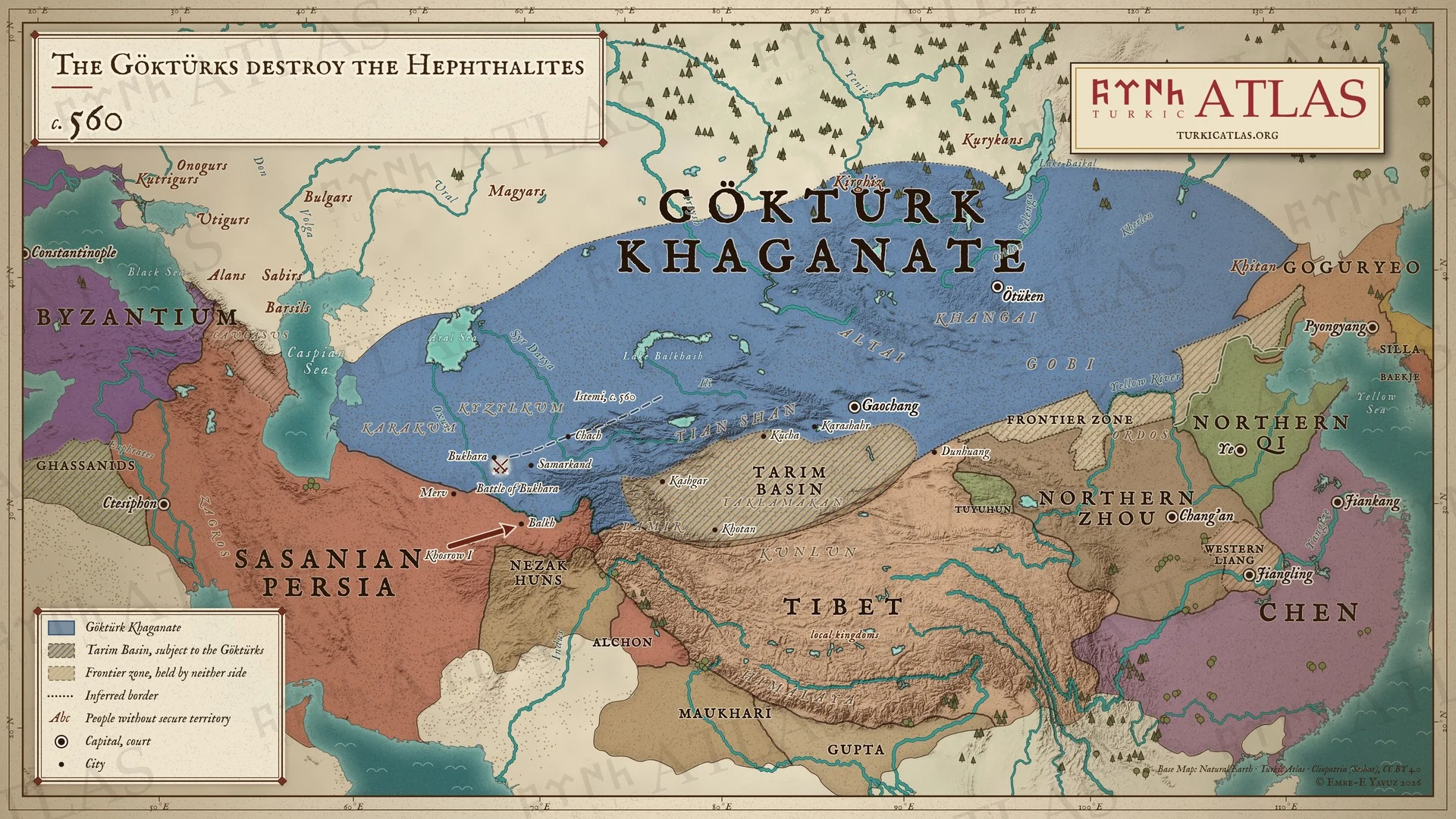
Bumin died in 552. His son Issik reigned only briefly. He reigned long enough, however, to break Dengshuzi’s Rouran at Mount Mulai, north of Woye on the edge of the Ordos.[2] The Rouran remnant in the Northern Qi destroyed itself against its hosts. The last Göktürk victory over it is dated to January 554. Mukan, Issik’s brother, reigned from 553 to 572. He took the Kirghiz on the Yenisei and the Khitan in the east.[2] With these campaigns, which have been dated between 554 and 560, the eastern wing reached the Khingan. The gold of the Yenisei flowed to Ötüken. Istemi, meanwhile, marched west in 553. He reached the Seven Rivers by 555 and took the Tarim through the Dzungarian Gate.[18] He destroyed the Hephthalites and took the trade of Sogdiana.[19] He may have done so in concert with the Sasanian king Khosrow I at Bukhara in 557 or 560, dividing their lands along the Oxus.[20] A different chronology puts the Persian opportunity in the years 563 to 567, with the lands north of the Oxus passing to the Göktürks only after 567.[21] In 568, when Persia shut its markets, he sent the Sogdian Maniakh to Constantinople. In return, he received the embassy of Zemarchos.[19] By his death in 576, the western wing reached the Volga and the northern Caucasus. In the year of his death, its army took Bosporos in the Crimea, the western limit of the Göktürk expansion into Europe.[19]
The Chinese alliance held throughout. The Western Wei that had given Bumin a princess gave way to the Northern Zhou. In the twelfth month of the seventh year of the Qi era Tianbao, January 557, Yuwen Jue received the abdication of the last Wei emperor.[22] The alliance passed with it. In 563 and 564, a Göktürk and Zhou army attacked Taiyuan in Northern Qi territory. Mukan’s daughter, Empress Ashina, married the Zhou emperor.[2] The Qi had sheltered the Rouran. They built a wall against the Göktürks and got no help from it.
Taspar (572–581)
Taspar, the youngest brother, reigned from 572 to 581 over the khaganate at its greatest extent. He called the two Chinese emperors his sons.[2] He set lesser khans over the east and west of his domain.[8] When the Zhou conquered the Qi in 577, he took up the Qi resistance in secret. He sheltered the Qi prince Gao Shaoyi and raided the Zhou in 578. In 580, he surrendered Shaoyi for a Zhou princess and a peace.[23] Under him, a Chinese monk converted the khan to Buddhism. The Göktürks did not follow. The Bugut inscription, the earliest monument of the khaganate, was set up about 584 in Sogdian script and is held to have been made for Taspar.[24] The years 552 to 581 can be counted as thirty years without a recorded rising of subject peoples, economic crisis or social conflict.
Succession war and division (581–603)
Taspar’s death opened the crisis. He had wished the throne to go to Mukan’s son Töremen.[8] The assembly at Ötüken, under the threat of revolt from the lesser khan Ishbara, chose Taspar’s son Amrak instead. Amrak abdicated within the year in Ishbara’s favour.[8] Töremen, as Apa Khan, went to war against Ishbara. Istemi’s son Tardush, yabgu in the west since 576, took Töremen’s side.[8] At the same moment, the Zhou fell to their general Yang Jian. He founded the Sui in 581 and, as emperor of a united northern China, declined to defer to the khan.[8]
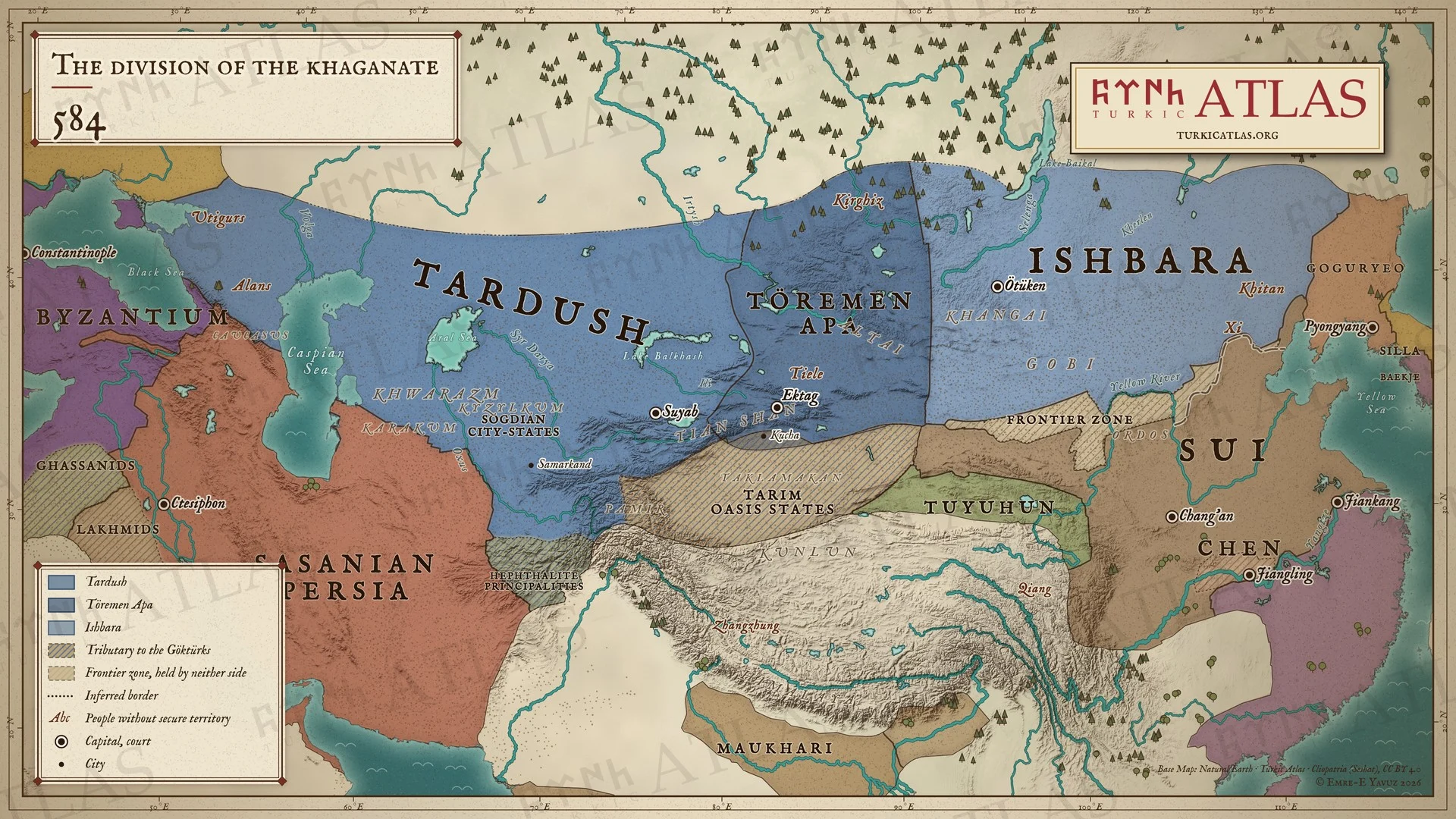
In 583, Ishbara, Apa, Tardush and Ishbara’s brother Bagha invaded China together. For the first time, they held a broad strip of the north. A Tiele rising in the west drew Tardush off. A Sui surprise attack in June 583 near Baidao broke the Göktürk army. Disease followed the retreat. Chinese agents set the commanders against each other, and Ishbara drove Apa west into Tardush’s arms. The civil war can be dated from 584, and its cause found in four princes raised to rule who could not all rule, and in the Sui, who fought the Göktürks with agents rather than soldiers and worked every division. Ishbara was isolated, with perhaps thirty or forty thousand men against Tardush’s hundred thousand. He submitted to the Sui emperor in return for protection.[8] Sui policy may have aimed at the survival of both khaganates. The eastern one was to be weakened enough to need Chinese support, and so to serve as a buffer against the strong western one.[25] In September 585, the western army marched on Ötüken, and Ishbara fled to China.[8] Ishbara died in 587. His brother Bagha, khan by his will, took Apa alive.[8] The state was now two.
Bagha’s successor Tulan tried to restore the khaganate’s independence of China and was killed by his own followers in 599.[8] Ishbara’s son Yami had gone over to the Sui before that and had been given a Chinese princess and the title of khan. After Tardush’s fall, he marched into Ötüken with Sui troops.[8] Tardush had tried to take the whole state after 587. A Tiele rising drove him into exile, and he died in 603.[8] 603 is regarded as the final division of the realm into two. In the west, the same years brought the first great Göktürk–Persian war. In 588, Bagha crossed the Oxus and took Balkh and Herat. He may have been beaten by Bahram Chobin at the Hyrcanian rock in April 588 and killed on the Oxus.[26] The Persian epic gives the fullest account of it, with the inflated numbers of an epic.
Eastern khaganate (603–630)
The last three decades of the eastern state were spent in the orbit of China. Yami, 603 to 609, was a Sui client. He fought the Khitan for his overlord and adopted Chinese ways at his court, until the Chinese themselves discouraged it.[8] Shibi, 609 to 619, reversed the policy. He rebuilt the army, reduced the Chinese advisers at Ötüken and supported the peasant risings that ended the Sui.[8] He besieged the Sui emperor himself at Yanmen in September 615. He armed the warlords of the interregnum, among them Li Yuan, the founder of the Tang, to whom he sent two thousand horses and five hundred riders.[8] Shibi has been credited with restoring Göktürk power, and charged with having, unwittingly, brought the Tang to the throne that would destroy it. His brother Chula reigned briefly and died, perhaps poisoned by a Chinese official at his court.
Ilig Khan, from 620, fought the Tang almost yearly. He took Yanmen and won five battles. In 626, eighteen days after Li Shimin had killed his brothers and taken the throne as Taizong, he stood with a great army before Chang’an.[27] Taizong met him with a display of composure and force, and Ilig withdrew.[27] Then the state came apart from inside. The Jiu Tang Shu gives the causes. Ilig entrusted his affairs to the hu and kept his own kinsmen at a distance. The hu, the text says, were greedy and changeable, and so the laws multiplied and the army took the field every year. The people suffered, and the tribes grew disloyal. Snow fell heavily year after year, and the livestock died. Ilig could not meet his expenses and taxed the tribes heavily once more, until they could not bear it and many turned against him.[27] The cost of his wars, which he could no longer pay from revenue won from outside, is given particular weight.[14] The khaganate, it is argued, lasted as long as the court at Chang’an could be made to pay.[14] The Tatabï rose. Ilig tortured the nephew who failed to put them down, and the nephew fled to China. The Nine Oguz killed a shad. In 628, the Xueyantuo broke away as a khaganate with Tang encouragement. In December 629, Tang cavalry struck in winter. In March 630, Taizong reached the Iron Mountain, the Göktürk front collapsed, and Ilig was handed to the Chinese by his own uncle. The Jiu Tang Shu has him flee to the Iron Mountain, offer submission, and ride alone to the camp of his kinsman Shaboluo. There Zhang Baoxiang took him in the third month of 630 and sent him to the capital.[27] He died a guest at the Tang court, and his people went under Chinese governors or under the Xueyantuo.[27] A century later, the Kül Tegin inscription describes the fifty years that followed. In those years, it says, the Göktürk begs gave up their names and took Chinese ones. The sons of the people became slaves, and the daughters concubines.[1]
Western khaganate
The western khaganate outlived the eastern. Under Tong Yabgu, 618 to 628, it reunited the west, recovered Bactria and renewed the Roman alliance. In 627, he sent an army under his nephew Börü through Derbent into the Caucasus. It took Tiflis with Heraclius and laid the ground for the Khazar state. His court at Suyab, which the pilgrim Xuanzang described in 629, was a place of silk, gold, music and envoys from every direction. It has been argued that by the first quarter of the seventh century most of the western Göktürks had adopted Buddhism, and that Tong Yabgu spread the faith with more energy than he conquered.[28] The same account notes that Xuanzang, in his record of his travels, says very little about Turkic Buddhists, at least among the people of the oasis states.[29] In the western khaganate, some Göktürks are said to have settled in the oases, and local rulers were replaced by Göktürks or became deputies of the khan. By the later seventh century the khans’ hold was weak, and some countries, among them Sogdian Semirechye, owed little more than tribute.[16]
The end of the western khaganate is dated by some to 657, when the Tang broke its last independent khan. Other reckonings run to the 650s, to 659, or as far as the 740s. Which is right depends on whether the question is the last khan, the last army or the last claim.
Causes of the fall
The inscription gives the Göktürks’ own theory. The younger brothers were not like the elder, and the sons were not like the fathers. Ignorant and bad khans took the throne. The begs and the people were not straight with each other.[1] The Chinese, cunning and deceitful, set brother against brother and lord against people. As a result, the Göktürks lost their realm and their khan.[1] Four causes are internal and one external. The external one works by exploiting the rest. Modern scholarship adds the climate: a run of extreme years in 536–545 and again in 581–583 lies behind both the slow start of Bumin’s rising and the outbreak of the civil war. It also points to the structural weakness of a nomad state that could lay up no reserves and depended on trade with the settled neighbours it fought. It further weighs the presence at Ötüken of Chinese princesses, Chinese advisers and a Chinese religion. It calls the accumulation of non-Tengrist foreigners at the sacred centre a fatal error.
The climate of the khaganate’s century is known from measurement, not only from the chronicles. The climate record shows the eruptions of 536 and 540. It shows the cold decade that followed, and the Late Antique Little Ice Age of 536 to about 660 in the Altai. It also shows good grass to about 600 and hard winters after it in the Khangai. It shows the eruption of 626 and the cold summer of 627, before the fall. Scholars have argued from these measurements. How far a climate record can carry a political explanation is the subject of a debate of its own.
Sources
The whole account rests on a narrow body of texts. The dependencies among them decide how much weight their agreement can bear. The Zhou Shu, compiled in 636, is the earliest and principal account. It is the source for the founding generation. The Sui Shu covers the division, the western wing and Sui diplomacy. The Bei Shi draws on both and is not an independent witness. The Zizhi tongjian compiles from all three in the eleventh century and is the natural place for chronology. All are Chinese, and all were written for states that fought the Göktürks. Where three of them say the same thing, that is one line of transmission.
Menander Protector is contemporary and independent. He is the chief source for the west from 568 to 576. The Persian and Arabic tradition, in Tabari and in the epic, is the source for the wars on the Oxus. The Bugut inscription is the only monument of the khaganate itself. It is written in Sogdian. The Kül Tegin inscription is the only Turkic-language account. It was carved two centuries later for a dynasty that needed the founders to have been what it said they were. It is therefore evidence for eighth-century memory first.
-
c. 402 Shelun takes the title khagan
Shelun, a fugitive who gathered a following in the Gobi, defeats the Tiele and takes the title khagan. The Wei Shu draws his realm in four directions: in the west the country of Karashahr, in the east the country of Korea, in the north across the desert to the Hanhai, in the south to the great desert. The line between these points is drawn, not recorded.
-
429 Taiwu crosses the Gobi
The Northern Wei emperor Taiwu leaves Pingcheng, crosses the Gobi and scatters the Rouran of Datan at the Li river; his armies sweep five thousand li from east to west. The route is drawn after the Wei Shu; the rivers it names are not located with certainty.
-
460 The Tölös subjected
In the west the Rouran subject the Tölös, that is the Tiele. That their reach then extended to Lake Balkhash and the Seven Rivers is the extent the modern literature gives; the sources do not state it. The Ashina, five hundred families, settle on the southern slope of the Altai as the smiths of the Rouran.
-
487 The Gaoche break away
More than a hundred thousand Gaoche tents under Afuzhiluo leave the khaganate and found a kingdom of their own north-west of Gaochang. The Rouran khan Tulun pursues them, is beaten again and again, and leads his people east.
-
525 Anagui fights for the Wei
In 520 Anagui has brought the Tiele under Rouran rule again; after the Chinese histories their lands reach as far as the Caspian and the Alans. In 523, in a year of hunger, Anagui raids the Six Garrisons on the Wei frontier. In 525, after the garrisons have risen themselves, he leads a hundred thousand men from Wuchuan west towards Woye against the rebels, on the Wei's behalf.
-
545 The Rouran at their height
The Rouran rule the eastern and central steppe; the Ashina in the Altai and the Tiele of Dzungaria are their subjects, and the Tiele range, after the Chinese histories, as far as the Caspian. The frontier drawn here, from the Khingan to the Seven Rivers and from Lake Baikal to the frontier of the Wei, is the extent the modern literature gives.
-
546 Bumin defeats the Tiele
In 546 the Tiele of Dzungaria move against the Rouran. Bumin, chief of the Ashina, intercepts them on the march and defeats them, and more than fifty thousand Tiele tents submit to him. The Ashina are still subjects of the Rouran, but now a power of their own.
-
552 Bumin destroys the Rouran
Early in 552 a Rouran army is beaten in Dzungaria and a second destroyed north of Huaihuang; Anagui dies. The Göktürks take the steppe, and a Rouran remnant holds out in the east. The extent of the new khaganate follows the modern estimate.
-
553–555 The last Rouran; Istemi marches west
Issik breaks the Rouran of Dengshuzi at Mount Mulai north of Woye, and the remnant in the Northern Qi is destroyed by its hosts in 554. In the west Istemi marches from 553 and, by one reckoning, reaches the Seven Rivers by 555.
-
c. 560 The Hephthalites destroyed
Istemi destroys the Hephthalites and takes the trade of Sogdiana. One reading has him act with the Persian king Khosrow I and divide their lands along the Oxus, in 557 or 560. The route drawn follows one modern reconstruction: the Göktürks take Chach, cross the Chirchik and win after eight days in the hills at Nasaf; a second reading has the decisive fight at Bukhara itself. Khosrow comes up from the south as far as Balkh. In the east Mukan takes the Kirghiz on the Yenisei and the Khitan.
-
568–569 Embassies to Constantinople
Persia shuts its markets to the Sogdian silk. Istemi sends the Sogdian Maniakh to Constantinople, and the Roman envoy Zemarchos reaches him in 569 at a mountain called Ektag. Where Ektag lay is disputed: the Altai and the Tian Shan are both proposed.
-
576 Bosporos
In the year of Istemi's death a Göktürk army takes Bosporos in the Crimea, the western limit of the expansion into Europe. That the western wing then reached the Volga and the northern Caucasus is inferred.
-
581–584 The realm divides
Taspar dies in 581 with the khaganate at what is inferred to be its greatest extent. The succession divides the house, and Ishbara, Apa and Tardush go to war while the Sui take sides. The line between the eastern and the western wing is reconstructed as running from the Altai through Dzungaria to the Dzungarian Gate.
- Place named in a source (position as commonly identified)
- Position disputed or approximate
- Area or line drawn from a description in the sources
- Area as the modern literature gives it
- Subject people or its range (dashed outline)
- Frontier zone between the steppe and China, held by neither side (hatched)
- Movement named in a source (route drawn)
- Route after a modern reconstruction
Rulers
First Göktürk Khaganate
- Bumin Khana552
- Issik Khan552–553
- Mukan Khan553–572
- Taspar Khan572–581
- Amrak581–582
- Ishbara Khan582–587
- Bagha Khan587–588
- Tulan Khan588–599
- Yami Khand603–609
- Shibi Khan609–619
- Chula Khan619–620
- Ilig Khan620–630
- Töles Khanf620–630
- Istemi552–576 · Yabgu
- Tardush576–603 · Yabgu
- Niri Khanbc587–603
- Heshana Khan603–611
- Shegui Khan611–619
- Tong Yabgue618–630 · Yabgu
- Baghatur Khangh628–630
- Si Yabgu Khani628–632
On the succession
- aBumin Khan: Tuwu's chieftaincy ends about 542 and Bumin's khanate begins in 552. The ten years between are Bumin's as yabgu, the title his father had borne under the Rouran; his reign counts only the khaganate, not the general command he held before.
- bNiri Khan: The Chinese histories make Heshana the son and successor of Niri. Niri was khan in the west in the same years as Tardush, and Heshana followed Tardush as well when Tardush fled in 603.
- cNiri Khan: Niri and Tardush are both called khans of the west in the same years. Niri was raised by the people of Apa after Apa's capture, while Tardush held the western khanate until his flight in 603.
- dYami Khan: Tulan was killed in 599; Tardush then held the east as Bujia Khan until his flight. The Sui had invested Yami as Qimin Khan in 599, and his reign is counted from 603, when he took over the eastern realm.
- eTong Yabgu: Four years and three khans lie between Tong Yabgu's murder in 630 and Ishbara Tolis's accession in 634: Moheduo as Quli Sibi Khan, Tong Yabgu's son as Si Yabgu Khan, and Nishu as Duolu Khan. The Tang histories list all three.
- fTöles Khan: Töles was a lesser khan under Ilig, not his predecessor or successor. The two reigns run together from 620 to 630 because the eastern wing had a great khan at Ötüken and a lesser khan over the eastern tribes.
- gBaghatur Khan: Baghatur took the throne by murdering his nephew Tong Yabgu. From then until his death in 630 he and Tong Yabgu's son Si Yabgu reigned side by side as rival khans, and the tribes recognised Si Yabgu as great khan after him.
- hBaghatur Khan: Baghatur and Si Yabgu reigned side by side as rival khans from Tong Yabgu's murder until Baghatur's death in 630.
- iSi Yabgu Khan: Si Yabgu was raised as khan against his father's murderer, Baghatur, who reigned beside him until 630. Nishu, who had raised him, followed him as khan in 632.
- Bumin Khan552–552
- Issik Khan552–553
- Mukan Khan553–572
- Taspar Khan572–581
- Amrak581–582
- Ishbara Khan582–587
- Bagha Khan587–588
- Tulan Khan588–599
- Yami Khan603–609
- Shibi Khan609–619
- Chula Khan619–620
- Ilig Khan620–630
- Töles Khan620–630
Relations with other states
Red is war, blue alliance, gold trade. Where several held at once, the line shows what prevailed; alliance and trade can run side by side. Each line rests on an article. Point at a state to see its weightiest relation, select it to see its events. The slider shows what stood in a given year, and Play runs through the years.
Western Wei545 to 557
- Alliance545 to 557The Göktürk–Wei alliance
- Trade545Border Marketssilk at the frontier
- Embassy545Western Wei embassy of 545the mission of An Nuopantuo to Bumin
- Alliance552 to 557Hegemony Wars in Northern China
- Alliance556Göktürk–Wei Campaign against Tuyuhun (556)
Northern Qi552 to 577
- War552 to 577Hegemony Wars in Northern China
- War553The Qi March to Shuozhou (553)
- War557 to 577The Zhou–Qi war, 557–577
- War563 to 564Jinyang campaign, 563–564
- War564The Woye and Luoyang Campaign (564)
- Tribute572 to 577Border Marketsthe treasuries emptied for fear of raids
Rouran Khaganate552 to 554
- War552 to 554The Göktürk–Rouran Wars
- War552 to 554Hegemony Wars in Northern China
- War553Battle of Mount Mulai (553)
- War553 to 554Mukan's Destruction of Dengshuzi (553–555)
Sasanian Persia555 to 571
- Alliance555 to 563The Göktürk–Hephthalite war, 555–563
- War568 to 571The Göktürk–Sasanian Trade Conflictthe quarrel over the silk
- War569Istemi's campaign against Persia, 569
Northern Zhou557 to 581
- Alliance557 to 577The Zhou–Qi war, 557–577
- Alliance557 to 581The Göktürk–Zhou alliance
- Alliance563 to 564Jinyang campaign, 563–564
- Alliance564The Woye and Luoyang Campaign (564)
- Tribute572 to 581Border Marketsa hundred thousand pieces of silk a year
- War578The Siege of Jiuquan (578)
- War578The Raid on Youzhou (578)
- Marriage580The Marriage of Princess Qianjin (580)Princess Qianjin for Taspar
Byzantium568 to 576
- Alliance568 to 576The Göktürk–Byzantine alliancealliance against Persia
- Embassy568 to 569Maniakh's embassy to Constantinople, 568Maniakh in Constantinople, Zemarchos at Ektag
- Trade568Maniakh's embassy to Constantinople, 568raw silk
Sui582 to 603
- War582 to 603The Göktürk–Sui wars, 582–603
- Alliance582 to 603The Göktürk–Sui wars, 582–603
- War582Battle of Zhoupan (582)
- War583Battle of Baidao (583)
- Embassy584Embassy of Yu Qingze (584)Yu Qingze before Ishbara
- Overlordship584Embassy of Yu Qingze (584)Ishbara called himself the emperor's subject
- Trade588Border Marketsmarkets along the frontier
- War599The Sui Campaign of 599
Western Göktürk Khaganate584 to 603
- War584 to 603The Göktürk Civil War
- War587Capture of Apa (587)
Tang621 to 630
- War621Raid on Yanmen (621)
- War622The Göktürk Campaign of 622
- War624The Standoff at Binzhou (624)
- Trade624Border Marketsthe mutual market at the Beilou pass
- War625The Göktürk Campaign of 625
- War626 to 630Tang conquest of the eastern Khaganate, 626–630
- War626Battle of Jingyang (626)
- War630Battle of the Iron Mountain (630)
- War630Night Attack on Dingxiang (630)
Xueyantuo Khaganate (Syr Tardush)628 to 630
- War628 to 630Tang conquest of the eastern Khaganate, 626–630
References
- ^ a b c d e f g h i j k l m Kül Tegin inscription
- ^ a b c d e f g h i j k l m n o p Zhou Shu (Book of Zhou), juan 50
- ^ Kwanten 1979, p. 29–32
- ^ Kwanten 1979, p. 32
- ^ a b Yavuz 2025
- ^ Sinor 1990, p. 295,296
- ^ Sinor 1990, p. 297
- ^ a b c d e f g h i j k l m n o p q Sui Shu (Book of Sui), juan 84
- ^ Xin Tangshu (New Book of Tang), juan 215
- ^ Yavuz 2025, p. 249
- ^ Yavuz 2025, p. 249,385
- ^ a b Sinor 1990, p. 298
- ^ Khazanov 1994, p. 231–233, 254–256
- ^ a b c d Khazanov 1994, p. 256
- ^ Khazanov 1994, p. 255
- ^ a b Khazanov 1994, p. 257
- ^ Kwanten 1979, p. 42–43
- ^ Yavuz 2025, p. 260–263
- ^ a b c Menander Protector
- ^ Yavuz 2025, p. 270–273
- ^ Kwanten 1979, p. 22
- ^ Bei Qi Shu (Book of Northern Qi), juan 4
- ^ Zizhi tongjian (Comprehensive Mirror in Aid of Governance), juan 173
- ^ a b Bugut inscription
- ^ Kwanten 1979, p. 35
- ^ Yavuz 2025, p. 323-325
- ^ a b c d e Jiu Tangshu (Old Book of Tang), juan 194
- ^ Kwanten 1979, p. 37, 46
- ^ Kwanten 1979, p. 46, 309
Sources
- Zhou Shu (Book of Zhou), juan 50
- Sui Shu (Book of Sui), juan 84
- Xin Tangshu (New Book of Tang), juan 215 (after Jiu Tangshu)
- Bei Shi (History of the Northern Dynasties), juan 99 (after Wei Shu, Zhou Shu and Sui Shu)
- Bei Qi Shu (Book of Northern Qi), juan 4 (after Bei Shi)
- Zizhi tongjian (Comprehensive Mirror in Aid of Governance), juan 164, 173 (after Wei Shu, Zhou Shu, Sui Shu and Bei Shi)
- Kül Tegin inscription
- Menander Protector
- Bugut inscription
- Jiu Tangshu (Old Book of Tang), juan 194
Literature
- Emre-E. Yavuz, The Gokturk Empire: 2nd Edition (2025)
- Ulf Büntgen; Vladimir S. Myglan; Fredrik Charpentier Ljungqvist; Michael McCormick; Nicola Di Cosmo et al., Cooling and societal change during the Late Antique Little Ice Age from 536 to around 660 AD (2016)
- Julian Struck; Marcel Bliedtner; Paul Strobel; William Taylor et al., Central Mongolian lake sediments reveal new insights on climate change and equestrian empires in the Eastern Steppes (2022)
- Denis Sinor (ed.), The Cambridge History of Early Inner Asia (1990)
- Luc Kwanten, Imperial Nomads. A History of Central Asia, 500–1500 (1979)
- Anatoly M. Khazanov, Nomads and the Outside World (1994)
What links here86
- Persons
- Bagha Khan · Börü Khan · Chiji Shad · Diqincha · Dusuliu · Hezhi Khan · Ilig Khan · Issik Khan · Istemi · Justin II · Kuhanzhen · Kunaxolan · Lijicha · Mukan Khan · Pan Die · Princess Anyi · Princess Qianjin · Qinyu Shad · Rudan Khan · Rudan Tegin · Sparzeugun · Suopi Shad · Tanhan Khan · Tulan Khan · Tuldich · Turum · Yami Khan
- States
- Gaoche · Northern Wei · Northern Zhou · Rouran Khaganate · Second Göktürk Khaganate · Western Wei
- Conflicts
- Göktürk Expansion along the Silk Road · Göktürk Expansion into Europe · Rouran Domination of the Turkic Peoples · The Göktürk Civil War · The Turkic War of Independence
- Battles & Events
- Battle of Huaihuang, 552 · Göktürk Succession Crisis (581) · Ilig Khan's Dance at the Weiyang Palace (633) · Istemi's campaign against Persia, 569 · The fall of Ordu-Balık, 840 · The Göktürk–Byzantine alliance
- Peoples
- Eurasian Nomads · History of the Turkic peoples · Khitan · Kutrigurs · Ogurs · Onogurs · Sabirs · The Great Empires of the Steppe · Tiele · Turkic Tribes in Europe · Xianbei
- Institutions and Titles
- Anchan Juni · Funi Rehan · Geli Daguan · Helan Suni Que · Ishbara (Title) · Keluo Chuo · Suoge Tudun · The Twenty-Eight Ranks · Toy · Women among the Turkic Peoples · Yabgu · Yi Khan · Yinghefu
- Religions
- Ay Ata · Buddhism among the Göktürks · Tengrism
- Languages
- The Khazar language · The Old Turkic script
- Sources
- Bugut inscription · Issyk inscription · Shiji
Cite this article
Yavuz, Emre-E. “First Göktürk Khaganate.” Turkic Atlas, revised 8 November 2026. https://turkicatlas.org/polities/first-turkic-khaganate/
Last revised: 8 November 2026

