
- 400
- 500
- 600
- 700
- 800
- 900
- Rouran 400–554
- First Göktürk 552–630
- Tang rule 630–682
- Second Göktürk 682–744
- Uyghur 744–840
- Kirghiz 840–924
- Huns 370–469
- Western Göktürk 552–659
- Türgesh 699–766
- Karluk 766–800
- Khazar 650–969
The Western Göktürk Khaganate was the western half of the state that Bumin founded. For a century it was the larger, richer and better-connected half. Istemi created it in the 550s as a yabgu’s command under the khan at Ötüken. In his lifetime it reached the Oxus and the Volga. In the year of his death, its armies took Bosporos in the Crimea.[1] The khaganate broke away in the civil war that followed 581. His son Tardush tried to take the whole khaganate and lost even his own half. It rose again under Tong Yabgu. In the same decade his armies stood in Afghanistan and in the Caucasus, and his ally was the emperor of the Romans. After his murder in 630, the khaganate dissolved into the Ten Arrows, a confederation with khans but without a state. The Tang took it over in 657, and in the eighth century it faded under the Türgeš and the Karluks. When Göktürk power declined in the west, statehood faded with it. In the east and the far west, in Mongolia and Khazaria, the state survived.[2]
The Chinese histories supply the political narrative, above all the Sui Shu and the Tang histories. Menander and Theophylact Simocatta report the western wing’s dealings with Byzantium and Persia. The Persian tradition tells the wars on the Oxus. The Kül Tegin inscription, written from the eastern side a century later, gives the Göktürks’ own view of the Ten Arrows.
Origins as the western wing
The khaganate had two heads from the beginning. The western one was the junior. Bumin’s brother Istemi held the west as yabgu. This may have been a subordinate office of the eastern court. The Göktürk inscriptions, by contrast, give Istemi the same title as his brother.[3] This is the bipartite principle. An eastern and a western ruler share the realm, and supreme power resides in the senior khan of the east. The principle recurs in later Turkic states.[2] It carried a temptation. Distances and the notion of the ruling clan’s collective sovereignty invited a western ruler to make his command an appanage, or an independent polity, or to reach for the senior khaganate itself.[2] Istemi did none of these. His son did all three.
Scholars dispute when the western wing became a polity of its own. Some date it to Istemi’s era. Others date it to about 583 and the struggle for the supreme khaganate that began then. A third dating puts the division of the realm in 603, when Tardush fell. It treats the western command before that date as a wing. The 583 date comes from the Sui Shu. The text presents the western state as the product of a quarrel. In it Apa, Mukan’s son, fell out with Ishbara and so split the Göktürks in two.[4] This dating counts the state from 583. By then Apa had made it from the Western Region and from the Western Frontier Region taken from Tardush.[5]
Government and structure
The nature of Göktürk rule in the west differed from that in the east.[2] In Inner Asia the Göktürks dominated the population. In Central Asia, by contrast, they were the masters of a large tribal confederation. Turkic tribes were stationed at strategic points, from which they could strike at rebellious elements. The Göktürks did not, however, dominate ethnically. Beneath the Turkic tribes were Iranian nomads, who were in time absorbed. There was also a substantial urban population of Sogdians, Khwarezmians and Bactrians, with whom the ruling stratum was in close contact. From the outset the ruling structure was staffed with skilled and literate people from the conquered oasis cities. The Sogdians were ubiquitous in Göktürk commercial and diplomatic initiatives everywhere. In the west they were in their own heartland. On one account, some of the western Göktürks settled in the oases. Local rulers were gradually replaced by Göktürks or became deputies of the khan. By the later seventh century the khans’ hold was weak, and some countries, among them Sogdian Semirechye, owed little more than tribute.[6]
The wing was itself divided. Menander’s account of Valentinos’s embassy of 576 splits the western Göktürk territory into eight sections. Each section had a ruler, and a senior ruler stood over them. The envoys of 568 had described four administrative units.[1] A yabgu ruled the whole. Beneath him were šads over the sections, and beneath them the tarkhans and the begs of the tribes. Over conquered peoples stood eltebers. Under Tong Yabgu, tuduns, who were tax officials, were sent to supervise them. The seat moved. Istemi received Zemarchos at Ektag, the White Mountain. Menander renders the name as Golden Mountain. The mountain has been placed in the Altai and in the Yulduz valley.[2] Tardush sat at Suyab on the Chu. The Göktürks called the city Ordukent, the city of the army.[2] Tong Yabgu’s capital was the Thousand Springs east of the Talas.[7] The Jiu Tang Shu says that he moved his court there, north of Chach. It adds that he held the old land of the Wusun.[8]
Tardush (576–603)
Istemi died in 576, and his son Tardush succeeded him as yabgu.[1] Valentinos arrived from Constantinople in the year of the death. Türk-shad, a son of Istemi who administered one of the eight sections, received him first.[1] The shad accused the Romans of speaking with ten tongues and lying with all of them. He threatened to kill the envoy and catalogued Roman perfidies. He announced that the Alans and the Utigurs were now numbered among the Göktürks’ slaves.[1] Mourning softened him. He required the Romans only to slash their faces at the funeral. Four Hunnic captives and horses were sacrificed at it. In Menander, Turxanthos told the envoys that they had found him in mourning. Therefore, he said, they must cut their faces with their knives, as the custom for the dead required. They did so. On one of the days of mourning he brought four Hunnic captives in bonds, with his father’s horses. He ordered them to go and give his father a message. The text breaks off there.[1] He then sent Valentinos on to Tardush and threatened to take Bosporos in the Crimea at once. Bochan went against the city with a very large army. Anagai of the Utigurs already lay before it with another.[1] The city fell while the Roman envoys were still with the Göktürks. From then on, the Göktürks were at war with Rome.[1] The fall of the city has been dated to about 579.[9] The Göktürks had reached the Black Sea. In 576 the west was a realm that could threaten Byzantium and expect to be obeyed by the Alans.[1]
Tardush harboured great political ambitions. His revolt against the eastern khan began about 582 and aimed at nothing less than the complete takeover of the eastern and western khaganates.[2][10] He took Apa Khan’s side against Ishbara in the succession quarrel. He received the refugees Ishbara drove out. In 585 he pressed Ishbara so hard that the eastern khan declared himself a vassal of the Sui.[4] The civil war had a western chapter in the first great Göktürk–Persian war. A Göktürk army crossed the Oxus in 588 and took Balkh and Herat. Bahram Chobin destroyed it.[2] The Persian tradition names its leader Šāba, “the greatest king of the Turks”. One account makes him Tardush’s son. Another makes him Bagha, Ishbara’s brother. The identification is not settled.[2] The attack belongs to a concerted effort by the western Göktürks, Byzantium and its Arab allies against the Sasanians. Lev Gumilev claimed that its aim was to break the Sasanian hold on the east–west trade. The claim is interesting but unproven.[2]
Tardush recovered from the defeat and from domestic disturbances by 598. From about 600 to 603 he held supreme power in the united khaganates, the only man after Taspar to do so. Then, about 603, he faced a massive revolt of the Tiele and other tribes. The Sui Shu records the revolt, and the Sui had instigated or encouraged it. Tardush fled to the Tuyuhun and disappeared.[4] One account adds poisoned wells on the march east and an exile in northern Tibet, which is the Tuyuhun country. Tardush was active on a pan-Eurasian scale. He attempted to do too much.[2]
Succession after Tardush
The dislocations Tardush caused were as far-reaching in the west as in the east. The sources contradict one another about who the later western khans were.[2] Some derive them from Istemi. Others, following the Sui Shu, derive them from Apa Khan, Mukan’s son, who failed to gain the eastern throne. A third reconstruction has Istemi’s line take power in the west only after Tardush’s collapse. A fourth tries to reconcile the sources. In it Apa drives Tardush out of his western holdings, which sets Tardush on his drive for the east. Apa holds the west for a time until Istemi’s line reasserts itself. What can be said is that the Chinese histories give the men who ruled the west between 603 and 630 as members of the Ashina. The Türgeš who later took their place were not.
Heshana and Shegui (603–618)
Tardush’s successor, Heshana or Chuluo Khan, ruled from 603 to 611. His leadership was poor and led to revolts.[2] The revolts followed a new taxation of the Tiele and the execution of several hundred of their chiefs at a single meeting.[4] A rising set up a khan of the Qibi and drove the Göktürk ruler from Dzungaria to the Ili about 605.[4] Then the Sui strategist Pei Ju allied with the ambitious sub-khan Shegui. Shegui attacked his overlord and drove him to Gaochang.[4] Heshana submitted to the Sui under the threat of his mother’s death. He received the title Heshana Khan and a Chinese princess in 611.[11] The Sui Shu has him come to court in the winter of 611 and receive the title on Yangdi’s campaign against Goguryeo. It has him marry a Sui princess in 614.[4] He lost all control of his khaganate by 619. The first Tang emperor handed him to eastern Göktürk envoys at Chang’an, who executed him.[12] His whole biography is a humiliation. Why his eastern kinsmen wanted him dead is nowhere explained.[13]
Shegui is given as a younger brother of Tardush. He may have been a sub-khan under Pei Ju’s patronage. He ruled from 611 to 618 or 619.[7] The Chinese histories, by contrast, make him a grandson of Tardush.[12] He extended his lands to the Altai in the east and to the sea in the west. He set his court on the Sanmi mountain north of Kucha.[14] When his military power revived, the Xueyantuo and the Qibi, who had set up khans of their own against Heshana, dropped the title and submitted to him.[15] Chach had wavered in its loyalty to the Göktürks. Shegui crushed it and put a tegin named Dianzhi in charge of the country.[16] The Xin Tang Shu has Shegui send the giant eggs of Tiaozhi and lion skins year after year. The Jiu Tang Shu instead gives the eggs to Tong Yabgu, in 620.[17]
The second war with Persia belongs to these years. A Göktürk army reached Ray and Isfahan in 606 and 607. It was withdrawn for reasons unknown.[18] A Sasanian general then defeated the Göktürks’ Hephthalite vassals near Balkh. Bactria was recovered only eight years later under Tong Yabgu.[18] Sebeos, the Armenian historian, tells the war from the Persian side, without a year and without the name of the khan.[19] At the call of the Kushan kings the great Khak’an sent an army across the Oxus. It beat the Persians and raided as far as the borders of Ray and Isfahan. It went home when the Khak’an’s order reached its commander.[20] Afterwards the Armenian Smbat Bagratuni, in Persian service, killed the king of the Kushans in single combat and pursued his army to Balkh.[21] Smbat died soon after, in the twenty-eighth year of Khosrow II.[22]
Tong Yabgu (618–630)
Under Shegui’s younger brother Tong Yabgu the west had its brief efflorescence.[7] The Jiu Tang Shu calls him brave and resourceful.[8] He annexed the Tiele in the north and reached Persia in the west and Jibin in the south. He commanded several hundred thousand archers and was master of the Western Regions.[8] He extended his sway over Afghanistan as far as Gandhara.[7] He moved his court to the Thousand Springs north of Chach. The khan spent every summer there.[23] To the kings of the western countries he gave the title ilteber. Over each he set a tudun to supervise him and oversee the taxes. The Jiu Tang Shu adds that the western peoples had never been so powerful.[8] He kept good relations with the Tang. Together with mutual raiding, this contributed to the destruction of the eastern khaganate.[7] His envoys came to Chang’an almost every year from 619.[24] In 622 he agreed to march with the Tang against Ilig, who took fright and made peace with him. In 625 Gaozu promised him a princess. Ilig’s raids kept her from ever reaching him.[25]
As the ally of Heraclius he warred with Persia in Transcaucasia. He contributed significantly to the Byzantine victory and the collapse of the Sasanian state.[7] The war included a thousand Göktürk envoys to Heraclius in Anatolia, Börü Shad before Derbent in 627 with forty thousand men, the sack of Partaw, and the siege of Tiflis with the emperor.[26] The Armenian history of the Albanians tells of the thousand horsemen who confirmed the treaty and of the siege of Tiflis.[27] At their meeting Heraclius embraced the yabgu and called him his son. He crowned him with his own diadem and promised him his daughter.[28] Nikephoros tells of the crown, of the adoption as a son and of the promise of the emperor’s daughter. He calls her Eudokia.[29] Then came the withdrawal, Nineveh, and the return to take and sack Tiflis.[28] The Armenian history that gives this account calls the Göktürks Khazars. This is an anachronism with a true core.[30] The Khazar state grew from this ground. The yabgu khan who was Heraclius’s ally is the Jebu Khagan of the Armenian sources and the Sir Yabgu of the Greek sources.[31] Another suggestion regards Heraclius’s ally as a chief of the Khazars and not as Tong Yabgu.[32] The Jiu Tang Shu reports the Persian war from the other end. The Yabgu Khan of the western Göktürks broke Persia again and again and set his own commanders over it after the fall of its king.[33]
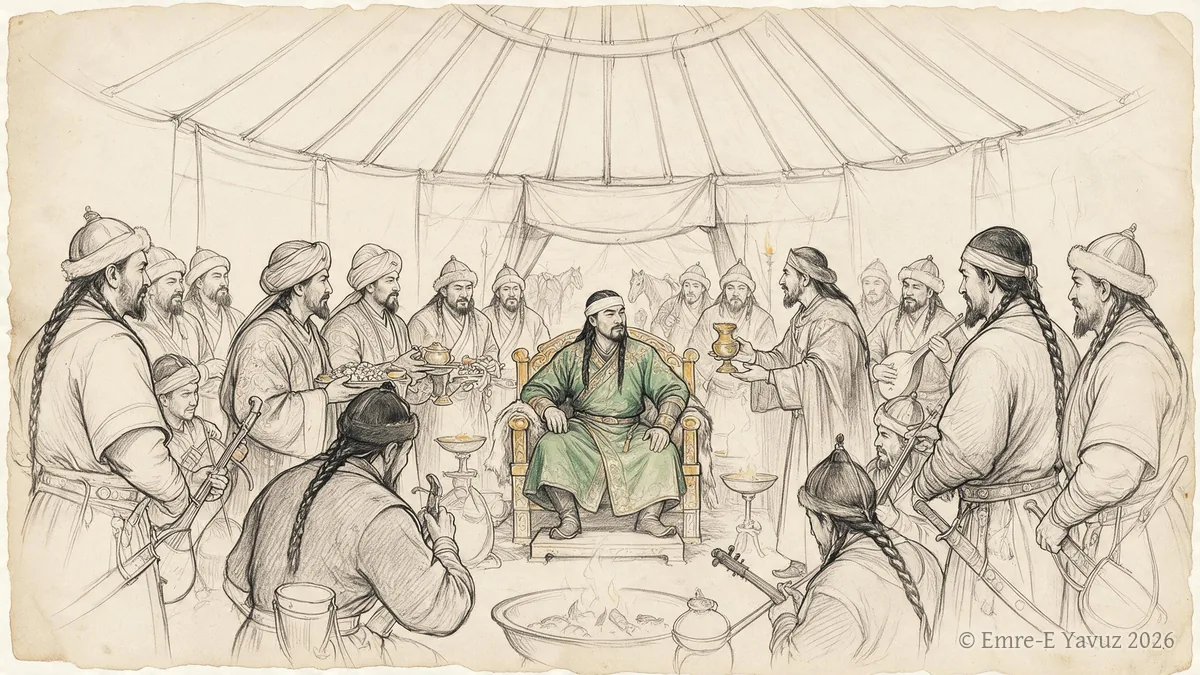
Xuanzang visited the court at Suyab in 629.[34] He found the khan out hunting, in a robe of green satin. The khan’s hair was loose and bound with a long band of white silk. More than two hundred officers in brocade robes were about him.[35] In the great tent, which shone with golden ornaments, he saw envoys from China and Gaochang. He saw wine and music for the envoys and grape juice for the pilgrim. He also saw a ruler who would not sit on wood, because the Göktürks honour fire.[36]
It has been argued that by the first quarter of the seventh century most of the western Göktürks had adopted Buddhism, and that Tong Yabgu spread the faith with more energy than he conquered.[37] The same account notes that Xuanzang, in his record of his travels, says very little about Turkic Buddhists, at least among the people of the oasis states.[38]
By 627 his power was waning. The Xueyantuo went over to Ilig. The Jiu Tang Shu says that he showed his people no kindness, so that many of the Karluks rebelled.[39][40] His paternal uncle murdered him and made himself khan as Moheduo Hou Quli Sibi Khan.[8] The Cefu yuangui sets Taizong’s mourning for him under 627. The Zizhi Tongjian enters the murder at the end of 628. One reckoning dates it to 630.[41] The reign is dated 618 to 630. Whether it began in 618 or in 619 is not settled.[7]
Ten Arrows (630–657)
The murder touched off a civil war. The western Göktürks disintegrated into the On Oq, the Ten Arrows.[7] Moheduo had governed part of the tribes as a lesser khan. The people would not follow him as Great Khan.[8] The Nushibi offered the title to Nishu Mohe Shad. He refused it and raised instead Tong Yabgu’s son, a refugee in Kangju, as Si Yabgu Khan.[8] The two khans fought without pause. The western countries and the Tiele who had served the western Göktürks fell away. Taizong refused both of them a princess while their country was in turmoil.[42] Si Yabgu drove Moheduo to the Altai, where Nishu killed him. Si Yabgu was proclaimed Great Khan.[42] The Xueyantuo defeated him, and his most deserving lesser khan was killed. These events turned the tribes against him. He fled to Kangju and died there.[43] A Buddhist story from Balkh has Si Yabgu lead his whole people against the Nava monastery to take its treasures. In the story he dreams that the god Vaiśravaṇa ran him through with a lance, and he dies before the monks he sent for could come.[44] The tribes fetched Nishu from Karashahr and made him Duolu Khan. The Tang confirmed him with a title of their own. On his death in 634 his brother became khan.[43]
The confederation took its full form under the khan Ishbara Tolis, whom the Chinese call Shaboluo Dielishi, in 634 to 639. It consisted of two tribal unions of five tribes each. The Üç Tuğlu were east of Suyab and the Nushibi west of it. Each union had its own khan. Each chieftain had been given an arrow as a symbol of authority, whence the name. The chieftains bore the titles čor in the Üç Tuğlu and irkin in the Nushibi. The Tang histories allow the tribes to be listed. The strife between the two unions was sanguinary, and China played an occasional part in the background.[2] It has also been described as a twenty-seven-year contest of five against five across the Ili. In it the Ashina were set up as khans and counter-khans in turn, symbolically, until the Chinese captured the last of them in the 650s.
That last khan was Ashina Helu of the Üç Tuğlu. He had dominated the Ten Arrows since 653, and Tang forces took him in 657. The western khaganate then came formally under Chinese protection and was divided into ten prefectures. The Tang annals put the campaign in 657, the capture in 658 and Helu’s death in 659. One reckoning takes the last of those years as the end of the khaganate.[2] The Tang used Ashina against Ashina. Princes who had served Ilig Khan as governors and generals were sent west at the head of Chinese armies. On the officers’ level, therefore, the war in the Tarim in the 640s was Göktürks against Göktürks. By the end all the Göktürks had lost, without exception. Those who had not gone over to the Tang were in captivity in northern China, under the Xueyantuo and the Nine Oguz, or had founded states of their own. Among these states were the Khazars, the Tokhara yabgus and the Göktürk Shahi.
Under the Tang and the Türgesh (657–766)
The rest is the history of a confederation that intermittently functioned as a state. Some of the Ten Arrows came under Tibetan overlordship in the late 660s. By the 680s the Tang had regained the region. On one account, the Tibetans after 659 allied themselves with the revived eastern Göktürks and with various tribes of the resurgent western Göktürks. They invaded the Tarim and repeatedly occupied the oasis states. After 663 the Chinese more than once had to give up the Four Garrisons, and in 692 they defeated the Tibetans.[45] For the nomadic western Göktürks the Tang had set up two loose-rein protectorates-general, Mengchi and Kunling, with the subordinate Göktürk chiefs appointed as khans and protectors-general. From 679 to 719 Suyab was counted among the Four Garrisons in place of Yanqi.[45] The revived eastern khaganate raided the Ten Arrows repeatedly in 685 to 688. In 690 the Üç Tuğlu khan emigrated to China. Tang-appointed Ashina governors twice took the title of khan in alliance with Tibet, in the 670s and in 694. In 699 the eastern khan Kapgan set his brother and nephew over the two branches.[46] Within the confederation, however, the Türgeš tribe was gaining supremacy. Their leaders Wuzhile, Saqal and Sulu held the west from 699 to 738 and made Suyab their urban centre. They defeated the Arabs in 720 and 724 and received an Ashina bride from the Tang in 722. The Arab victory at Kharistan in 737 broke them. The Kül Tegin inscription, carved in the middle of this, says that the Türgeš khan was “our own Türk, our own people”. It says that he died because of his ignorance and his offences against us, and that the people of the Ten Arrows suffered.[47] Among the mourners of 732 it names “my son the khan of the Türgeš, of the Ten Arrows”.[47] The Karluks, driven out of Mongolia by the Uyghurs, migrated into the Ten Arrows’ lands about 745. The Tang lost the region to the Arabs at Talas in 751. By 766 the Karluks held Suyab and the whole of the western Göktürk lands. In its Ten Arrows stage the western polity would be very hard to call a state. The khaganal dignity remained, and the titles and officials. Internal cohesion, however, had completely broken down, and the polity had reverted to a tribal union.[2]
Assessment
The western wing was the Göktürks’ bridge to the rest of the world. Through it the khaganate touched Persia, Byzantium, India and the Caucasus. It took the trade of Sogdiana and the tribute of the Tarim, sent silk to Constantinople and iron to the Romans, and fought three great wars with Persia in forty years. Its rulers married a daughter to a Sasanian king. They were crowned by a Roman emperor. The pax turcica was the free flow of goods between east and west that the Göktürk unification of the silk route allowed. It is above all an account of the west.[2] The western wing was also the half of the state in which the Göktürks were fewest. It was the half that ceased soonest to be a state. Most of Central Asia is still called Turkestan, the land of the Turks. This observation is a valuation of what the western wing left behind, not a finding.
Rulers
Western Göktürk Khaganate
- Istemi552–576 · Yabgu
- Tardush576–603 · Yabgu
- Niri Khanbc587–603
- Heshana Khan603–611
- Shegui Khan611–619
- Tong Yabgu618–630 · Yabgu
- Baghatur Khanfg628–630
- Si Yabgu Khanh628–632
- Nishu Bagha Shadi632–634
- Ishbara Tolis Khanj634–639
- Üç Tuğlu Khankl638–642
- Irbis Ishbara Yabgu Khanmn639–641
- Irbis Shegui Khano642–651
- Ashina Helup651–657
- Bumin Khana552
- Issik Khan552–553
- Mukan Khan553–572
- Taspar Khan572–581
- Amrak581–582
- Ishbara Khan582–587
- Bagha Khan587–588
- Tulan Khan588–599
- Yami Khand603–609
- Shibi Khan609–619
- Chula Khan619–620
- Ilig Khan620–630
- Töles Khane620–630
On the succession
- aBumin Khan: Tuwu's chieftaincy ends about 542 and Bumin's khanate begins in 552. The ten years between are Bumin's as yabgu, the title his father had borne under the Rouran; his reign counts only the khaganate, not the general command he held before.
- bNiri Khan: The Chinese histories make Heshana the son and successor of Niri. Niri was khan in the west in the same years as Tardush, and Heshana followed Tardush as well when Tardush fled in 603.
- cNiri Khan: Niri and Tardush are both called khans of the west in the same years. Niri was raised by the people of Apa after Apa's capture, while Tardush held the western khanate until his flight in 603.
- dYami Khan: Tulan was killed in 599; Tardush then held the east as Bujia Khan until his flight. The Sui had invested Yami as Qimin Khan in 599, and his reign is counted from 603, when he took over the eastern realm.
- eTöles Khan: Töles was a lesser khan under Ilig, not his predecessor or successor. The two reigns run together from 620 to 630 because the eastern wing had a great khan at Ötüken and a lesser khan over the eastern tribes.
- fBaghatur Khan: Baghatur took the throne by murdering his nephew Tong Yabgu. From then until his death in 630 he and Tong Yabgu's son Si Yabgu reigned side by side as rival khans, and the tribes recognised Si Yabgu as great khan after him.
- gBaghatur Khan: Baghatur and Si Yabgu reigned side by side as rival khans from Tong Yabgu's murder until Baghatur's death in 630.
- hSi Yabgu Khan: Si Yabgu was raised as khan against his father's murderer, Baghatur, who reigned beside him until 630. Nishu, who had raised him, followed him as khan in 632.
- iNishu Bagha Shad: Nishu reigned as Duolu Khan from 632 to 634, and at his death his younger brother, the Tong'e Shad, took the throne as Ishbara Tolis Khan.
- jIshbara Tolis Khan: Four years and three khans lie between Tong Yabgu's murder in 630 and Ishbara Tolis's accession in 634: the murderer Baghatur as Quli Sibi Khan, Tong Yabgu's son as Si Yabgu Khan, and Ishbara Tolis's elder brother Nishu as Duolu Khan, 632 to 634. The Tang histories carry all three.
- kÜç Tuğlu Khan: Set up as a rival khan beside Ishbara Tolis, not after him. From 638 the west had two khans: Yukuk Shad over the tribes of the northern side of the Ili, and Ishbara Tolis, then Irbis Ishbara Yabgu, then Irbis Shegui over the Nushibi.
- lÜç Tuğlu Khan: Contemporaries and enemies, 639 to 641; Yukuk Shad had him killed and annexed his state.
- mIrbis Ishbara Yabgu Khan: Between them stands Yiqulishi Yipi Khan, Ishbara Tolis's son, for less than a year.
- nIrbis Ishbara Yabgu Khan: Irbis Shegui was set up in 642, after the year in which Yukuk Shad held the whole west; the throne of the Nushibi stood empty between.
- oIrbis Shegui Khan: Set up against Yukuk Shad in 642 while Yukuk still held Baishui; the two reigns overlap in that year.
- pAshina Helu: Helu seized Irbis Shegui's hordes in 651; what became of the khan the histories do not say, and Helu's reign is counted from the seizure.
- Istemi552–576Yabgu
- Tardush576–603Yabgu
- Niri Khan587–603
- Heshana Khan603–611
- Shegui Khan611–619
- Tong Yabgu618–630Yabgu
- Baghatur Khan628–630
- Si Yabgu Khan628–632
- Nishu Bagha Shad632–634
- Ishbara Tolis Khan634–639
- Üç Tuğlu Khan638–642
- Irbis Ishbara Yabgu Khan639–641
- Irbis Shegui Khan642–651
- Ashina Helu651–657
Relations with other states
Red is war, blue alliance, gold trade. Where several held at once, the line shows what prevailed; alliance and trade can run side by side. Each line rests on an article. Point at a state to see its weightiest relation, select it to see its events. The slider shows what stood in a given year, and Play runs through the years.
Byzantium553 to 629
- Alliance553 to 629Göktürk Expansion along the Silk Road
- War557 to 598Göktürk Expansion into Europe
- Alliance568 to 576Maniakh's embassy to Constantinople, 568alliance against Persia
- Trade568 to 569Maniakh's embassy to Constantinople, 568raw silk
- War576Siege of Bosporos, 576
- War579The Göktürks before Cherson (579)
- Alliance627 to 629The Caucasus campaign, 627–629
- Alliance627 to 629Siege of Tiflis (627–629)
Sasanian Persia553 to 630
- War553 to 629Göktürk Expansion along the Silk Road
- War588 to 589Göktürk–Persian war, 588–589
- War606 to 607Smbat Bagratuni's war with the khan
- War627 to 629The Caucasus campaign, 627–629
- War627 to 629Siege of Tiflis (627–629)
- War629 to 630Battle of Lake Sevan (629–630)
First Göktürk Khaganate584 to 603
- War584 to 603The Göktürk Civil War
- War587Capture of Apa (587)
Tang640 to 657
- War640 to 657The Tang conquest of the western Khaganate, 640–659
References
- ^ a b c d e f g h i Menander Protector
- ^ a b c d e f g h i j k l m n o p q Golden 1992
- ^ Yavuz 2025, p. 249
- ^ a b c d e f g Sui Shu (Book of Sui), juan 84
- ^ Sinor 1990, p. 306
- ^ Khazanov 1994, p. 257
- ^ a b c d e f g h i Golden 1992, p. 135
- ^ a b c d e f g Jiu Tangshu (Old Book of Tang), juan 194; Tongdian, juan 199
- ^ Golden 1992, p. 131
- ^ Sümer 1972, p. 10
- ^ Yavuz 2025, p. 342
- ^ a b Sui Shu (Book of Sui), juan 84; Jiu Tangshu (Old Book of Tang), juan 194
- ^ Yavuz 2025
- ^ Jiu Tangshu (Old Book of Tang), juan 194
- ^ Zizhi tongjian (Comprehensive Mirror in Aid of Governance), juan 192
- ^ Sui Shu (Book of Sui), juan 83
- ^ Xin Tangshu (New Book of Tang), juan 215; Jiu Tangshu (Old Book of Tang), juan 194
- ^ a b Yavuz 2025, p. 359
- ^ Sebeos, ch. 28
- ^ Sebeos, ch. 28
- ^ Sebeos, ch. 28
- ^ Sebeos, ch. 29
- ^ Jiu Tangshu (Old Book of Tang), juan 194; Record of the Western Regions, juan 1
- ^ Cefu yuangui, juan 970
- ^ Jiu Tangshu (Old Book of Tang), juan 194; Zizhi tongjian (Comprehensive Mirror in Aid of Governance), juan 191
- ^ Yavuz 2025, p. 361–368
- ^ Movsēs Dasxurancʿi, book II
- ^ a b Yavuz 2025, p. 370
- ^ Nikephoros
- ^ Yavuz 2025, p. 363
- ^ Golden 1992, p. 236–237
- ^ Chavannes 1903, p. 256
- ^ Jiu Tangshu (Old Book of Tang), juan 198
- ^ Yavuz 2025, p. 352
- ^ Life of Xuanzang, juan 2
- ^ Life of Xuanzang, juan 2
- ^ Kwanten 1979, p. 37, 46
- ^ Kwanten 1979, p. 46, 309
- ^ Zizhi tongjian (Comprehensive Mirror in Aid of Governance), juan 192; Jiu Tangshu (Old Book of Tang), juan 194
- ^ Litvinsky 1996, p. 329
- ^ Cefu yuangui, juan 974; Zizhi tongjian (Comprehensive Mirror in Aid of Governance), juan 193; Chavannes 1903
- ^ a b Jiu Tangshu (Old Book of Tang), juan 194; Zizhi tongjian (Comprehensive Mirror in Aid of Governance), juan 193
- ^ a b Jiu Tangshu (Old Book of Tang), juan 194; Zizhi tongjian (Comprehensive Mirror in Aid of Governance), juan 194
- ^ Record of the Western Regions, juan 1
- ^ a b Litvinsky 1996, p. 346
- ^ Sümer 1972, p. 7
- ^ a b Kül Tegin inscription
- ^ a b c Golden 1992, p. 121
- ^ a b c Golden 1992, p. 136
- ^ Golden 1992, p. 141
- ^ Golden 1992, p. 134
- ^ Life of Xuanzang, juan 2
- ^ Theophylact Simocatta; Whitby 1986, vii.8.14, p. 191
Sources
- Sui Shu (Book of Sui), juan 83, 84
- Zhou Shu (Book of Zhou), juan 50
- Jiu Tangshu (Old Book of Tang), juan 194, 198
- Xin Tangshu (New Book of Tang), juan 215 (after Jiu Tangshu)
- Tongdian, juan 199 (after Sui Shu and Zhou Shu)
- Zizhi tongjian (Comprehensive Mirror in Aid of Governance), juan 191, 192, 193, 194 (after Wei Shu, Zhou Shu, Sui Shu and Bei Shi)
- Cefu yuangui, juan 970, 974 (after Tongdian and Jiu Tangshu)
- Life of Xuanzang, juan 2
- Record of the Western Regions, juan 1
- Menander Protector
- Theophylact Simocatta
- Movsēs Dasxurancʿi, book II
- Nikephoros
- Sebeos, chs. 28, 29
- Kül Tegin inscription
- Tabari
Literature
- Emre-E. Yavuz, The Gokturk Empire: 2nd Edition (2025)
- Peter B. Golden, An Introduction to the History of the Turkic Peoples (1992)
- Édouard Chavannes, Documents sur les Tou-Kiue (Turcs) occidentaux (1903)
- Liu Mau-tsai, Çin Kaynaklarına Göre Doğu Türkleri (1958, Turkish edition)
- Denis Sinor (ed.), The Cambridge History of Early Inner Asia (1990)
- Anatoly M. Khazanov, Nomads and the Outside World (1994)
- Luc Kwanten, Imperial Nomads. A History of Central Asia, 500–1500 (1979)
- B. A. Litvinsky; Zhang Guang-da; R. Shabani Samghabadi (ed.), History of Civilizations of Central Asia, Vol. III (1996)
- Faruk Sümer, Oğuzlar (Türkmenler). Tarihleri, boy teşkilâtı, destanları (1972)
What links here83
- Persons
- Anagai · Anankhast · Arsilas · Ashina Helu · Askel · Bagha Shad · Baghatur Khan · Bochan · Bumin Khan · Chorpan Tarkhan · Damozhi · Duliu · Heraclius · Hormizd IV · Lady Xiang · Moduo Daguan · Niri Khan · Nishu Bagha Shad · Poshi Tegin · Princess Xinyi · Que Dadu Shad · Šāba · Si Yabgu Khan · Silifa · Su Dingfang · Tagma Tarkhan · Tanhan Khan · Tardu Shad · Tardush · Tong Yabgu · Töremen Apa · Yangsu Tegin · Zhenzhu Tong Irkin
- Conflicts
- Göktürk Expansion along the Silk Road · Göktürk Expansion into Europe · Göktürk–Persian war, 588–589 · The Caucasus campaign, 627–629 · The Göktürk Civil War · The Göktürk–Sasanian Trade Conflict
- Battles & Events
- Abrui and Shir-i Kishvar · Embassy of Cui Junsu (608) · Fall of Heshana Khan (611) · Killing of Heshana Khan (619) · Murder of Tong Yabgu (630) · Siege of Bosporos, 576 · The Göktürk–Byzantine alliance · Tiele Revolt (605)
- Places
- Bosporos · Cherson · Huo · Issyk-Kul · Jade Gate · Lake Sevan · Paikent · Partaw · Sanmi Mountain · Suyab · Tanhan Mountain · Thousand Springs · Tian Shan · Volga · Yingsuo · Yiwu
- Peoples
- History of the Turkic peoples · Nezak Shahs · Nushibi · The Great Empires of the Steppe · Utigurs
- Lineages
- Ashina
- Institutions and Titles
- Baghatur · Great Khan · Ishbara (Title) · Sifa · Tegin · The Twenty-Eight Ranks · Yanhongda
- Religions
- Sacrifice and the year
Cite this article
Yavuz, Emre-E. “Western Göktürk Khaganate.” Turkic Atlas, revised 8 November 2026. https://turkicatlas.org/polities/western-turkic-khaganate/
Last revised: 8 November 2026

